
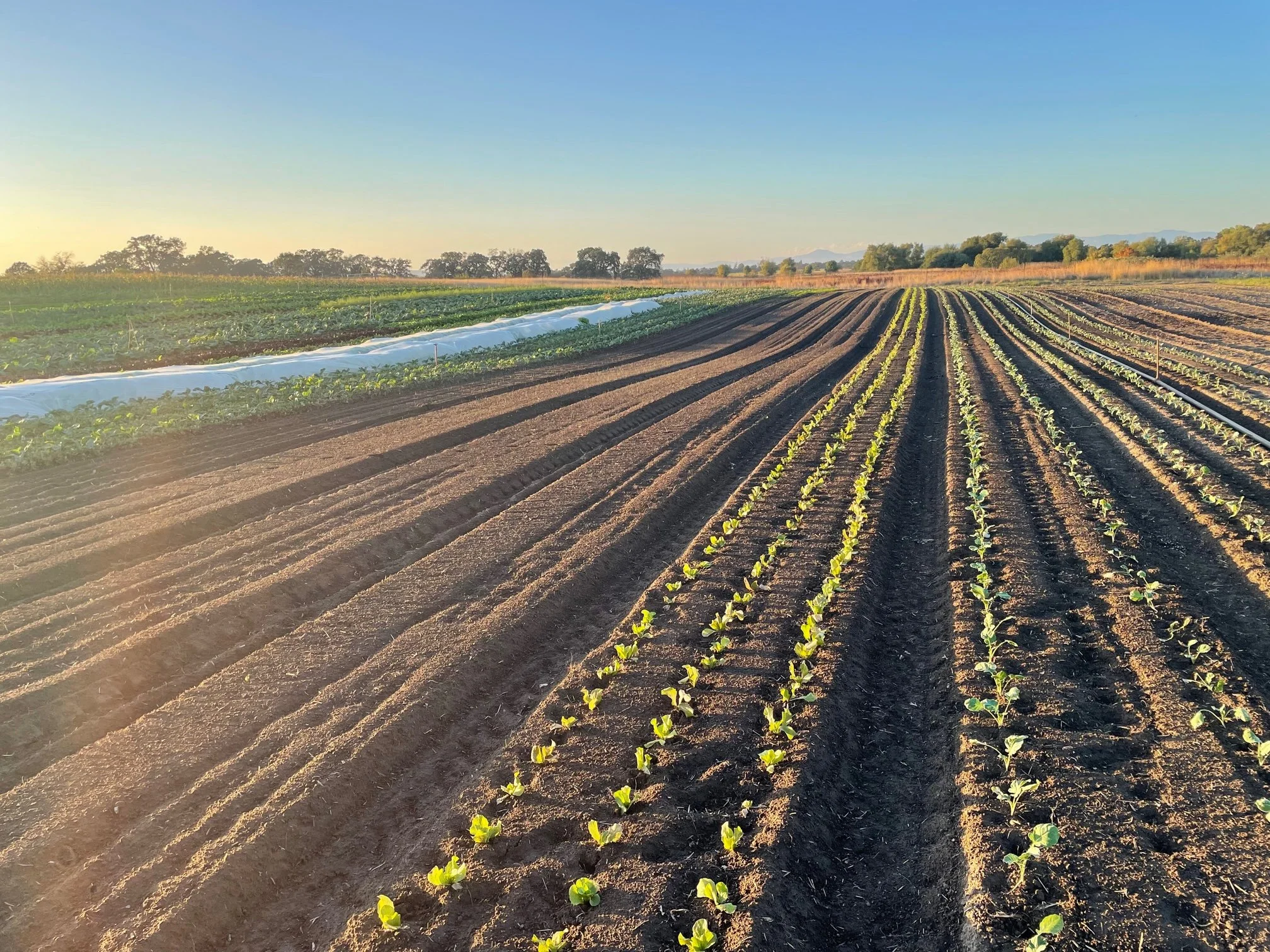
Harvest Week 11 - Special Arugula

THIS WEEK’S HARVEST

Arugula, Salanova Gem Lettuce, Romaine Lettuce, Pink Ladyslipper Radishes, Purple Daikon, Carrots, Red Ace Beets, Sweet Corn, Celery, Assorted Zucchini & Summer Squash, Sarah’s Choice Cantaloupe, Poblano Peppers, Fresh Torpedo Onions, Early Girl & Heirloom Tomatoes
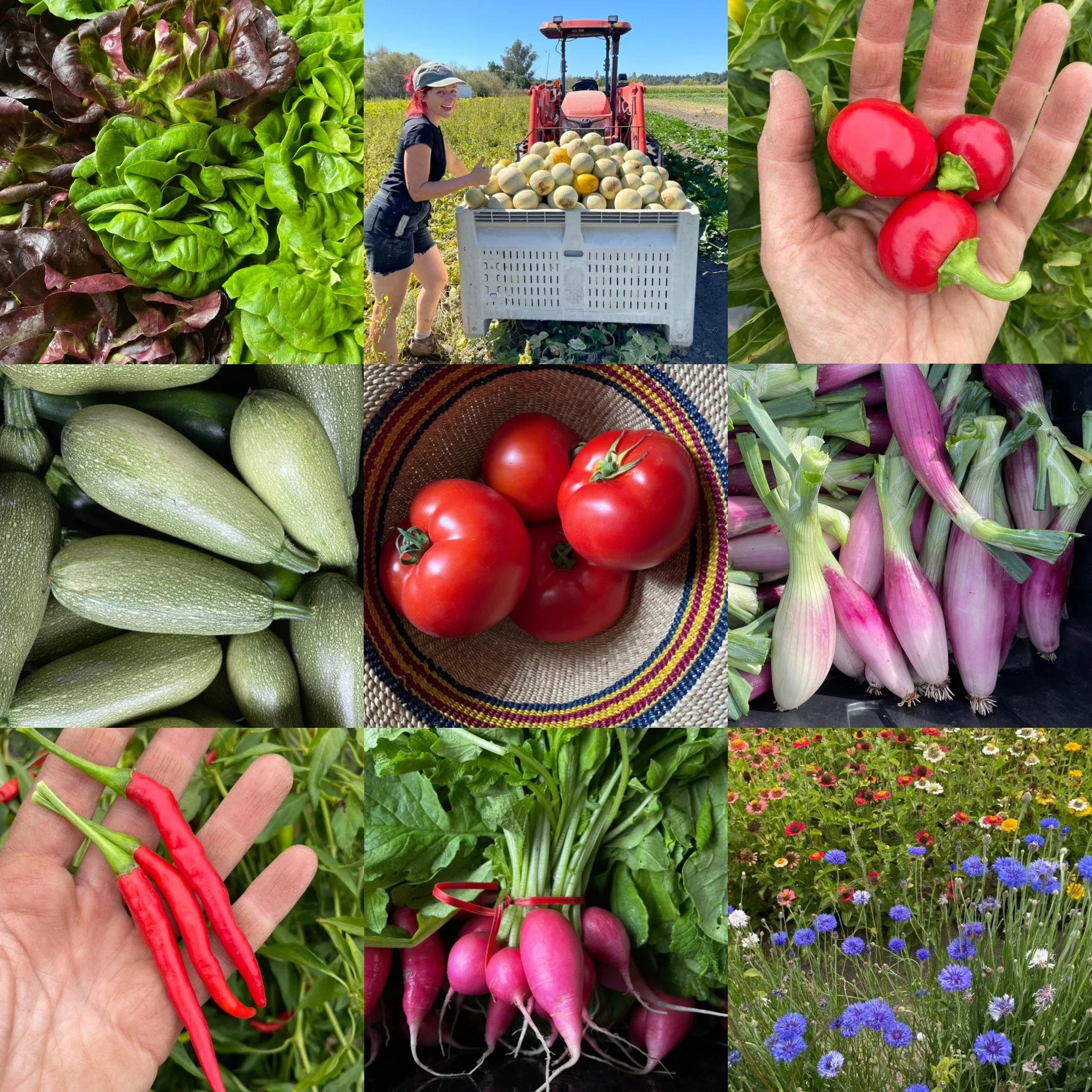
U-PICK

🚨 ATTENTION! With all the u-pick crops, the areas at the heads of each bed are significantly more picked over than the back — don’t forget to branch out to the back areas to find the jack-pots!

  • Albion Strawberries | 3 pints per share

  • Padrón Peppers | 1 pints per share | Note that as Padróns age, they are more likely to be spicy!

  • Shishito Peppers | 2 pints per share | While still most likely to be mild, even shishitos can have a little heat towards the end of the season.

  • Cherry Tomatoes | 4 pints per share

  • Amethyst Green Beans | Gleanings

    HOT PEPPERS:

  • Jalapeños | 5 peppers per share | To find the hottest ones, look for “checking”, the delicate cracks in the skin that indicate the pepper has aged into its heat.

  • Thai Chilis | 3 peppers | Pick when red

  • Cherry Bomb Peppers | 3 peppers per share | Pick when red

    HERBS:

  • Italian, Purple and Thai Basil, Dill, Tulsi, Chamomile, Parsley, Onion Chives, Garlic Chives, Tarragon, Thyme, Oregano, Marjoram, Culinary Sage, Lemon Balm, Lemon Verbena, Vietnamese Coriander, Shiso (Perilla), Catnip, Pineapple, Sorrel, Assorted Mints & Husk Cherries!

  • Flowers!

We have reached peak u-pick cruising altitude.

HARVEST NOTES

  • Thai Chilis: These gorgeous little hot peppers can be added whole to soups or stir-fries for a milder heat or diced for a more intense heat. They also dry beautifully!

  • Cherry Bomb Peppers: Hot and sweet. These round, red peppers are perfect for stuffing and pickling. Since we’ll have limited quantities available this year, we recommend adding them to jars of other pickled vegetables to add a little heat and flavor.

  • Purple Daikon: Purple daikon are sweet and mild, with just a touch of spicy mustard flavor. Try slicing them raw to dress up your salad or crudités platter, adding them to kimchi, or making them into a quick pickle. For extra magic, toss them with a little acidic salad dressing or lemon juice and watch their color change to hot pink!

PRESERVING THE HARVEST

We have reached Peak Tomato Season! Bulk tomatoes will be available for projects, canning and preserving from now until the end of tomato season, but we recommend taking advantage as soon as you’re able to ensure you don’t miss the best of the season. Check out last week’s newsletter for easy ways to put them up.

FLOWER ARRANGING HAPPY HOUR!

Saturday, August 31st
10:00 am

Are you a new member looking for some tips and inspiration on flower picking and arranging?

Are you a seasoned flower-nerd and feel like sipping bubblies and arranging flowers with like-minded friends?

Join our Flower Ambassador Cassidy Blackwell in the garden next Saturday, August 31st, for our 2nd annual Flower Power Happy Hour!

Cassidy will be fresh off an intensive flower arranging workshop with the legendary Susan Ryhanen of SAIPUA at the Farm at World’s End.

Bring your clippers, your fave vase or flower vessel, a cup to drink non-alcoholic bubblies out of, and let’s arrange flowers together!

Cassidy, with pre-arrangment bucket in the barn at World's End.

WINTER SISTER FARM CSA SIGN-UPS OPEN!

Going to miss us this winter? Well you’re in luck! Our dear friends next door at Winter Sister Farm have got you covered for veggies all winter and spring. All memberships include diverse winter-hardy veggies such as broccoli, carrots, potatoes, onions, winter squash, lettuce, kale, chard, as well as access to a small u-pick garden with cold hardy herbs and spring flowers. Click here to get all the details on this wonderful CSA program and to reserve your spot today!

FARMER’S LOG

SPECIAL ARUGULA

The photo below, snapped this morning of Henry, Char and Sarah harvesting arugula, is significant to us in that those beds of arugula may well be our crowning achievement as farmers — as greens farmers at least.

Let me explain…

Here at West County Community Farm if we are anything, we are generalists. When we tally up the number of crops we grow, including varieties, the number reaches well over 200.

Being generalists is good for a number of reasons; it makes the farm biodiverse; it keeps the CSA share and (we hope) your experience here interesting; and it also keeps the farm interesting for us, tasks are constantly changing and rarely get too repetitive.

But being a generalist has its downsides.

All the crops we grow here are similar in that they loves good moisture, sun, and healthy fertile soil. But, if you drill down, they all have more nuanced irrigation, nutrient, and horticultural preferences. To truly specialize, many of the crops we grow also beg for specialized tools. The agricultural outfit that specializes in growing fat bulbous potatoes will look rather different in its weekly rhythms, techniques and tools than the outfit that grows perfect arugula.

Henry, Sarah and Char in the arugula Friday morning — photo by Aisling.

But we try here at West County Community Farm. Out of pride, or to avoid embarrassment, we try to act like specialists every year in a rotating cast of one or two crops, to fill the gaps in our knowledge or tweak techniques on things we feel we aren’t doing well.

This spring we had a couple rounds of arugula and radishes (which grow very similarly to arugula) that didn’t really work. Weed pressure was too high; uniformity over the health of the bed was bad. In the evenings, I would obsess over the Instagram account of a small farm in Oregon that has taken the opposite route and specialized in organic salad greens, including arugula. Their beds look like they had been made by an AI image generator: A perfect carpet of immaculate baby arugula, full coverage, not a weed in site. It became my White Whale.

From their account, I was able to piece together some of the things that they were doing that we weren’t — extensive stale bedding; rows spaced an inch apart to outcompete weeds; sprinklers with small nozzles at tight spacing for fine droplet sizes and excellent distribution uniformity; solid row cover.

We staked out a handfull of beds in Farfield in early July and shaped them up. We put our finest nozzled sprinklers on the risers surrounding them. We irrigated those beds deeply (without arugula seed). A week later, when the first weeds flushed, we flamed them good and dead. When the weeds flushed again, we flamed them dead again… and again. A month later, Asa, after killing a few more tenacious weeds with a hula hoe, put down more arugula seed per square foot than we thought possible. We covered it with our best row cover. We misted those beds nice and regularly, religiously, with those misty nozzles….

And voila.

After a couple months of grimy arugula harvests, let me tell you, harvesting that fairy tale carpet was sublime — the harvest knife seemed to flow through arugula shaped water; the bins filling, quickly, as if under an arugula waterfall.

I don’t think we’ll ever trade away the joys of being generalists — but specializing seems to have it’s perks.

* * * * * * *

See you in the fields,
David


Tomato Tart with Garlic and Capers

Recipe by Alison Roman, from her Newsletter

Alison describes this as “a quick, throw-together affair, [with] no crust that needed to be chilled or rolled out, nothing to delay me from having crisp, cheesy crust with a simple layer of softened, jammy, garlicky tomatoes as soon as possible. I’m happy to report that this one, with its peppery crust (which I’ve been told tastes like a Cheez-It or “a refined Dorito,”) is worth the price of admission alone. An excellent and versatile vehicle for many savory summertime tarts, it’s tomatoes that it was truly born to be with, absorbing the juiciness without becoming soggy, staying crunchy and crisp against all odds.”

Makes one 9-inch tart, serves 4—6

FOR THE CRUST:

  • 6 tablespoons/3 ounces/85g unsalted butter

  • 1 cup/145g all-purpose flour

  • ¼ cup/45g coarse or medium grind polenta or cornmeal

  • 1 cup/50g lightly packed finely grated parmesan cheese

  • 1½ teaspoons/6g kosher salt

  • 1 teaspoon/4g sugar

  • Freshly ground black pepper

for the tart:

  • 2 pounds/900g small tomatoes, thinly sliced: try to pick the ones that are on the small side (think golf ball or tangerine), and throw in a few Sungolds, cherry, or grape tomatoes for good measure and textural contrast.

  • 2–4 garlic cloves, very thinly sliced

  • Kosher salt and freshly ground black pepper

  • Crushed red pepper flakes

  • 2 tablespoons capers (optional), roughly chopped

  • 2 tablespoons olive oil, plus more for drizzling

  • 1 tablespoon sherry vinegar, red wine vinegar, or white wine vinegar

  • Herbs/parmesan, for serving

1. Make the crust: Preheat the oven to 375°F.

2. In a small pot or skillet, melt the butter over medium-high heat. Whisking occasionally, scrape up the browned bits as they form and continue to cook the butter until it smells like popcorn, 3–5 minutes. Remove from the heat and let cool slightly.

3. In a medium bowl, mix the flour, polenta, parmesan, salt, and sugar. Add 2 tablespoons water, plenty of black pepper, and pour the butter over. Using your hands, mix until well combined. The dough will be slightly sticky, but that’s okay

4.  Press the dough into a 9-inch tart pan or regular (not a deep-dish) pie plate, at first making sure the sides are evenly packed, then press a nice, even layer on the bottom. Prick all over with a fork or tip of a knife.

5. Bake until golden brown on the sides and, most important, on the bottom (this is your chance to crisp up the bottom!), 20–25 minutes.

6. Set the crust aside and leave the oven on. (You can bake this shell ahead of time, if you like. Store it wrapped well at room temperature for up to 2 days.)

7. Assemble the tart: Arrange the tomato and garlic slices onto the parbaked shell in a nice, even layer, seasoning with pinches of salt, pepper, and red pepper flakes as you go. Top with capers (if using), then drizzle everything with 2 tablespoons olive oil, seasoning again with salt and pepper.

8. Place the tart pan on a sheet pan, return to the oven, and bake until the tomatoes are jammy and starting to brown and caramelize a touch on top, 55–60 minutes.

9. Remove the tart from the oven, splash with the vinegar, give it another drizzle of olive oil and let cool slightly before slicing. Serve with grated/shaved parmesan and some fresh herbs on top, if you’d like.

**The tart is best baked and enjoyed the day of, but is still excellent at room temperature the next day.


CSA BASICS

Drive slow! Please drive slow on Cooper Rd. and in our driveway / parking lot area. Kids at play!

No dogs: Unfortunately, dogs are not allowed on the farm.

What time is harvest pick-up?:

  • Saturday harvest pick-ups run from 9:00 am - 2:00 pm

  • Tuesday harvest pick-ups will run from 1:00 pm - 6:00 pm

Oriented members can come to the farm any time, 7 days a week, sunrise to sunset, to u-pick and enjoy the farm.

Where is the farm? The member parking lot is located at 1720 Cooper Rd., Sebastopol, CA 95472.

Where is the food? The produce pick-up barn is just to the right of the solar panels and above our big greenhouse. You can’t miss it!

2024 CSA program dates: Our harvest season will run from Saturday, June 15th through Tuesday, December 10th this year.

Harvest Week 10 - Ode to the Onion

THIS WEEK’S HARVEST

Arugula, Cegolaine Gem Lettuce, Romaine Lettuce, Lady Murasaki Purple Bok Choi, Red Russian Kale, Carrots, Sweet Corn, Celery, Eggplant, Striped Armenian Cucumbers, Assorted Zucchini & Summer Squash, Cantaloupe & Galia Melons, Poblano Peppers, Fresh Cipollini Onions, Early Girl & Heirloom Tomatoes

U-PICK

🚨 ATTENTION! With all the u-pick crops, the areas at the heads of each bed are significantly more picked over than the back — don’t forget to branch out to the back areas to find the jack-pots!

  • Albion Strawberries | 3 pints per share

  • Padrón Peppers | 2 pints per share | Note that as Padróns age, they are more likely to be spicy!

  • Shishito Peppers | 3 pints per share | While still most likely to be mild, even shishitos can have a little heat towards the end of the season.

  • Cherry Tomatoes | 3 pints per share

  • Amethyst Green Beans | Gleanings

  • Jalapeños | 3 peppers per share | To find the hottest ones, look for “checking”, the delicate cracks in the skin that indicate the pepper has aged into its heat.

  • Herbs: Italian, Purple and Thai Basil, Dill, Tulsi, Chamomile, Parsley, Onion Chives, Garlic Chives, Tarragon, Thyme, Oregano, Marjoram, Culinary Sage, Lemon Balm, Lemon Verbena, Vietnamese Coriander, Shiso (Perilla), Catnip, Pineapple, Sorrel, Assorted Mints & Husk Cherries!

  • Flowers!

Some beautiful dill, along with lots of other goodies, are popping off in North Garden

HARVEST NOTES

  • Poblano Peppers: The poblano chili pepper is the beloved, mild chili from the state of Puebla, México. When dried it is called “ancho” or chili ancho and when roasted and stuffed with cheese becomes the magnificent chili relleno. This week we’ll be offering the first taste of these wonderful peppers. For an easy, incredibly satisfying combo, try sautéing chopped poblanos with sweet corn kernels, torpedo onions, smoked paprika, lime and salt! Or just throw them in every dish you make like Aisling!

  • Sarah’s Choice Cantaloupe & Galia Melons: This week we’re debuting two of our favorite melons. Sarah’s Choice is the best cantaloupe we’ve ever tasted — incredibly sweet, smooth and dense with a deliciously spiced flavor. Galia melons are a cross between Cantaloupe and Honeydew, with green flesh and a tropical flavor all their own.

TOMATO INTRODUCTIONS


Welcome to peak tomato season everyone! All of our heirloom field tomatoes are now fruiting happily and it’s time we introduced you. We hope you fall in love with one of them this year. Tell us which is your favorite!

Top row (left to right): Black Krim, Valencia, Black Prince, Aunt Ruby's German Green, Speckled Roman, Blue Beech / Bottom row (left to right): Goldie, Striped German, German Johnson, Big Beef.

  • Black Krim: A Russian heirloom with a bold, smoky flavor.

  • Valencia: Small, firm and golden, Valencia is a Maine family heirloom with a meaty texture and bold flavor that makes a nice addition to sauce or canned tomatoes.

  • Black Prince: An Eastern-European Heirloom, Black Prince is one of the least flashy, but most flavorful tomatoes we grow. Perfect for slicing into a simple tomato salad.

  • Aunt Ruby’s German Green: Green turning slightly to yellow when ripe, this tomato is our all-time favorite. First introduced by Ruby Arnold whose German-immigrant grandfather saved the seeds. You'll know Aunt Ruby's is ripe when it gives just slightly to the touch.

  • Speckled Roman: An exceptionally delicious sauce tomato with a psychedelic dream-coat. Excellent for fresh eating as well.

  • Blue Beech: An heirloom “sausage”-type paste tomato that was originally brought from Italy to Vermont during World War II. We’ve planted a significant amount of Blue Beech this year, which will hopefully begin ripening in earnest over the next few weeks.

  • Goldie: David’s personal favorite. A good Goldie (dark orange when ripe) will taste like flowers and melons and goes down smooth and sweet.

  • Striped German: Arguably the prettiest tomato we grow. Smooth, mellow, fruity flavored.

  • German Johnson: a pink Brandywine type, with a smooth, creamy texture and bright flavor.

  • Big Beef: Like jeans and a t-shirt, a classic red beefsteak.

PRESERVING THE HARVEST

Bulk Tomatoes are here! From now until the end of tomato season, bulk quantities of sauce varieties and all 2nds (tomatoes that are blemished or quite ripe but still tasty) will be available in addition to the perfect ones! Bulk tomatoes will have a season limit, meaning is is the total amount of 2nd tomatoes you can take over the course of the year. You’re welcome to take them all at once or a little bit here and there, whichever you like!

The easiest way to put up tomatoes is freezing. While you can simply pop them in the freezer without processing first, we particularly love halving them, drizzling with olive oil and roasting in a low-temp oven to concentrate the flavors. Or, if you have the time now and want to make a sauce that truly bottles the taste of summer, consider making fresh tomato sauce!

FRESH TOMATO SAUCE

For the simplest and most satisfying tomato sauce, we recommend sautéing onions and garlic in more olive oil than you might think you need. Then add tomatoes and salt to taste and cook down for 45 minutes to an hour until your sauce has reached the desired consistency and flavor. Depending on your preferred consistency, tomatoes can be peeled and de-seeded before cooking, or if you prefer a more rustic sauce, chop and them throw them in the pot seeds and all, or blend partially with an immersion blender. For more detailed instructions, and some good ideas for variations on tomato sauces, check out this Smitten Kitchen post on Fresh Tomato Sauce.

VOLUNTEERING ON THE FARM!

Feel like getting some dirt on your hands and working in the garden with us? CSA member and former veggie farmer Rose Brink Capriola is generously coordinating volunteer meet-ups! Send us an email if you’d like to get on her volunteer email list. Kids welcome!

The last bed of Farfield planted with indigo radicchio with Mount Saint Helena in the background. 

FARMER’S LOG

AN ODE TO THE ONION

We love fresh onion season. We’ve been putting them on everything — pizza, second breakfast tomato sandwiches, salads.

It’s almost time for our storage onion harvest out there in Farfield. Our storage varieties are all beautifully sized up, the tips of most of the leaves are just starting to turn yellow. Soon we will bust out the macro bins and haul 10,000 lbs of delicious orbs into the greenhouse for curing.

But in our harvest share, we are still in that stage of innocence — fresh onion season. Fresh onions, for some reason, feel like an impossible food, a gift from heaven, “they make us cry without hurting us.”

Pablo Neruda somehow managed to capture the pure majesty of the onion. We’ll let him take it from here…

Ode to the Onion
by Pablo Neruda

Onion,
luminous flask,
your beauty formed
petal by petal,
crystal scales expanded you
and in the secrecy of the dark earth
your belly grew round with dew.
Under the earth
the miracle
happened
and when your clumsy
green stem appeared,
and your leaves were born
like swords
in the garden,
the earth heaped up her power
showing your naked transparency,
and as the remote sea
in lifting the breasts of Aphrodite
duplicating the magnolia,
so did the earth
make you,
onion
clear as a planet
and destined
to shine,
constant constellation,
round rose of water,
upon
the table
of the poor.

You make us cry without hurting us.
I have praised everything that exists,
but to me, onion, you are
more beautiful than a bird
of dazzling feathers,
heavenly globe, platinum goblet,
unmoving dance
of the snowy anemone

and the fragrance of the earth lives
in your crystalline nature.

* * * * * * *

See you in the fields,
David & Kayta


CSA BASICS

Drive slow! Please drive slow on Cooper Rd. and in our driveway / parking lot area. Kids at play!

No dogs: Unfortunately, dogs are not allowed on the farm.

What time is harvest pick-up?:

  • Saturday harvest pick-ups run from 9:00 am - 2:00 pm

  • Tuesday harvest pick-ups will run from 1:00 pm - 6:00 pm

Oriented members can come to the farm any time, 7 days a week, sunrise to sunset, to u-pick and enjoy the farm.

Where is the farm? The member parking lot is located at 1720 Cooper Rd., Sebastopol, CA 95472.

Where is the food? The produce pick-up barn is just to the right of the solar panels and above our big greenhouse. You can’t miss it!

2024 CSA program dates: Our harvest season will run from Saturday, June 15th through Tuesday, December 10th this year.

Harvest Week 9 - August Emptiness

THIS WEEK’S HARVEST

Mustard Mix, Cegolaine Gem Lettuce, Bluerock Romaine Lettuce, Red Butter Lettuce, Easter Egg Radishes, Carrots, Sweet Corn, Red Ace Beets, Farao Cabbage, Eggplant, Striped Armenian Cucumbers, Lemon Cucumbers, Costata Romanesco Zucchini & Patty Pan Squash, Fresh Torpedo Onions, Early Girl & Heirloom Tomatoes

U-PICK

  • Albion Strawberries | 3 pints per share: 🚨 ATTENTION! The areas near the entrances are pretty picked on, don’t forget to branch out to the back areas to find the jack-pots!

  • Padrón Peppers | 2 pints per share | See Week 4’s Newsletter for tips on how to prepare these delicacies.

  • Shishito Peppers | 3 pints per share | See Week 4’s Newsletter for tips on how to prepare these delicacies.

  • Cherry Tomatoes | 2 pints per share

  • Amethyst Green Beans | 1 pint per share

  • Jalapeños | 2 peppers per share | To find the hottest ones, look for “checking”, the delicate cracks in the skin that indicate the pepper has aged into its heat.

  • Herbs: Italian, Purple and Thai Basil, Dill, Tulsi, Chamomile, Parsley, Onion Chives, Garlic Chives, Tarragon, Thyme, Oregano, Marjoram, Culinary Sage, Lemon Balm, Lemon Verbena, Vietnamese Coriander, Shiso (Perilla), Catnip, Pineapple, Sorrel, Assorted Mints & Husk Cherries!

  • Flowers!

HARVEST NOTES

  • Husk Cherries: Also called Ground Cherries or Cape Gooseberries, these little treats look like tiny tomatillos and taste a bit like orange juice. Ripe husk cherries have dry, tan-colored papers and a golden berry inside, and are most easily found by looking on the ground under the plant. Find a few to snack on in the Northern side of the garden, near the basil and sunflowers.

Ripe husk cherries and Aisling with a load of fresh Torpedo Onions.

LEMON DILL SAUERKRAUT

We have some beautiful heads of cabbage in the share this week, perfect for making sauerkraut! Here is our favorite garlicky dill kraut recipe from the book Fermented Vegetables by Kristen and Christopher Shockey.

Note: if you’ve felt intimidated by making kraut, don’t worry! It’s basically just chopping and salting cabbage, then keeping it submerged in a brine. That, plus a couple days of waiting is all you need to make exceptional sauerkraut.

(Yields about 1 gallon of kraut)

  • about 6 pounds cabbage (2 small heads or one large one)

  • 1 1/2-2 tablespoons unrefined sea salt

  • 4 tablespoons lemon juice

  • 1-2 tablespoons dried dill or about 1/4 cup fresh dill, according to taste

  • 4-5 cloves of garlic, finely grated

  1. To prepare the cabbage, remove the coarse outer leaves. Rinse a few unblemished ones and set them aside. Quarter and core the cabbage, thinly slice, and transfer to a large bowl. 

  2. Add the dill, lemon juice, and 1 tablespoon of the salt and, with your hands, massage it into the leaves, then taste. You should be able to taste the salt without it being overwhelming. Add more salt if necessary. The cabbage will soon look wet and limp, and liquid will begin to pool.  At this point, add the garlic. If you've put in a good effort and don't see much brine in the bowl, let it stand, covered, for 45 minutes, then massage again. 

  3. Transfer the cabbage to a crock or 2-quart jar, a few handfuls at a time, pressing down on the cabbage with your fist or a tamper to work out air pockets. You should see some brine on top of the cabbage when you press. Leave 4 inches of headspace for a crock, or 2 to 3 inches for a jar. Top the cabbage with one or two of the reserved outer leaves. Then, for a crock, top the leaves with a plate that fits the opening of the container and covers as much of the vegetables as possible; weigh down with a sealed, water-filled jar. For a jar, use a sealed, water-filled jar or ziplock bag as a follower-weight combination. 

  4. Set aside the jar or crock on a baking sheet to ferment, somewhere nearby, out of direct sunlight and cool, for 4 to 14 days. Check daily to make sure the cabbage is submerged, pressing down as needed. 

  5. You can start to test the kraut on day 4. You'll know it's ready when it's pleasingly sour and pickle-y tasting, without the strong acidity of vinegar; the cabbage has softened a bit but retains some crunch; and the cabbage is more yellow than green and slightly translucent. 

  6. Ladle the kraut into smaller jars and tamp down. Pour in any brine that's left. Tighten the lids, then store in the refrigerator. This kraut will keep, refrigerated, for 1 year.

MADHAR JAFFREY’S BEET DIP

From World Vegetarian

This bright magenta dip is easy to make and easy to eat! It’s luxuriously silky, with an earthy sweetness that’s perfectly balanced by the richness of the walnuts and sharpness of garlic and vinegar. Serve it as a visually-stunning appetizer with crudités, or slathered on crusty bread.

  • 1 good sized red beet (about 6 oz) or two smaller ones

  • 4 T chopped walnuts

  • 1 slice stale white bread (optional)

  • 1 clove garlic, coarsely chopped

  • 6 T olive oil

  • 2 T red wine vinegar

  • 1/2 t salt, or to taste

Boil the beet in its skin until soft, about 40 minutes.  Drain, peel, and let cool. Chop coarsely. Throw everything in a food processor and blend until smooth.

Last Friday we said farewell to our dear Hippie Dust (aka The Goat, aka Tristan) as he heads to law school in Colorado! Tristan held it down in so many ways on the farm and in the fields and we will miss him!

VOLUNTEERING ON THE FARM!

Feel like getting some dirt on your hands and working in the garden with us? CSA member and former veggie farmer Rose Brink Capriola is generously coordinating volunteer meet-ups! Send us an email if you’d like to get on her volunteer email list. Kids welcome!

FARMER’S LOG

AUGUST EMPTINESS

At this time of year it is hard to find the headspace for a thoughtful Farmer’s Log — the steady rhythm of the bulky harvests drowns out softer notes of reflection.

To sneak in planting, seeding, and weeding in the margins of harvest your only thoughts are farm thoughts, your only feelings are farm feelings. You must remain disciplined, focused… you can’t miss a beat (no pun intended).

This week, while the harvest share gets more summery, we turned the fields another notch towards fall. We transplanted over 2,000 ft of romanesco, chicories, and lettuce. Asa seeded our fall daikon and watermelon radishes. We started tapering the water down on our bulbous onion crop. And we started cultivating our 6,400 ft of fall carrots — now two inches tall and unfurling their first true leaves.

Wednesday morning transplanting for autumn and winter shares. We’re Getting down the last few big transplantings of the year!

It’s a strange feeling, this time of year: Our internal lives, our emotions, dreams, and whimsies — feel far away, shoved aside by the harvest and urgent needs in the field — but at the same time we never feel more full. 

There is a sort of innocence, a fullness, in being so busy as to be empty.

Then, the swelling of the corn stalks can you lift you up to the eaves. The heat is your sorrow. The flowering potatoes are your whimsical thoughts. And the little things — a good sip of coffee, a crew mate’s joke, a good harvest —  can fill you up to the brim.

See you in the fields,
David


CSA BASICS

Drive slow! Please drive slow on Cooper Rd. and in our driveway / parking lot area. Kids at play!

No dogs: Unfortunately, dogs are not allowed on the farm.

What time is harvest pick-up?:

  • Saturday harvest pick-ups run from 9:00 am - 2:00 pm

  • Tuesday harvest pick-ups will run from 1:00 pm - 6:00 pm

Oriented members can come to the farm any time, 7 days a week, sunrise to sunset, to u-pick and enjoy the farm.

Where is the farm? The member parking lot is located at 1720 Cooper Rd., Sebastopol, CA 95472.

Where is the food? The produce pick-up barn is just to the right of the solar panels and above our big greenhouse. You can’t miss it!

2024 CSA program dates: Our harvest season will run from Saturday, June 15th through Tuesday, December 10th this year.