Harvest Week 8 - The Dog Days of Summer

THIS WEEK’S HARVEST

Arugula, Mustard Mix, Rosaine Gem Lettuce, Red Romaine Lettuce, Red Russian Kale, Rainbow Carrots, Sweet Corn, Eggplant, (last of the) Pickling Cucumbers, Persian & Lemon Cucumbers, Costata Romanesco Zucchini & Patty Pan Squash, Fresh Torpedo Onions, Early Girl & Heirloom Tomatoes

U-PICK

  • Albion Strawberries | 3 pints per share: 🚨 ATTENTION! The areas near the entrances are pretty picked on, don’t forget to branch out to the back areas to find the jack-pots!

  • Purple Sugar Snap Peas | Gleanings

  • Padrón Peppers | 2 pints per share | See Week 4’s Newsletter for tips on how to prepare these delicacies.

  • Shishito Peppers | 3 pints per share | See Week 4’s Newsletter for tips on how to prepare these delicacies.

  • Cherry Tomatoes | 1 pint per share

  • Amethyst Green Beans | 1 pint per share

  • Jalapeños | 2 peppers per share | To find the hottest ones, look for “checking”, the delicate cracks in the skin like on the one on the right in the photo above.

  • Herbs: Italian, Purple and Thai Basil, Dill, Tulsi, Chamomile, Parsley, Onion Chives, Garlic Chives, Tarragon, Thyme, Oregano, Marjoram, Culinary Sage, Lemon Balm, Lemon Verbena, Vietnamese Coriander, Shiso (Perilla), Catnip, Pineapple, Sorrel, Assorted Mints

  • Flowers!

HARVEST NOTES

  • Fresh Torpedo Onions: A favorite in Italy and France, these beautiful, pink, elongated onions are similar in flavor to Cipollinis — mild, delicate, and delicious raw. We recommend incorporating them into fresh salads, pizza or sandwiches.

  • Sweet Corn: This week we’re welcoming the first of our scrumptious bicolor sweet corn! There’s a chance you may find a European Corn Borer Caterpillar at the top of an ear or two — an unavoidable reality of organically-grown sweet corn — but this little moth grub is harmless. Don’t let it deter you—just cut or wash out any eaten part and enjoy your corn!

  • Eggplant: Returning members will be glad to see that eggplant is back this week after a long hiatus due to the cooler growing conditions on the Laguna. We can thank the heat waves for this year’s crop! This year’s eggplant will all be a gorgeous black Italian variety. Perfect for eggplant parmesan and ratatouille.

Grilled Corn Tiger Salad

BY SHUAI WANG

This week we’re sharing a recipe from Bon Appetit for an inspired combo of a “Chinese tiger salad—a crisp, refreshing side of raw cucumbers, cilantro, scallions, and chiles [that] incorporates elements of Mexican esquites—grilled corn, creamy avocado, and salty cheese—for a dazzlingly bright summer dish you’ll want to eat all on its own. To more closely resemble the original inspiration, include half a stalk of celery sliced into thin matchsticks or half moons.” Yields 6 servings.

Ingredients

  • 2 Tbsp. sesame seeds

  • 3 garlic cloves, finely grated

  • ½ cup fresh lime juice

  • 3 Tbsp. vegetable oil

  • 2 tsp. low-sodium soy sauce

  • 2 tsp. oil from a jar of chili crisp (preferably Lao Gan Ma)

  • 2 tsp. toasted sesame oil

  • 2 tsp. unseasoned rice vinegar

  • 1½ tsp. Diamond Crystal or 1 tsp. Morton kosher salt, plus more

  • 2 large ears of corn, husked

  • 1 ripe avocado, cut into large pieces

  • ½ Persian cucumber, halved lengthwise, seeds removed, halves sliced crosswise on a diagonal ¼" thick

  • 1 small shallot, halved through root end, thinly sliced

  • ½ bunch cilantro, tough stems removed

  • 2 Tbsp. crumbled queso fresco or Cotija cheese

Preparation

  1. Toast 2 Tbsp. sesame seeds in a dry small skillet over medium heat, shaking pan constantly, until deep golden brown and fragrant, about 5 minutes; transfer to a large shallow bowl. Add 3 garlic cloves, finely grated, ½ cup fresh lime juice, 3 Tbsp. vegetable oil, 2 tsp. low-sodium soy sauce, 2 tsp. oil from a jar of chili crisp, 2 tsp. toasted sesame oil, 2 tsp. unseasoned rice vinegar, and 1½ tsp. Diamond Crystal or 1 tsp. Morton kosher salt and stir vigorously until salt is dissolved. Set dressing aside.

  2. Prepare a grill for medium-high heat. Grill 2 large ears of corn, husked, turning often, until lightly charred all over and tender, 8–10 minutes. Transfer corn to a cutting board and let sit until cool enough to handle. Slice kernels from cobs (you should have about 2 cups).

  3. Add corn, 1 ripe avocado, cut into large pieces, ½ English hothouse cucumber, halved lengthwise, seeds removed, halves sliced crosswise on a diagonal ¼" thick, 1 small shallot, halved through root end, thinly sliced, and ¼ bunch cilantro, tough stems removed, to reserved dressing; toss gently to combine. Taste salad and season with more salt if needed. Top with 2 Tbsp. crumbled queso fresco or Cotija cheese and remaining ¼ bunch cilantro, tough stems removed.


WINE UPDATE!

Over the next few weeks, Martha Stoumen Wines will be offering a selection of their wines made from organic grapes grown in dry-farmed vineyards, where grapevines rely solely on water from winter rains and the moisture held in the soil. These are limited production wines, with just a few barrels made annually.

Please see the wine barrel “shop” to purchase wines to go — or to enjoy at the farm! There is a small collection of shared glasses available to use. Please wash and return these glasses after use.

The first wine available is the Pinot Noir 2022 ($55/bottle) from Hawkeye Ranch in Redwood Valley.

VOLUNTEERING ON THE FARM!

Feel like getting some dirt on your hands and working in the garden with us? Send us and email! CSA member Rose Brink Capriola has generously offered to coordinate. She’ll send out an email and try to find a day / time that works for as many of you as possible! Kids welcome!

FARMER’S LOG

THE DOG DAYS OF SUMMER

The sun beats down, the hills are bleached gold, and the fruits of summer rain down… the dog days of summer are here.

The term “dog days”, for the late summer, comes from ancient Greece and Mediterranea where people associated the mid-July return of our brightest star, Canis Majoris (aka Sirius, aka “Orion’s Dog”), to the beginning of the hottest, sultriest days of late summer when, as Virgil put it, “the Dog-star cleaves the thirsty ground.” These ancient people associated the dog days of summer with grumpy humans, fever, bad luck, and heat.

As contemporary West Marin naturalist and animal tracker Richard Vacha brilliantly observes of our own Mediterranean climate in his book The Heart of Tracking, the dog days can also be an abundant, raucous, frolicking time for wild canines like coyotes, as they feast on the fattened prey and fruit of summer and as canine pups leave the den and come into their own. (Perhaps this is the wild origin of the naming of the star?)

In Mediterranean climates like ours, the dog days are also a scarce time, a spent time. They are the beginning of the great dry down in California and the great dormant period of our year.

“For a wild animal,” Vacha writes, the late summer and early fall “can be as tough to endure as an East Coast winter. Food is scarce, water is scarce, and green vegetation is crowded into riparian corridors, drawing the animals that depend on these resources closer together. The animals who prey upon them have shifted correspondingly. Territorial patterns are all in great flux as the expansive cycle of the summer season slowly winds down.”

“Fox in a Coyote Bush” illustration by Kayta from The Heart of Tracking by Richard Vacha from Mount Vision Press

On the farm, this shift into the dog days — their abundance and scarcity — has been clear.

Our harvests are more and more heavy with fruit — tomatoes, peppers, eggplant, the first sweet corn. Soon we will be enjoying the first melons and sweet peppers. The wild blackberries are laden. The cherry plum tree in Farfield that shades a favorite crew break spot is raining down plums and is a veritable watering hole for humans and crows, turkey, deer, and raccoons alike. In the garden, our first rounds of flowers and herbs are following the wild grasses, tapping out and throwing seed.

And in our staple field crops, if July was an outward explosion of verdant vegetation, the dog days are the beginning of the hunkering down, the drawing nigh, the focused inward stare toward the serious work of setting fruit, forming bulbs and tubers, and setting seed. Our verdant green acre of winter squash leaves are now starting to yellow slightly as the sun battered plants focus on the swelling of their green and gold orbs in the shade below. Our Floriani Flint corn and sweet corns are all in various stages of silks, with ears swelling.

And as the wildland plants surrounding the farm dry out and are scorched to gold, her wild inhabitants turn more and more to the farm — an irrigated green oasis — for moisture and succulent meals. The wild turkeys and their fluffy younglings visit the fields every morning and evening, snipping off hydrating bits of lettuce (they seem to love romaine!). Gophers take bites out of drip irrigation lines and young melons nightly. 

But the sweet relief of the first fall rains will come soon enough.

Until then, keep cool, move slow, remember to be nice, and enjoy the fruitful abundance as we enter the dog days of summer.

See you in the fields,
David


CSA BASICS

Still need an orientation? Please contact us by email with a few days notice to set up a time for an orientation tour. We are available for tours during Tuesday CSA pickups from 1-6 pm and Saturday CSA pickups from 9 am - 2 pm.

No dogs: Unfortunately, dogs are not allowed on the farm.

Drive slow! Please drive slow on Cooper Rd. and in our driveway / parking lot area. Kids at play!

What time is harvest pick-up?:

  • Saturday harvest pick-ups run from 9:00 am - 2:00 pm

  • Tuesday harvest pick-ups will run from 1:00 pm - 6:00 pm

Oriented members can come to the farm any time, 7 days a week, sunrise to sunset, to u-pick and enjoy the farm.

Where is the farm? The member parking lot is located at 1720 Cooper Rd., Sebastopol, CA 95472.

Where is the food? The produce pick-up barn is just to the right of the solar panels and above our big greenhouse. You can’t miss it!

2024 CSA program dates: Our harvest season will run from Saturday, June 15th through Tuesday, December 10th this year.

Harvest Week 7 - On Limits and the Enjoyment of Life

THIS WEEK’S HARVEST

Little Gem Lettuces, Rouxai Oakleaf Lettuce, Assorted Chicories, Dino Kale, Assorted Cabbage, Bunched Golden Beets, Green Magic Broccoli, Celery, Loose Narvik Carrots, Pickling Cucumbers, Persian & Lemon Cucumbers, Costata Romanesco & Patty Pan Squash, Fresh Cipollini Onions, Early Girl Tomatoes

U-PICK

  • Albion Strawberries | 3 pints per share: 🚨 ATTENTION! The areas near the entrances are pretty picked on, don’t forget to branch out to the back areas to find the jack-pots!

  • Purple Sugar Snap Peas | 2 pints per share: As these peas fill out and get sweeter they also get more green. Look out for camouflaged green ones, which are particularly plentiful towards the back left of the beds.

  • Padrón Peppers | 2 pints per share | See Week 4’s Newsletter for tips on how to prepare these delicacies.

  • Shishito Peppers | 3 pints per share | See Week 4’s Newsletter for tips on how to prepare these delicacies.

  • Cherry Tomatoes | 1/2 pint per share | Just getting started…

  • 🌟 Amethyst Green Beans | 4 pints per share | See harvest note below.

  • 🌟 Jalapeños | 2 peppers per share | To find the hottest ones, look for “checking”, the delicate cracks in the skin like on the one on the right in the photo above.

  • Herbs: Italian, Purple and Thai Basil, Dill, Tulsi, Chamomile, Parsley, Onion Chives, Garlic Chives, Tarragon, Thyme, Oregano, Marjoram, Culinary Sage, Lemon Balm, Lemon Verbena, Vietnamese Coriander, Shiso (Perilla), Catnip, Pineapple, Sorrel, Assorted Mints

  • Flowers!

This week’s u-pick abundance!

HARVEST NOTES

  • Fresh Cipollini Onions: A sweet, fresh delicacy that is often eaten raw — it is so mild you can cut it thin and eat in on pizza, salad, or straight up! Also delicious grilled or roasted until translucent and slightly charred.

  • Early Girl Tomatoes: Because we’re farming in the cool bowl of the Laguna, we’ve planted these reliable, early red slicers as our entire first succession to make sure we get you tomatoes as early as possible. Tomato limits should increase over the course of the next month, and when the second succession comes on we’ll have an array of heirloom and canning tomatoes too.

  • Bunched Golden Beets: The sweetest and least earthy of the beets. For a simple preparation, boil until tender, peel and cube and store in the refrigerator tossed with a bit of lemon juice to heighten their color and flavor. Then toss on a green salad or dress up to make a salad on their own.

  • Amethyst Beans: Purple on the outside and green on the inside! Like many purple vegetables, they will turn green when cooked, so if you want to highlight their beautiful color, we recommend using them raw. Even if you plan to cook them in your favorite green bean dish, do make sure to taste one or two as you’re picking so that you can appreciate their sweet, delicate flavor.

From left: Baby cabbage, beds waiting for fall carrot seeds, young lettuce, turnip, arugula and mustard green beds under cover.

Big-Flavor Broccoli

BY CHRIS MOROCCO

While this recipe was written for Broccoli, it would also be a delicious way to cook this week’s Amethyst Beans!

Chris writes: “Chances are you’re trimming off and discarding way too much of your broccoli stems. The stems are so flavorful, they should be their own vegetable. This is our hands-down favorite way to cook the whole plant.”

Ingredients

  • 1 lb. broccoli (about 1 large or 2 medium heads)

  • 5 Tbsp. extra-virgin olive oil, divided

  • Kosher salt

  • 1 small red onion, cut lengthwise into ½"-thick slices

  • 4 garlic cloves, sliced

  • 6 oil-packed anchovy fillets

  • 1 oz. Parmesan, finely grated (about ¼ cup)

  • Lemon wedges (for serving)

Preparation

  1. Preheat oven to 400°. Trim only the very bottom, woody part of broccoli stem. Peel tough outer layer from stem, from the florets down to the end of the stalk. Starting from stem end, cut broccoli at a 45° angle into ¾"-thick slices until you reach the florets. Break florets apart with your hands into bite-size pieces (this avoids getting bitsy trimmings all over the place).

  2. Heat 3 Tbsp. oil in a large heatproof skillet over medium-high until shimmering. Add broccoli; season with salt. Cook, tossing occasionally, until broccoli is bright green and lightly charred, about 3 minutes. Transfer to a plate. Wipe out skillet.

  3. Heat remaining 2 Tbsp. oil in same skillet over medium. Cook onion and garlic, stirring often, until onion is beginning to soften, about 3 minutes. Add anchovies and cook, breaking apart with a spoon, until broken down and garlic is beginning to turn golden around the edges, about 2 minutes.

  4. Return broccoli to skillet and toss to coat with oil. Transfer to oven and roast, tossing once, until broccoli is browned and tender, 20–25 minutes. Wrap handle of skillet with a towel before you forget it’s REALLY HOT.

  5. Scatter Parmesan over hot broccoli. Divide among plates. Serve with lemon wedges alongside.

HOW TO STORE YOUR VEGETABLES

We’ve been getting some questions in the pickup barn about how to best store your produce, so we wanted to offer a few simple tips to help you get the most out of the fresh food we’re growing for you.

  • Keep them enclosed. Vegetables, like all plants, are mainly water, so the quickest way to lose them is to let them desiccate. We recommend keeping all of your produce (with a few exceptions, listed below) in plastic bags or airtight containers. Don’t rely on the crisper drawer in your fridge — it won’t do much to keep things turgid on its own.

  • Keep them cool. Put everything right in the fridge when you get it home. If you find that anything’s wilted on the way home, a brief soak in cold water will do wonders. This is particularly true for u-pick crops like green beans and snap peas that have been picked during the heat of the day.

  • Take off tops and store them separately. Vegetables will continue to transpire after they’ve been picked, so for crops like beets and carrots, it’s best to remove the tops so that the roots don’t wilt as the greens do. This is also true for celery, which will wilt faster if you leave the leaves attached — consider taking them off and storing them for making stock with. It’s great to keep a bag of aromatic scraps in the freezer for this purpose.

  • Use the most delicate things first. As you’ve probably experienced by now, there’s a lot of variety in terms of how long different crops will store. Loose greens tend to have a shorter shelf like than whole heads, so plan on using up loose salad mixes and arugula early in the week, and counting on heads of lettuce for later on.

  • Treat your herbs like flowers: While they can also be bagged and put in the fridge, u-pick herbs like basil, dill, marjoram, etc. will be most vibrant and easiest to remember to use if you put them in a jar or vase on the kitchen counter. More delicate herbs like chives would prefer to be refrigerated in a bag.

  • The exceptions: tomatoes, winter squash and cured onions and garlic. Everything in this list would prefer to be kept unbagged on the counter. Tomatoes tend to change texture when refrigerated, and winter squash, cured onions and garlic have all gone through a curing process that enables them to last for a long time in normal household temperatures. The fresh onions that we’ve been distributing this week and last have not been cured (notice their shiny skin and juicy flesh) and would last best in the fridge, stored according to the recommendations above.

VOLUNTEERING ON THE FARM!

Feel like getting some dirt on your hands and working in the garden with us? Send us and email! CSA member Rose Brink-Cappriola has generously offered to coordinate. We’ll send out an email and try to find a day / time that works for as many of you as possible! Kids welcome!

FARMER’S LOG

ON LIMITS AND THE ENJOYMENT OF LIFE

As our fields and harvests transition away from the delicate greens of early summer into the cacophonous colors and flavors of peak summer, we are reminded of some of the reasons why we love eating seasonally from the farm.

Nothing dictates what is on our tables more than the tilt of the Earth. As you’ve seen, the shares of mid-June are very different from those of late July. The spring, with its soft waxing light, grows tender, almost translucent, baby-soft greens. While the hard summer sun condenses itself into weighty, colorful, sweet fruits. Mentally compare an early Spring strawberry, with it’s silky soft skin and wateriness, to the more sun hardened, acid-sweet strawberries this week.

Another cool thing about eating from the farm is that we get to experience the full arc of plant growth — from fresh onions to cured onions; from baby Spring carrots to deep orange Fall carrots kissed by frost. In supermarkets, most produce is harvested at one standard stage of a few standard varieties. Here, life is happening, and we pull it all out of the field for you to taste.

We also love that this model allows us the chance to distribute less-than-perfect produce and to share over-abundant harvests with members. You’ll experience this more as the season goes on. Ancestral cultures were scrupulously efficient in their use of food because they had to be. There was a use for everything. And it was a duty to preserve the abundance of Summer. In this spirit, we will put out the 2nd tomatoes, split and cracked, but still perfectly good (sometimes even better) sliced on a BLT.

But perhaps our favorite thing about this model is an unsung hero: Limits.

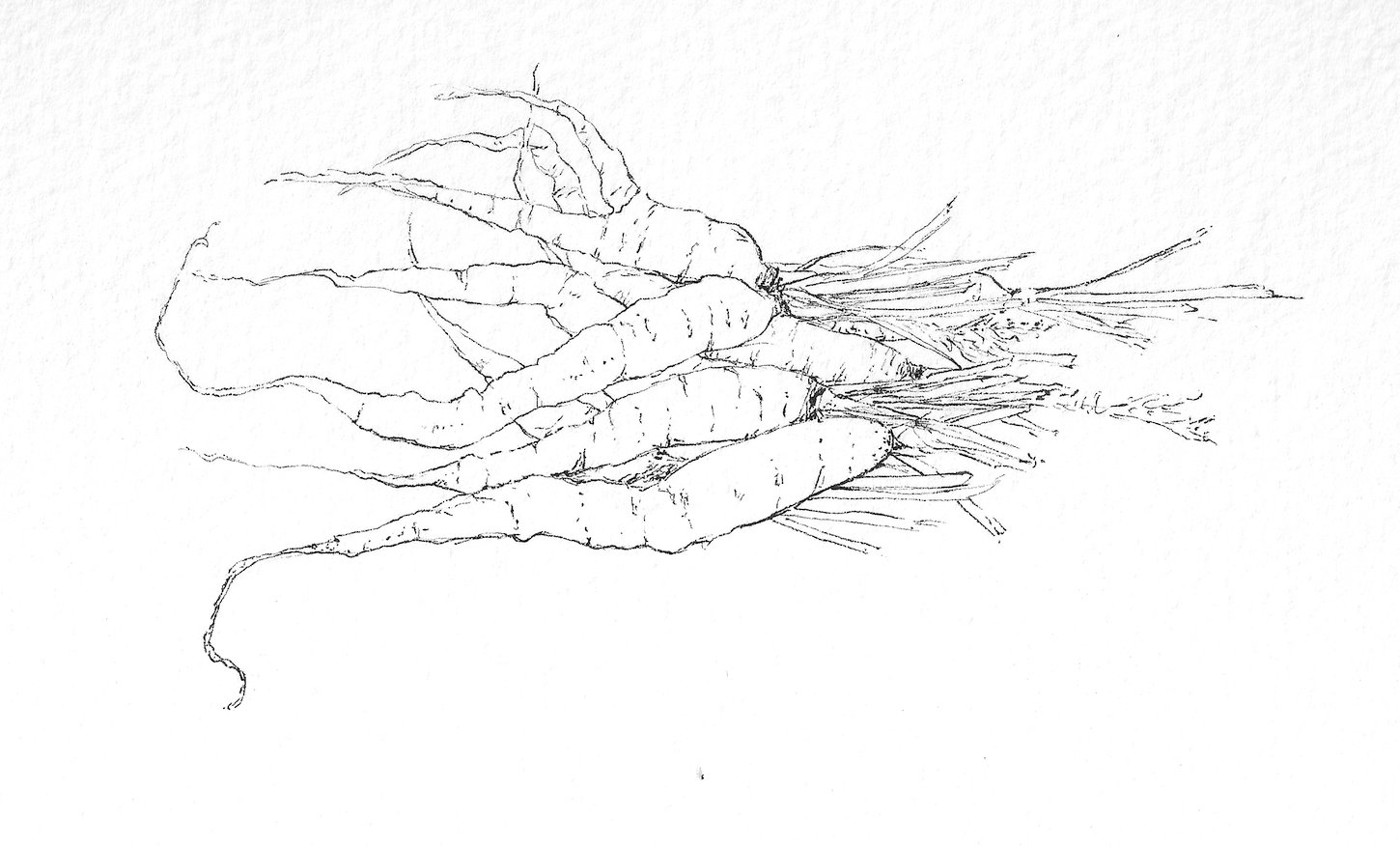
Nothing like those first spring carrots. (Drawing by Kayta)

Yes, limits. Not having something. “Limit: 1 per share.”

“What!?”

We live in a time and a place where we can get just about any food, anytime, en masse, if you can afford it. Tomatoes in January. Melons in the February. Mangos in Sebastopol.

We have conquered seasons. We have conquered limits.

But have we also conquered one of life’s simplest pleasures? What is the fulfillment of desire without the longing that precedes it?

This week, we will cherish the year’s first slicing tomato. That first slice of vine-ripened tomato on an open faced sandwich (with a little basil, olive oil, and salt) will bring back a flood of memories from last summer, and summers before that, and we will smile at our loved ones at the table in our shared remembrance and shared enjoyment of this thing that we have now, but did not have for so long. It will bring us together. Perhaps your first bite of Kabocha squash will unlock a similar smile this Fall.

In most (or maybe all) rooted cultures there are festivals celebrating the return of foods. In Southern France there is a plum festival and a Spring festival marking the return of the egg, when the hens start laying again. (What is life without eggs?) In Sebastopol, we have the Gravenstein Apple Fair.

Limits, scarcity, the lean times — they help us appreciate, like really appreciate, what we have and where we are, maybe even who we are.

Life's fleeting nature is really it's spice — and so it goes for food, we'd say.

In a few short weeks, we will be drowning in tomatoes. We will be filthy rich in tomatoes of all stripes and colors. We will take for granted their spiced-earth smell and the way they tie so many meals together. We may even grow sick of tomatoes. But not this week. This week we will hold up the year’s first tomato and rotate it around with our fingers — impossibly red, impossibly perfect — and it will shine back at us and remind us how impossibly lucky we are.

See you in the fields,
David


CSA BASICS

Still need an orientation? Please contact us by email with a few days notice to set up a time for an orientation tour. We are available for tours during Tuesday CSA pickups from 1-6 pm and Saturday CSA pickups from 9 am - 2 pm.

No dogs: Unfortunately, dogs are not allowed on the farm.

Drive slow! Please drive slow on Cooper Rd. and in our driveway / parking lot area. Kids at play!

What time is harvest pick-up?:

  • Saturday harvest pick-ups run from 9:00 am - 2:00 pm

  • Tuesday harvest pick-ups will run from 1:00 pm - 6:00 pm

Oriented members can come to the farm any time, 7 days a week, sunrise to sunset, to u-pick and enjoy the farm.

Where is the farm? The member parking lot is located at 1720 Cooper Rd., Sebastopol, CA 95472.

Where is the food? The produce pick-up barn is just to the right of the solar panels and above our big greenhouse. You can’t miss it!

2024 CSA program dates: Our harvest season will run from Saturday, June 15th through Tuesday, December 10th this year.

Harvest Week 6 - Seed Choreography

THIS WEEK’S HARVEST

Newham Little Gem Lettuces, Cherokee Summer Crisp Lettuce, Sugarloaf Chicories, Red Russian Kale, Tendersweet Cabbage, Bunched Chioggia Beets, Fennel, Celery, Loose Narvik Carrots, Pickling Cucumbers, Persian & Lemon Cucumbers, Costata Romanesco & Patty Pan Squash, Fresh Elsye Onions

U-PICK

  • Albion Strawberries | 3 pints per share: 🚨 ATTENTION! The areas near the entrances are pretty picked on, don’t forget to branch out to the back areas to find the jack-pots!

  • Purple Sugar Snap Peas | 2 pints per share: As these peas fill out and get sweeter they also get more green. Look out for camouflaged green ones, which are particularly plentiful towards the back of the beds.

  • Padrón Peppers | 1 pint per share | See Week 4’s Newsletter for tips on how to prepare these delicacies.

  • Shishito Peppers | 2 pint per share | See Week 4’s Newsletter for tips on how to prepare these delicacies.

  • 🚨 Cherry Tomatoes are on hold this week — we jumped the gun on opening up our cherry tomatoes. They need another week or two before the avalanche begins. Tomato season approaches!

  • Herbs: Italian, Purple and Thai Basil, Dill, Tulsi, Chamomile, Parsley, Onion Chives, Garlic Chives, Tarragon, Thyme, Oregano, Marjoram, Culinary Sage, Lemon Balm, Lemon Verbena, Vietnamese Coriander, Shiso (Perilla), Catnip, Pineapple, Sorrel, Assorted Mints

  • Flowers!

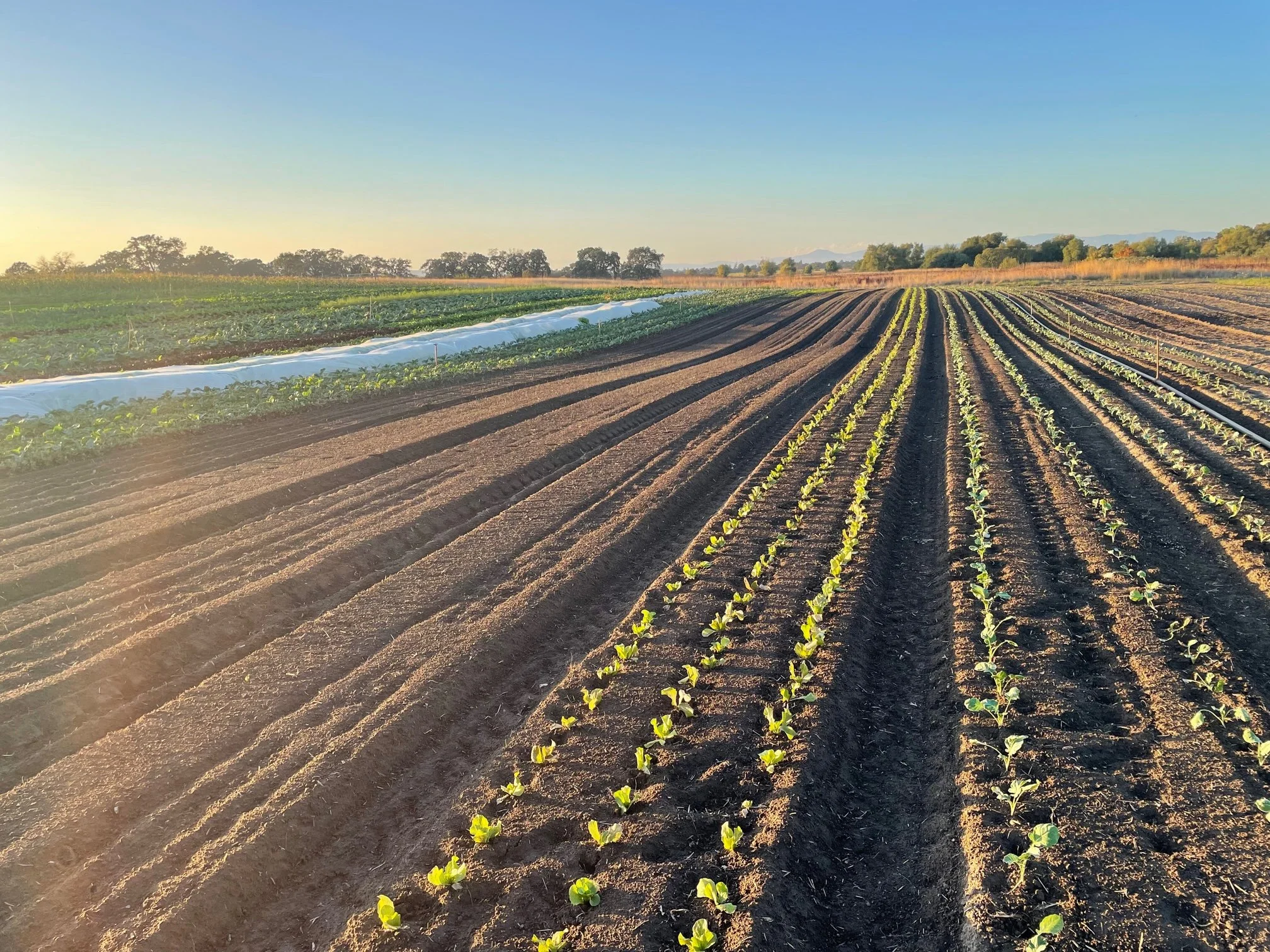
Sunrise over the Laguna right before seeding our big fall carrot patch.

HARVEST NOTES

  • Fresh Elsye Onions: Impossible to find in a grocery store, fresh onions are a vibrant farmer’s treat. They are typically more mild than their cured counterparts. Use like you would any onion, or try slicing thin and eating raw on your salads this week, or adorn your pizzas, sandwiches, or rice bowls with them.

  • Sugarloaf Chicories: We would die happy famers if we initiated all our CSA members into a deep and abiding love for Sugarloaf Chicories. The sweetest of the bitter chicory family, it’s delicious as a raw salad green, chopped up and paired with a rich fatty dressing (think caesar) or caramelized or roasted. To roast, cut a Sugarloaf head into quarters, coat the quarters completely with olive oil, rub in some crushed garlic, and then broil them until the outer leaves are slightly crisped and blackened the leaves are melted and soft. Then top with salt and grated parmesan and eat as a side.

  • Bunched Chioggia Beets: Also known as Candystripe Beets, these gorgeous pink beets have a bullseye inside and are often eaten raw to highlight their beauty and mild flavor (as in the recipe below). When cooked, the colors meld and soften into a delicate pink that is enlivened by the presence of acid like vinegar or lemon juice. See the recipe below!

Photo by Ted Cavanaugh

Crunchy Salty Lemony Salad

By Andrew Knowlton for Bon Appetite

Consider this recipe a formula where you can sub in any raw vegetable, oil, or cheese you feel like. And if you’re feeling fancy, add some crunch (nuts, seeds, or fried onions) or fresh herbs from the garden.

This week we’re thinking of fresh yellow onion, Chioggia beets, Persian cucumbers, fennel and purple basil!

Ingredients

  • 2 small Chioggia (candy-stripe) beets, trimmed, peeled

  • 2 Persian cucumbers

  • 1 medium watermelon radish, trimmed

  • 1 ounce Parmesan, Pecorino, Asiago, or other hard cheese, shaved

  • 1 lemon

  • Olive oil (for drizzling)

  • Flaky sea salt

  • Freshly ground black pepper

Preparation

Very thinly slice beets, cucumbers, and radish on a mandoline or with a knife. Arrange slices on a platter. Scatter you cheese on top. Finely grate some lemon zest over salad, then slice open lemon and squeeze on some juice. Drizzle with oil; season with salt and cracked pepper.

VOLUNTEERING ON THE FARM!

Feel like getting some dirt on your hands and working in the garden with us? Send us and email! CSA member Rose Brink-Cappriola has generously offered to coordinate. We’ll send out an email and try to find a day / time that works for as many of you as possible! Kids welcome!

FARMER’S LOG

VEGGIE CHOREOGRAPHY

We had a great week out here in the fields! Asa seeded over a mile of carrots for our 3rd and final carrot patch. We transplanted Brussels sprouts for Thanksgiving and our last succession of zucchini. Char and Henry weeded our 5th of 12 lettuce successions.

Sometimes people are curious, "How do you know what to plant and when?"

Crop planning, as we call it, looks different on every farm, but here’s a little rundown of how it works at WCCF…

Working Backwards

During the winter before our first season, in December of 2016, Kayta and I worked backwards from sketches of the harvest shares we want to have for CSA members over that spring, summer, and fall. It went something like…

“Well, we gotta have alliums every week. What’s life without alliums?”
“And snack crops! The kiddos gotta have snacks!”
“Lettuce and carrots = staples.”
“Yeah, and some sort of hearty green for braising and sides.”
“And novelties to keep it fun: Corn, scapes, fennel, kohlrabi…”
“What flowers are possible in early June?”
“What are the most epic 9 Winter Squash varieties to dole out in the Fall?” Etc, etc….

From those envisioned harvests, we started spreadsheeting. Using harvest and planting logs (and memories) from seasons past regarding yields and taking into account each crop’s growth cycle, heat and frost sensitivities, yield expectations, and things like that, we could roughly deduce how many seeds to sow in the greenhouse and fields and when.

A Dance of Time Scales

When we plant seeds depends on each individual crop’s life span, or “days to maturity” in farmer lingo. For example, we like to try to have arugula and mustard greens at least twice a month every week from June-December. Arugula and mustard salad greens are super fast maturing crops (~25 days from germination to harvest) so this year we’ll sow about 1,600 ft of arugula every month from May 8th until September 25th. Carrots, on the other hand, take 75-90 days to mature. They also have a much larger harvest window (meaning they grow slow and keep well in the soil, so we can harvest off the same planting for over a month). So for carrots we sow 3 larger blocks, the first on April 24th (ideally), and the last in mid-July (yesterday!), and that gives us fresh bunched and loose carrots all the way until mid-December. On the long end of the spectrum are crops like our Floriani Flint Corn, Jack-O-Lantern Pumpkins and Winter Squash. These crops we seed once in the late-Spring, they take all summer to mature, and we‘ll harvest and enjoy them in the fall.

And so it goes that each Spring we embark with a neat greenhouse sowing and field planting spreadsheet — a musical score. This spreadsheet then becomes the drum-beat of our weeks, shape our to-do lists, and eventually become the harvest shares you see each week!

At left, Kayta checking on the onions in the greenhouse May 8th and at right those same onions yesterday morning growing strong and starting to bulb up out in Farfield!

Rubber Hits the Road

Harvest is when the real work of crop planning — the note taking and record keeping — begins. What actually happened that first year in 2017? How many bed-feet of cabbage were transplanted? How much cabbage did we harvest and how much did people take home? Was it enough? Was it too much? How did that variety hold up to the heat of July? Some things we don’t need to take notes on, like Sarah’s Choice Cantaloupe being the best melon of all time. We remember that one.

Record keeping is key. After every CSA pick-up we record how much people took home of various crops. Kayta uses those records from previous year’s pickups to determine how much to harvest each morning, and to hone how much we plant in following years.

Indeed, the most sacred objects on the farm are our harvest logs and crop planning spreadsheets (and the dirty old binder that lives in the truck labeled “Planting Log”). These are our memories, forever being honed and amassed, logs of 8 seasons of successes and failures that we will continue to refine, year by year, and that will help us, each winter, to create a planting plan ever more custom tailored to this soil, this microclimate, and this CSA.

Painting with Seeds

But the “art” of crop planning for us is in taking all of this business and planting for harvests in a way that harmonizes with the seasons, surprises, delights, and helps CSA members fall in love with food and flowers every week.

If everything goes to plan this year, for example, you should experience a seasonal arc of alliums. The fresh garlic and delicate scallions of our early harvests are now giving way to the first bulbed fresh onion bulbs of summer which will in turn give way to the solid, crispy-paper-cured orbs of late Summer and Fall. In this way we hope our allium crop plan, and our whole crop plan, inspires you.

They say, "If you want to make God laugh, make a plan." But with our amazing crew and a little bit of luck, it’s looking like we will pull off our 60 column, 230 row “2024 Crop Plan” Google sheet!

See you in the fields,
David


CSA BASICS

Still need an orientation? Please contact us by email with a few days notice to set up a time for an orientation tour. We are available for tours during Tuesday CSA pickups from 1-6 pm and Saturday CSA pickups from 9 am - 2 pm.

No dogs: Unfortunately, dogs are not allowed on the farm.

Drive slow! Please drive slow on Cooper Rd. and in our driveway / parking lot area. Kids at play!

What time is harvest pick-up?:

  • Saturday harvest pick-ups run from 9:00 am - 2:00 pm

  • Tuesday harvest pick-ups will run from 1:00 pm - 6:00 pm

Oriented members can come to the farm any time, 7 days a week, sunrise to sunset, to u-pick and enjoy the farm.

Where is the farm? The member parking lot is located at 1720 Cooper Rd., Sebastopol, CA 95472.

Where is the food? The produce pick-up barn is just to the right of the solar panels and above our big greenhouse. You can’t miss it!

2024 CSA program dates: Our harvest season will run from Saturday, June 15th through Tuesday, December 10th this year.