
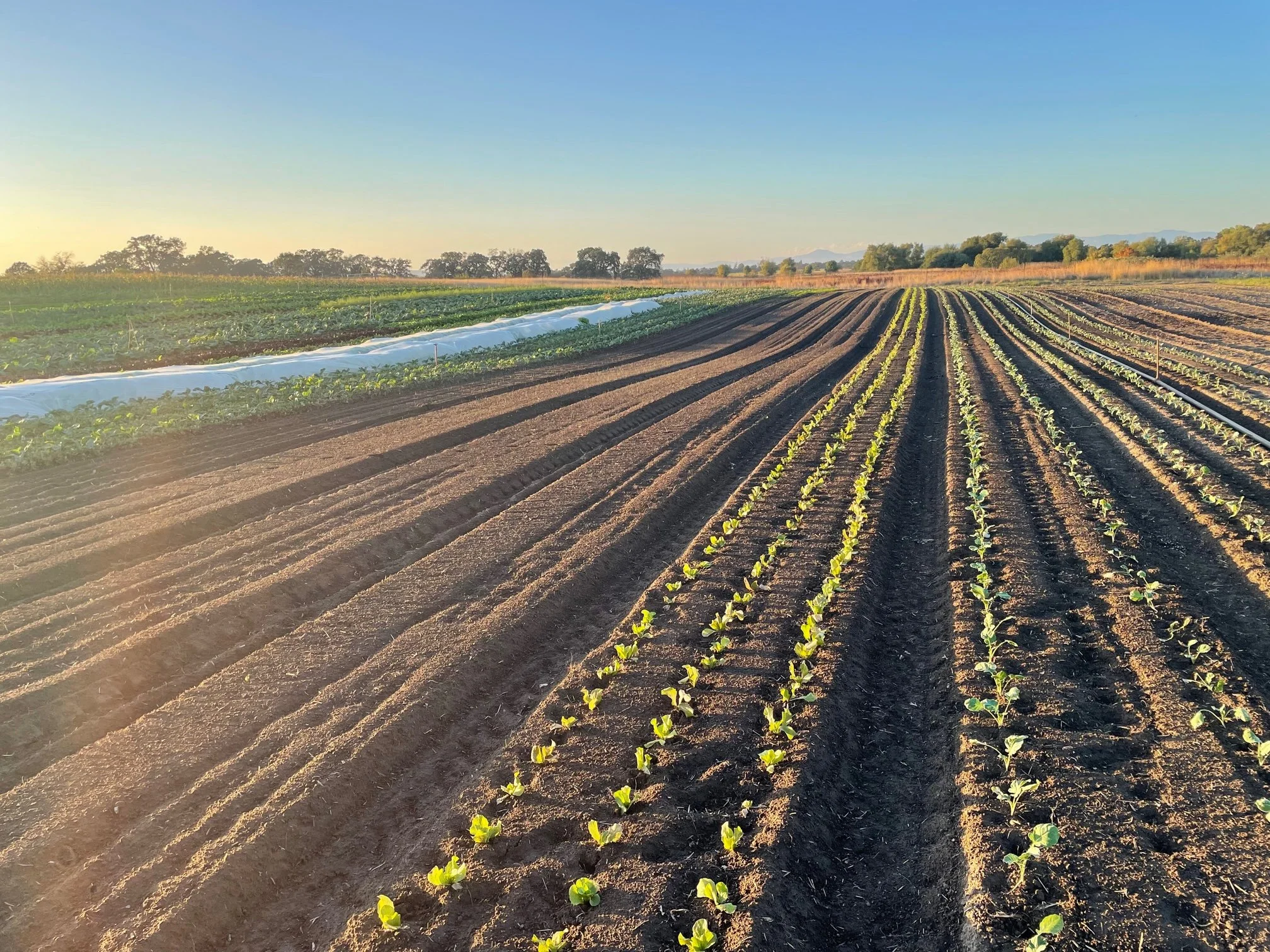
Harvest Week 24 - Winter Echoes

THIS WEEK’S HARVEST

Hardy winter stalwarts to ground and nourish you as the light wanes.

Spinach, Cherokee Lettuce, Dazzling Blue Kale, Kohlrabi, Brussel Sprouts, Leeks, Celery Root, Mixed Daikon Radishes, Cabbage, Delicata and Jester Winter Squash, Bolero Carrots, Bintje Potatoes, Yellow Elsye Onions, Lorz Softneck Garlic

U-PICK

  • Herbs: We will be mowing the annual portion of the garden soon, but until then there is still a very small amount of select herbs left for the gleaning: Italian Parsley, Onion Chives, Garlic Chives, Oregano, Lemon Verbena, Thyme, and French Sorrel.

HARVEST NOTES

  • Delicata and Jester Winter Squash: Do you have a squash horde (colloquially known as a “squord”) at home? One tip to taking best advantage of the season’s winter squash bounty is to make sure to eat the small ones first. The sweet little gems like this week’s Delicata and Jester will start to lose their flavor more quickly than the larger varieties such as Butternut and the upcoming Marina di Chioggia pumpkins. We recommend enjoying these sweet treats within the next few weeks. Try having a piping hot roasted half for breakfast! Yum!

  • Celery Root: See the recipe below, or Week 22’s Newsletter for ideas on what to do with this rare and delicious winter vegetable.

  • Multi-colored Daikon: Three varieties of Daikon make a confetti of color. Try using a mandolin or cutting super thin slices and adding a splash of lemon juice and salt for a colorful side salad to brighten up your winter plate.

We had some super cold — for California — morning’s this week!

WHEN DOES THE CSA END?

Because of the wet Spring and late start we had, our 2023 harvest season will run all the way until the third week of December this year! The last Saturday pickup will be December 16th, and the last Tuesday pick-up of the year will be December, 19th.

WHEN CAN I RESERVE MY SPOT FOR 2024?

We are deep in the planning phases for next season, rest assured, current members will be given the first chance to reserve a spot in our 2024 CSA program!

Celery Root Rösti with Caper and Celery Salsa

Recipe by Yotam Ottolenghi

This is a dish for any time of the day: for brunch (with some crisp bacon, maybe?), or for a light meal or first course. Makes 10 rösti, to serve two to four.

Note: if you’re in need of some additional Celery Root inspiration, check out Ottolenghi’s other mouth-watering recipes here.

Ingredients

1 celeriac, peeled and coarsely grated
1 small desiree potato, peeled and coarsely grated
1 shallot, peeled and thinly sliced (use a mandolin, if you have one)
1 tbsp lemon juice
Salt and black pepper
½ tsp each coriander seeds, celery seeds and caraway seeds, toasted and finely crushed
½ garlic clove, peeled and crushed
2 eggs, beaten
2½ tbsp plain flour
Vegetable oil, for frying
100g sour cream, to serve

For the salsa:
½ small shallot, peeled and very finely chopped
2 celery sticks, finely chopped
10g basil leaves, finely shredded
10g parsley, finely chopped
15g capers, roughly chopped
Finely grated zest of 1 lemon, plus 1 tbsp juice
1½ tbsp olive oil

Celeriac rösti — photo from The Guardian

INSTRUCTIONS

Combine the celeriac, potato, shallot and lemon juice in a medium bowl with two teaspoons of salt, then tip into a sieve lined with a clean tea towel or cheesecloth. Set the sieve over a bowl and leave for 30 minutes, for the liquid to drain off. Draw together the edges of the towel, then wring it a few times, to get rid of as much water as possible. Transfer to a clean bowl and combine with the spices, garlic, eggs and flour. Using your hands, form the mix into 10 6cm-wide patties, compressing the rösti as you make them, to squeeze out any remaining liquid.

Put all the salsa ingredients in a separate bowl, add a generous grind of pepper and mix to combine.

Pour enough oil into a medium-sized nonstick frying pan to come 1/2 inch up the sides. Put the pan on a medium heat and, once the oil is very hot, fry the rösti in batches for seven minutes, turning them a few times, until crisp and golden-brown all over. Transfer to a plate lined with kitchen towel and keep warm while you cook the rest of the rösti. Serve at once with the salsa and a spoonful of sour cream. 

Local Olive Oil For Sale this Week!

Hawks Feather Olive Oil will be available for purchase at both this week’s Saturday and Tuesday pickups. Please come sample local, organic, extra-virgin olive oil that is grown and pressed here in Sebastopol by a fellow CSA member. Tuscan varietals thrive in our ideal climate, making a divine EVOO.  Please come sample the latest harvest - Olio Nuovo – a vibrant green full of peppery personality. 375 ml bottles ($25) are a perfect holiday gift!  

FARMER’S LOG

ECHOES

On the farm, time is an echo. Moments, days — the particular slant of light while you harvest Fall carrots — each return from a long distance, the long distance of a year, like a deja-vu.

A corn plant itself is an echo. It’s whole life, from seed to harvest, is the echo of the lives of the thousands of corn plants that came before it.

For a farmer, these echoes are full of memory. All it takes is a certain smell, the sound of dry corn rustling in the wind, and there you are again, surrounded by the memories of who you were and who you were with the last time you heard that sound.

Last December 1st, we were also rich in winter vegetables. We were prepping next year’s strawberry beds in the icy morning. We were pulling our irrigation lines out of the field and battening down the hatches for the winter floods. Frosts were sweeping through the farm, turning it silver for an hour or two on cold mornings.

Prepping 2023’s strawberry patch last December — looked mighty similar to this Monday morning.

The silver December light is full of echoes. We can hear them in the early morning, shimmering out over the frosted cover crop, and they make us smile.

Sometimes, when we are still, the echoes seem to continue on forward, strangely, and it is as if we can hear the echoes of December’s yet to come…

See you in the fields, 
David & Kayta 

Harvest Week 23 - Belonging

THIS WEEK’S HARVEST

In a nutshell: the bitter and sweet flavors of winter.

Leeks, Cabernet Onions, Lorz Italian Softneck Garlic, Purple Cabbage, Bodega Red Potatoes, Black Futsu Winter Squash, Dandelion Greens, Brussels Sprouts, Bolero Carrots, Assorted Lettuces, Radicchio, Bok Choi, Beets, Green Magic Broccoli.

This week’s Black Futsu squash hanging out before their big day.

U-PICK

  • Albion Strawberries: Very last gleanings (mostly in the new, Western patch)

  • Herbs: Italian Parsley, Onion Chives, Garlic Chives, Oregano, Lemon Verbena, Thyme, French Sorrel.

HARVEST NOTES

  • Black Futsu Winter Squash: A beloved Japanese delicacy, this bite sized, mini Butternut relative has bright orange flesh with unique fruity flavor and edible skin. New to the farm this year! Let us know if you like it!

  • Dandelion Greens: These succulent Italian dandelions are the perfect bitter winter green. As with chicory, they pair well with rich, sharp flavors. For a simple and delicious side dish, try sautéing in bacon fat with a dash of red wine vinegar and topping with parmesan. Also try including them in an omelet, or making the recipe for chickpea pancakes with dandelions and caramelized onions below!

  • Lorz Italian Softneck Garlic: If you read Harvest Week 16 Farmer’s Log, you know that the ultra wet winter we had hit this year’s garlic crop hard. We did get enough garlic to save for seed — which we planted on higher beds a couple weeks ago, so now we can distribute the remaining garlic we had. Let these little guys be but a taste for what we hope are big bulbous garlics next year.

WHEN DOES THE CSA END?

Because of the wet Spring and late start we had, our 2023 harvest season will run all the way until the third week of December this year! The last Saturday pickup will be December 16th, and the last Tuesday pick-up of the year will be December, 19th.

WHEN CAN I RESERVE MY SPOT FOR 2024?

We are deep in the planning phases for next season, rest assured, current members will be given the first chance to reserve a spot in our 2024 CSA program!

Chickpea Pancakes with Dandelion Greens & Caramelized Onions

From Heirloom by Sarah Owens

This recipe brings together hindbeh, a Lebanese dish of dandelion greens and caramelized onions eaten with Arabic flatbread, with chickpea crepes, traditionally enjoyed in southern France, northern Italy, North Africa and Gibraltar. Its crispy edges and custardy interior make for an edible scoop for the sweet onions and bitter greens, and its nutty flavor complements both.

Ingredients

  • 125 g / 1 cup chickpea flour

  • 1 cup water

  • 1 1/2 teaspoon fine sea salt, divided

  • 1/2 cup + 3 tablespoons extra-virgin olive oil, plus more for the pan

  • 7 1/2 cups sliced onions (about 6 to 7 small onions)

  • 1 pound dandelion greens (about 2 bunches)

  • splash of vinegar


    Instructions

  • Whisk together the flour, water, 1/2 teaspoon salt, and 2 tablespoons of the oil in a medium bowl. Cover with a kitchen towel and rest for at least 2 hours or up to 6 hours for the flour to fully hydrate. (Farmer’s note: we have skimped on this time and found the pancakes to still be delicious!)

  • In a large heavy-bottomed skillet, cook the onions and remaining 1 teaspoon of salt in 1/2 cup of the remaining oil over medium-low heat, stirring occasionally, until the onions are well caramelized, 40 to 45 minutes.

  • (Farmer’s note: because the dandelions we grow are cultivated varieties, they don’t necessarily need to be blanched before sautéing as the recipe directs, but you can if you’d like to further reduce their bitterness.) While the onions are cooking, bring a large pot of water to a rolling boil. Turn off the heat and dunk the dandelion greens in the water, stirring to wilt them, about 45 seconds to 1 minute. Pour through a colander positioned over the sink and run cold water over the greens to stop the cooking, then use your hands to wring out excess water. Coarsely chop the dandelion greens and add them to the skillet with the onions. reduce the heat to low and cook for 10 minutes or longer to remove more of their bitterness. Serve warm or at room temperature. You can make the greens up to 3 days in advance; store covered in the refrigerator.

  • Place a 10-inch cast-iron griddle or skillet 3 to 4 inches under your broiler and preheat the broiler on high for 15 minutes. Carefully remove the pan and pour in 1/2 tablespoon of oil, swirling to coat. Return to the broiler for 1 to 2 minutes to heat the oil, then pour in enough of the batter (about 1/3 to 1/2 cup) to create a thin 8- to 9-inch pancake, tilting the pan to swirl it or using the back of a spoon or measuring cup to quickly spread it. Broil for 3 to 4 minutes, until the crepe is blistered and cooked through with the edges curling slightly. Remove the crepe from the pan with a spatula and repeat with the remaining batter, adding more oil for each crepe — you should have enough batter to make about 4 crepes. Serve immediately, with the dandelion greens and onions, using the crepe as an edible scoop.

FARMER’S LOG

BELONGING

We’re having a busy Holiday, so this week we’ll reposting a Farmer’s Log from this time last year with a little epilogue update at the end. We hope you all felt nourished and that the farm produce helped liven your tables this week.

* * * * *

With the frost, the time of rest, gratitude, and reflection settles on the Laguna.

It was a quiet day today on the farm. I was on the tractor, shaping next year’s garlic and strawberry beds over what was the tomatoes and u-pick peppers, when a perennial Fall question occurred to me:

“What does it mean to belong to a place?”

Big questions like this are perhaps never answerable. Or perhaps, if they are answerable, the answers are constantly changing. Or, perhaps the point is not in the answers you get but in the perennial asking of the question.

So today on the tractor I wondered, “What does it mean to belong to a place?" for the first time on the new farm. I was struck by how different it felt from the last time I asked.

Though we just moved the farm a few miles across town this year, it was a big move. We uprooted from the place where we started the farm as a 30 member CSA 7 years ago and where we cut our teeth shaping fields, growing food, building soil, and trying to build community together. We made a lot of memories there. Every nook, cranny, and field in that valley was becoming a layer cake of memory for us — first harvests; getting engaged on the hill on a crisp Fall afternoon; getting married in the redwood barn; of meeting so many of you CSA members for the first time.

Beautiful lines of cover crop sprouting in the Creek Field planted by Longer Table Farm this year.

A palimpsest (from the Greek “scraped again”) is a writing material or surface (like a parchment or tablet) used again after earlier writing as been erased. It’s a surface that is being continuously renewed but the etches and marks of the past remain and build up.

A farm is a palimpsest for a farmer: The more years you’ve lived and worked in a place, the more the marks of memory build and layer depth onto the continuously renewing fields and landscape. This is why elders are the most revered members of agrarian cultures.

When you come to a new place, to a new farm in our case, the heaviest lifting isn’t physical — it’s mental. You have to learn the history of the place by talking to those who know the place and by reading whatever clues the land can tell you. Then you have to start working.

“Where should the garden go?”, “Where should we plant the garlic?” You are bound to make mistakes — some big, some small as you build your memories and map on the place you inhabit.

One small mistake we made this Spring was shaping our tomato and u-pick beds too close to the drainage that separates that field from the garden so it ended up being hard to drive a truck comfortably around those oft visited zones.

So today, as I was outlining 2023’s strawberry and garlic fields over 2022’s erased tomatoes, I gave us another 6 feet of leeway. And whenever I drove the tractor East, I could see the garden and the strawberry patch and was flooded with memories; of second-breakfasts with the crew under the oak trees; of friends and families picnicking and perusing the July flower garden; of kiddos plucking strawberries in the evening light.

And in that reverie the question arose: “What does it mean to belong to this place?”

I don’t know the answer — but I think those kinds of memories have a lot to do with it.

* * * * *

2023 epilogue: One of the highlights of 2023 for us was how many of you used the farm as a hang out spot — to lounge, throw a birthday party, to take family pictures, drink wine with friends...

We always meant for the farm to serve this purpose, and people have kicked it on the farm before, but never like this year. Maybe it was the extra picnic benches, maybe it was the relaxing of COVID fears, heck, maybe it was the swing set! Whatever it was, you all are doing a great job of making memories and making us belong to this place. Keep it up.

Also, how about a play structure for 2024!?

A mighty fine spot for a play structure.

OTHER RESOURCES FOR BELONGING

In asking the “belonging” question, the one thing we do know is that it is imperative to learn from and support the people and cultures who have belonged to this place for many thousands of years:

  • mak-'amham / Cafe Ohlone: Vincent Medina and Louis Trevino created Cafe Ohlone as, in their words "an Ohlone cultural institution empowering our community with tradition—and we teach the public, through taste, of our unbroken roots."

  • Federated Indians of Graton Rancheria: The federally recognized confederacy of Coast Miwok and Southern Pomo people. Their website contains a concise history of the Rancheria and news of current cultural initiatives.

  • California Indian Museum and Culture Center in Santa Rosa which in addition to its other work offers programs for Tribal youth.

  • Sogorea Te' Land Trust is an urban, indigenous women-led land trust that facilitates the return of indigenous land to indigenous people in the East Bay.

  • We have been grateful to follow along and learn from the amazing Indigenous farmer and seedkeeper Rowen White. She can be found here and at Sierra Seeds.

  • We highly recommend the documentary Gather. In the filmmakers words, "Gather is an intimate portrait of the growing movement amongst Native Americans to reclaim their spiritual, political and cultural identities through food sovereignty, while battling the trauma of centuries of genocide."

* * * * *

See you in the fields, 
David & Kayta 

Harvest Week 22 - A Farmer's Thanksgiving

THIS WEEK’S HARVEST

In a nutshell: There is a reason we give thanks in the Fall — bounty!

Leeks, Yellow Elsye Onions, Garlic, Celery Root, Yukon Gold Potatoes, Winter Luxury Pie Pumpkin or Sunshine Kabocha, Dino Kale, Brussels Sprouts, Cauliflower, Carrots, Assorted Salanova Lettuces, Radicchio, Watermelon Radish, Butternut Squash, and Broccoli.

U-PICK

  • Albion Strawberries: Gleanings (mostly in the new, Western patch)

  • Herbs: Italian Parsley, Onion Chives, Garlic Chives, Oregano, Lemon Verbena, Thyme, French Sorrel.

HARVEST NOTES

  • Brussel Sprouts: We’re distributing Brussel sprouts on the stalk as they grow in the field. For storage — and to fit them in your fridge — just pop the sprouts off and store them in a bag or closed container.

  • Watermelon Radish: This is a hardy, dense, and gorgeous winter radish with a vivid magenta inner core. We love it on top of a green salads, rice bowls or highlighted as a small salad of its own — try ginger, garlic and lime on julienned or sliced watermelon radishes as a bright side dish. We recommend lightly peeling. Pro tip: while they’re generally quite mild, if you find them to be somewhat too spicy for your taste, try soaking in an ice water bath!

  • Winter Luxury Pie Pumpkin: The supreme pie pumpkin with gorgeous, netted skin. The only pie pumpkin that can compete with a Sunshine Kabocha. You will have your choice of a Kabocha, or a Winter Luxury, for pie this week.

  • Celery Root: Also known as Celeriac, Celery Root is a traditional European winter vegetable with smooth, white flesh that is packed with pure celery flavor. Try adding it to a hardy winter stew, mashing it along with potatoes, or roasting. We’ve also heard legend that celery root fries (i.e. deep fried celery root sticks) are the best thing ever. For a more refreshing take, Celery Root can be grated or julienned into a fresh salad of apples and a creamy or mustardy dressing.

Over the next few weeks we’ll be making big moves around garden. We’re taking the old strawberries out, doubling the size of the flower garden, and putting in 3,600 ft of new strawberries!

WHEN DOES THE CSA END?

Because of the wet Spring and late start we had, our 2023 harvest season will run all the way until the third week of December this year! The last Saturday pickup will be December 16th, and the last Tuesday pick-up of the year will be December, 19th.

WHEN CAN I RESERVE MY SPOT FOR 2024?

We are deep in the planning phases for next season, rest assured, current members will be given the first chance to reserve a spot in our 2024 CSA program!

Introducting Zweibel’s Bakery!

With Freehand Bakery taking a winter break, we are very excited that starting this Tuesday, Karl and Ursula of Zweibel’s will be offering their amazing baked goods for purchase during Tuesday pickups!

Zweibel’s is a small farmers’ market-based, whole grains-focused bakery based in Santa Rosa. They use very close to 100% organic ingredients and are dedicated to sourcing their ingredients primarily from the bounty of Sonoma and Marin. Some of people’s favorites are their naturally-leavened bagels, spelt puff pastry apple-rhubarb hand pies, and delicious granola.

On Tuesday they’ll be bringing:

  • Bagels!

  • Pepper and Mozzarella OR Mixed Olive Focaccia!

  • Soft Pretzels!

  • Apple-Rhubarb Puff Tarts!

  • Mini Caramelized Pumpkin Pies!

  • Cake Slices!

  • Banana Breakfast Cookies!

  • 100% Rye Flour Chocolate Cookies!

  • Buckwheat Chocolate Chip Cookies!

  • Triple Ginger Cookies!

  • Coconut Macaroons!

  • Almond-Golden Raisin Granola!

If you’re interested in seeing more, you can check them out on Instagram: @zweibels_

For questions or to special order something, email them at derzweibel@gmail.com

KAYTA’S CLASSIC PUMPKIN PIE RECIPE

This is an elegant and simple pumpkin pie recipe which relies entirely on the quality of its ingredients for its flavor. We find that it tastes amazing with a high-quality squash and fresh whole milk (although coconut milk would make a delicious version as well). This recipe will work with really any of the winter squash we distribute, but we saved two of our favorites for this week: The Winter Luxury pie pumpkins will give you a silkier texture and heightened pumpkin-y flavor, while the Sunshine Kabochas bring incredible chestnutty sweetness and a slightly denser texture.

THE CRUST

  • 1/2 tsp salt

  • 75 ml water, about 1/3 cup, very cold (I usually start with this amount and add a touch more as needed)

  • 227 g all purpose flour, about 1 and 3/4 cup

    150 g unsalted butter, 1 stick plus 2.5 tablespoons, very cold

Cut the cold butter into pea sized chunks and mix into the flour and salt mixture. With your fingers, squeeze the butter chunks so that they flatten into the flour. Add the water gradually, pressing and kneading the dough as you go, until all of the flour has been moistened and is able to be formed into a ball. (I usually use slightly more water than the recipe calls for.) While you’re doing this process, it’s important to keep the butter cold, and keep it from incorporating evenly into the dough — it’s the discrete layers of butter between layers of flour that makes a dough flaky.

Make the dough into a ball and then flatten into a disc and refrigerate, wrapped in a bag, until you are ready to roll it out. Once the crust has been rolled out and placed in your pie pan, refrigerate or freeze it until right before you put it in the oven. Pro tip: you’ll achieve more layered flakiness if you fold the dough over on itself several times before shaping into the pie pan.

To get a perfectly flaky crust, it’s best to blind bake your crust a bit before adding in the filling. Preheat oven to 350°F with a rack in the center. Line pie shell with parchment paper and fill to the top with pie weights or baking beans. Bake until edges are dry and firm, 20 to 25 minutes. Remove parchment and pie weights, then bake until bottom crust is completely dry and light golden, 5 to 10 minutes more. Set aside to cool. When you’re ready to finish baking the pie, increase the oven temperature to 400°F.

THE FILLING

  • 1 3/4 cup baked winter squash or pumpkin flesh

  • 1/2-3/4 cup sugar (if you’re using a Kabocha, you may want to err on the lower side)

  • 1/2 tsp. salt

  • 3/4 tsp. cinnamon

  • 1/2 heaping tsp. ground ginger

  • 2 eggs

  • 1 cup cream

  • 1/2 cup milk (feel free to adjust the ratio of cream to milk, or substitute coconut milk for all of it!)

Mix the sugar, salt, and spices into the pumpkin. Then mix in the eggs, milk, and cream, and whisk until smooth.

Pour the pie filling into your par-baked crust, and bake at 400 degrees until only an inch in the center of the pie remains liquid and the crust is golden brown. Let set before eating.

FARMER’S LOG

A FARMER’S THANKSGIVING

Kayta and I both grew up in the suburbs and, like everyone, we encountered those ubiquitous expressions  — “make hay while the sun shines,” “three shakes of a lamb's tail,” “like a horse who’s seen the barn,” etc. It wasn’t until we started farming that we began to feel the visceral poetry of these expressions and to understand their roots. And it wasn’t until we started farming that we began to understand — like really understand — the need to give thanks in the Fall.

The Fall is an incredible time of year in the temperate world. It is a season of unimaginable bounty. The plants of the forest and the field have spent all Spring and Summer harnessing the sun’s energy into their fruits, seeds, roots, and leaves and we have harvested. In the Fall, the root cellar is full, the larder is full, the granary is full — the land has burst forth at its seams and we have gathered the overflow.

The farmer, sitting at home with their feet up next to the fire, is keenly aware of the bounty in the root cellar below. We feel a great contentment in this but no pride because we realize how little we did to create it. Sure, we worked hard all year — moving things here and there — but it was others, present now and before, that filled that cellar. It was others who dug it out and laid the roof. Others who made the tools and taught us how to use them. Others who saved the seeds and taught others, who taught others, who taught others, who taught us how to care for them. And what (or who) made those seeds sprout? Not we.

For all this, there is nothing to give but thanks.

We’d like to take a moment to give thanks those who made this season possible.

* * * * *

First and foremost, we are so grateful to our incredible crew, who masterfully shepherded the farm through a year of immense growth and change. These wonderful farmers seeded, planted, harvested, washed all of the produce we’ve enjoyed this year, put their blood and sweat into working this land, and made what could been a hectic and stressful year into the most balanced, smooth, and abundant yet.

Call signs from L to R: Nooch, PBJ, Beemster, Hippie Dust, Pepita.

Asa Black who joined us this year from Odiyan Center near Stewart’s point, brought his careful, observant touch to all corners of the farm. He kept our tomatoes upright and happier than ever, our vulnerable crops covered and weeded, and deer out of our Farfield among so many other things. Thanks for staying late and having our back so much this year, Pepita.

Aisling Okubo, our Assistant Harvest Manager, who you know and love from Tuesday pick-ups, gracefully handled the management of so many Monday and Thursday harvests —  a heavy lift — and became the queen, and magical morning elf, of our wash-pack station and was, day-after day, week-after-week, a quiet leader and cornerstone in the field for us. We’re so lucky to have you, Nooch. 

Paige Taylor, our Greenhouse and Garden Manager, who joined us this year from Red Dog Farm in Chimacum, WA, stepped into a new farm and took on a huge chunk of responsibility with consummate attention to detail, skill, and confidence. Paige oversaw the seeding of every plant we grew on the farm this year and managed the garden and u-pick zones to perfection — and they never looked better. Thanks for sending it so epically, PBJ.

Tristan Frakes, our Production Manager, joined us this year from Oz Farm in Point Arena, also jumped right into the deep end with us and set up, dialed in, and mastered all this new equipment to prep and plant 7 acres after just a few weeks of orientation. He then, with characteristic ease and good humor, oversaw the execution of our complicated planting schedule wherein dozens of crop varieties must be planted in 5 different fields all within a short planting window and managed to grow the best onions we’ve ever grown, among other things. A grateful “hellll yeah” to you, Hippie Dust. 

Hippie Dust bringing home the bacon.

Anna Dozor, who you know and love from Saturday CSA pick-up, did double duty and juggled her role next-door at Winter Sister in order to be with us this year and we couldn’t be more grateful. Anna helped us build this farm, so it was an immense comfort to know the farm was in such good hands when Alice arrived in May, and to have her continually holding it down as Harvest Manager, and in the fields all year as we became new parents. Huzzah, Beemster!

To Alberto and Anayeli Guzman, who work full-time at Longer Table Farm, and occasionally put in extra hours here in the afternoon during our peak season. Their skilled work at key moments was the key to an abundant harvest of numerous crops here this year. Anayeli also organized work crews to help us bring in this year’s bumper potato and Fall carrot harvests. Anayeli and Alberto were born into Mixtec and Zapotec (respectively) speaking indigenous communities near Oaxaca, Mexico. Anayeli also organizes for farm worker rights in Sonoma County. You can learn more about her and her work here and here.

To Scott Mathieson and Laurel Anderson, farm family and the landowners of this amazing place. There are much easier things to be doing with a property than leasing to a noisy, busy, often smelly operation. But your commitment to building community and sharing beauty and bounty shines through in how you support us the farm everyday. Local agriculture simply couldn’t exist without people like you.

To Sarah Dozor and the team at Winter Sister, and Will, Lucas and everyone at Longer Table Farm; and to Graham — thank you for being the best farm neighbors and the knowledge and tool sharing and camaraderie.

To our Flower Ambassador, Cassidy Blackwell, and our Home Chef Ambassador, Adam Kahn — thank you for sharing your contagious inspiration and excitement about the farm with all of us and for your beautiful additions to the newsletter this year. Gold stars!

To Abby Teitelbaum and Daniel Gonzales of Freehand Bakery for blessing us Tuesdays with some of the best bread and pastries we ever tasted in Sonoma County. 

To Jared Sutton and Tristan Benson for their clutch metal and mechanical work.

To our neighbor Sara McCamant for helping to injecting some really special, excitings new garlic seed into our field this year. That Aglio Seco! We can’t wait to see how they turn out and, hopefully, to multiply them!

Our family and friends for all your incredible support and food, especially this spring, as we became new parents. 

To our sweet baby Alice — thank you for exploding our hearts everyday and being the chillest baby that farmer parents could ever ask for.

And finally, to you, dear members. Whatever bounty we’ve enjoyed this year is because of you. You made a real connection to, and shared in the real risk of a growing season with farmers — something extremely rare and important, we think, in this crazy world. Your support made it possible for us to plant each seed, spread the compost, lay the irrigation lines, and harvest the food that nourished us all — and you did quite a bit of u-picking yourself! You showed up each week with sweet smiles, gifts, and words of encouragement and appreciation that charged us up in so many ways.

You remind us, day after day, week after week, that real, life-sustaining bounty comes from a community rolling up its collective sleeves and building something needful and beautiful together.

Thank you.

See you in the fields, 
David & Kayta