
9/11/2020 - Week 14 - Of Smoke and Onions

THIS WEEK’S HARVEST

Heirloom Tomatoes (See Week 13’s newsletter for variety descriptions), Sweet Corn, Metechi Hardneck Garlic, Rainbow Chard, Bok Choi, Bel Fiore Radicchio, Fennel, Cabbage, Carrots, Eggplant, Summer Squash & Zucchini, Olympian Cucumbers, Walla Walla Sweet Onions, Sweet Peppers, Poblano Peppers, Assorted Head Lettuce

E2ACD9F4-9866-4AF9-8F86-12E7D611451E.JPG

U-PICK

Check the u-pick board for updated weekly limits. With the ash settling on produce, we recommend washing all u-pick produce before consumption

  • Albion Strawberries: For some reason there has been an insane explosion in the population of yellow jackets in Green Valley this year. They have just discovered our beloved strawberries and are eating them because they love sugar. They do not sting unless you accidentally squish one — be aware while picking.

  • Cherry Tomatoes: See week 10’s newsletter for variety descriptions. There are a lot of soft, overripe cherries tomatoes because of the intense heat wave last weekend.

  • Frying Peppers: Shishitos, Padróns | See week 5’s newsletter for harvest tips

  • Jalapeños: Located below the Padróns

  • Yellow & Red Thai Hot Peppers: Located next to the Jalapeños

  • Husk Cherries: Located just above the gnome homes in the garden | See Week 9’s Harvest Notes for tips

  • Herbs: Rosemary, Thyme, Tulsi Basil, Thai Basil, Purple Basil, Oregano, Marjoram, Tarragon, Onion Chives, Garlic Chives, Vietnamese Coriander, Culinary Lavender, Culinary Sage, French Sorrel, Lemon Verbena, Lemon Balm, Perilla & Purple Shiso, Chamomile, Green Coriander

  • New Flowers: There are two new beds of Cosmos and Zinnias blooming right next to the farm strawberries!

IMG_0049.JPG

HARVEST NOTES

  • Bicolor Sweet Corn: We avoided growing sweet corn the past three years because it is a heavy feeder and takes up a lot of space — but then we caved like when you cave and order in pizza on a Saturday night. Before you do anything to this sweet corn, take a bite of it raw. It’s like candy.

PICK-UP SCHEDULE

The 2020 harvest season runs from Saturday, June 13th til Tuesday, December, 8th.

  • Saturday pick-up runs from 9:00am - 2:00pm

  • Tuesday pick-up runs from 1:00 pm - 6:00 pm

U-picking is open 7-days a week, sunrise to sunset. Please close the gates behind you on off days.

FARMER’S LOG

OF SMOKE AND ONIONS

This week was our first week oriented around a big harvest — the storage onions — and with this harvest we began of the Fall Phase of our harvest season. As one of our farmer heroes, Dan Kaplan of Brookfield Farm near Amherst, MA, put it, “After a winter of planning. A spring of getting going, plowing, and planting. A summer of crop growing, putting out fires, keeping plants alive, staying hydrated. We arrive to a fall of harvesting, of playing the cards we've been dealt, of reaping what we have sown. Or another way to look at it:  Winter is dreaming and scheming, Spring is action, Summer is fretting, and Fall is acceptance. And that is where we are heading headlong right now. That first hurdle into the bittersweet final place where there's nothing more for us to do, or worrying about — just plain being with what is.”

We had a nice intro to this phase this year.

This week, Monday had us doing our usual pre-harvesting for Tuesday — except with a 6:00am start time and an extra speed in our step to escape the heat (110 here!). We harvested cukes and squash and carrots as fast as we could, and called it a day and got inside by 1:00pm . David went to Santa Rosa to shop for parts to build a new root washer. A seldom reported, but very important part of farming — hardware store shopping!

On Tuesday we did our main harvest, washed, Anna ran pick-up, Kate chipped away at more garlic, and David prepped for the Great Onion Harvest.

IMG_1040.jpg

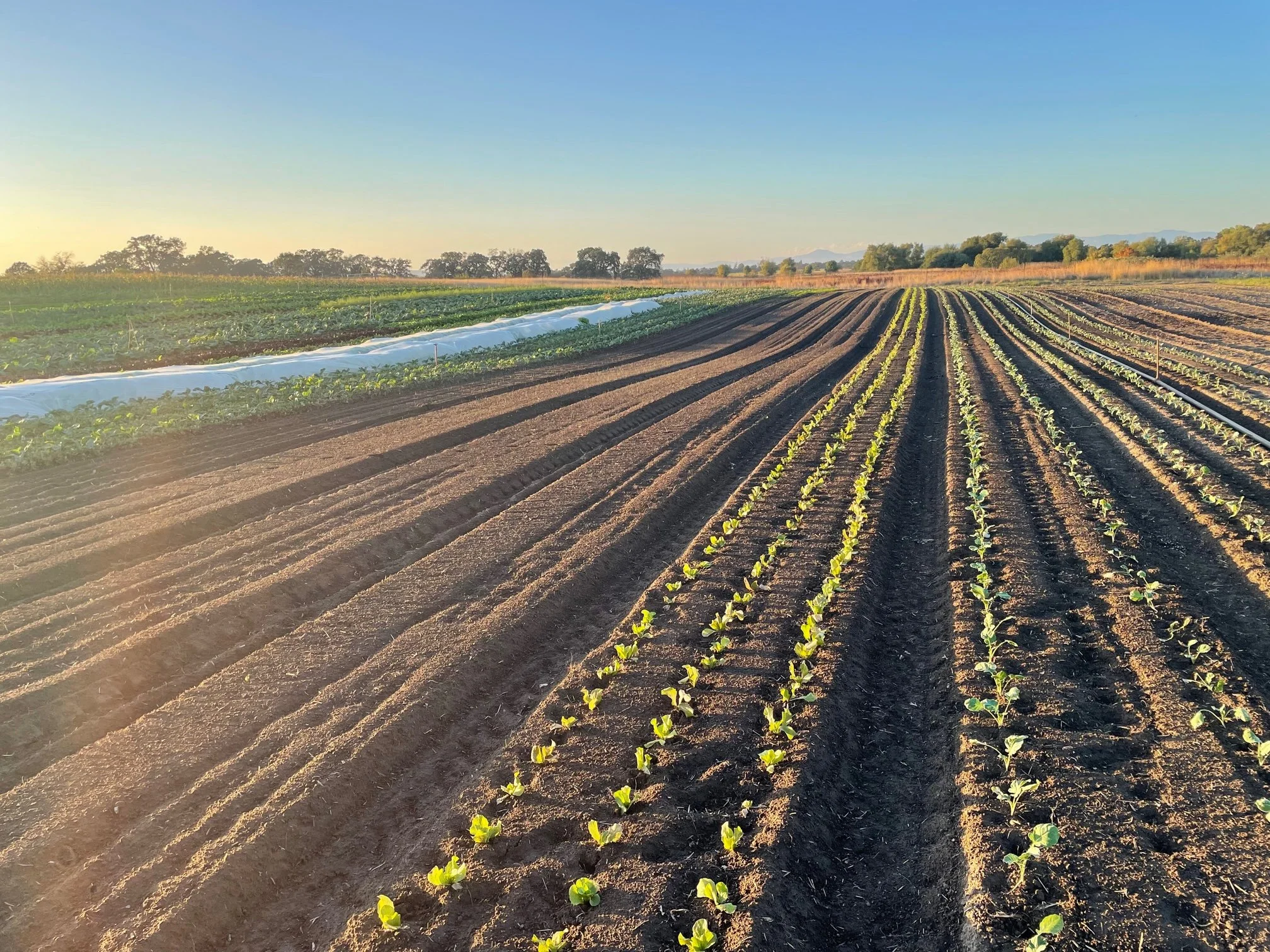
Wednesday - Harvest Day. We woke up to a cool-fog-smoke mix so thick that the sun never seemed to rise. To kill time before harvest, we hoed mustards and lettuce and weeded leeks in a light so dim it was hard to distinguish the colors of the plants. (Good thing we weren’t harvesting tomatoes, we wouldn’t have been able to see their colors.) At 10:00 am we started pulling onions! 6 volunteers, including David’s parents! braved the eerie skies and helped filled bin after bin with large orbs of Zoey Yellow Onions and the last Cabernets. The truck ferried loads back and forth as fast as she could while a separate team laid out the onions carefully to cure in our little greenhouse. (Be sure to take a peek in the little greenhouse — our onion hoard is a sight to behold!) It was our best onion crop ever at GVCFarm, we will be enjoying large beautiful large orbs all the way til mid-December. Thanks, volunteers, for all the help planting, weeding, and harvesting these beauties, this was a community supported bumper onion crop!

Yesterday, we harvested nightshades and squash, prepped beds for our last direct seedings, and transplanted the last Beets, Bok Choi, and 3rd to last Lettuce succession of the year. At the end of the day Kayta sowed Easter Egg Radishes, Fancy Mix, and Arugula and David built a new irrigation line for Fall spinach.

Today, we did our big harvest for Saturday, David had another Santa Rosa adventure scavenging bike rims for the root washer, and after washing, Anna and Kayta planted some Cosmos and Amaranth in the garden and finished trimming our Lorz Softneck Garlic.

And so, life goes on on the farm. We’re keeping our heads down and trying to stay positive in what has to have been one of the most harrowing weeks in memory in California and the West Coast. We hope you are all staying safe. Sending love to you and yours…

See you in the fields,
David for Kayta, Anna & Kate

CLICK HERE FOR AN ARCHIVE OF PAST NEWSLETTERS

9/4/2020 - Week 13 - Let the Big Harvests Begin

THIS WEEK’S HARVEST

Crimson Sweet Watermelon, Celery, Heirloom Tomatoes, Metechi Hardneck Garlic, Curly Kale, Kohlrabi, Rainbow Carrots, Eggplant, Summer Squash & Zucchini, Striped Armenian Cucumbers, Olympian Cucumbers, Green & Purple Daikon, Torpedo Onions (Saturday) & Walla Walla Sweet Onions (Tuesday), Sweet Peppers, Arugula & assorted Head Lettuces

IMG_1029.jpg

U-PICK

Check the u-pick board for updated weekly limits. With the ash settling on produce, we recommend washing all u-pick produce before consumption

  • Albion Strawberries

  • Cherry Tomatoes: See week 10’s newsletter for variety descriptions

  • Frying Peppers: Shishitos, Padróns | See week 5’s newsletter for harvest tips

  • Jalapeños: Located below the Padróns

  • Yellow & Red Thai Hot Peppers: Located next to the Jalapeños

  • Husk Cherries: Located just above the gnome homes in the garden | See Week 9’s Harvest Notes for tips

  • Herbs: Rosemary, Thyme, Tulsi Basil, Italian Basil, Thai Basil, Purple Basil, Oregano, Marjoram, Tarragon, Onion Chives, Garlic Chives, Vietnamese Coriander, Culinary Lavender, Culinary Sage, French Sorrel, Lemon Verbena, Lemon Balm, Perilla & Purple Shiso, Chamomile, Green Coriander

  • New Flowers: There are two new beds of Cosmos and Zinnias blooming right next to the farm strawberries!

IMG_0080.jpg

ONION HARVEST THIS WEDNESDAY 10am

We will be harvesting all the rest of our storage onions this Wednesday starting at 10 am! Come experience the wonder of a pulling up a field of onions. We’ll pull onions and lay them out to cure in our curing greenhouse. Please bring a mask / face covering #COVID.

HARVEST DISTRIBUTION SCHEDULE

  • Saturday pick-up runs from 9:00am - 2:00pm

  • Tuesday pick-up runs from 1:00 pm - 6:00 pm

U-picking is open 7-days a week, sunrise to sunset. Please close the gates behind you on off days.

TOMATO TEAM 2020

Welcome to peak tomato season everyone! All of our heirloom field tomatoes are now fruiting happily — time we introduced you. We hope you fall in love with one of them this year. Tell us which is your favorite!

Top row, left to right: Cherokee Purple, Striped German, Green Zebra, Big Beef | Middle row, left to right: Aunt Ruby’s German Green, Brandywine, Berkeley Tie-dye | Bottom Row: Goldie, Black Krim, Sunrise Sauce Tomato, Speckled Roman Sauce Tomato, G…

Top row, left to right: Cherokee Purple, Striped German, Green Zebra, Big Beef | Middle row, left to right: Aunt Ruby’s German Green, Brandywine, Berkeley Tie-dye | Bottom Row: Goldie, Black Krim, Sunrise Sauce Tomato, Speckled Roman Sauce Tomato, Garden Peach


  • Cherokee Purple: A classic, super productive heirloom tomato particularly good for BLTs

  • Striped German: Arguably the prettiest tomato we grow. Smooth, mellow, fruity flavored.

  • Green Zebra: A delightful, tart and acidic, miniature tomato. Ripe when yellow-green and slightly soft to the touch.

  • Big Beef: Like jeans and a t-shirt, a classic red beefsteak.

  • Aunt Ruby’s German Green: Green turning to yellow when ripe, this tomato is our all-time favorite. First introduced by Ruby Arnold who's German immigrant grandfather saved the seeds. You'll know Aunt Ruby's is ripe when it gives just slightly to the touch.

  • Brandywine: The quintessential pink heirloom, “rich, loud, and distinctively spicy" according to Johnny's Selected Seeds

  • Berkeley Tie-Dye: Dark pink with green stripes with soft and delicate skin. Was developed by the tomato breeding specialists at Wild Boar Farms in Napa.

  • Goldie: David’s personal favorite. A good Goldie (dark orange when ripe) will taste like flowers and melons and go down smooth and sweet.

  • Black Krim: A Russian heirloom often described as having a bold, smoky flavor. Black Krim and Cherokee Purple look quite similar. Black Krim tends to have more pronounced green/brown shoulders.

  • Sunrise: A dense and sweet yellow sauce tomato we are trialing this year.

  • Speckled Roman: An exceptionally delicious sauce tomato with a psychedelic dream-coat. Excellent for fresh eating as well.

  • Garden Peach: A new trial this year. The catalogue said, “Yellow fruits blush pink when ripe and have thin fuzzy skins somewhat like peaches, soft-skinned, juicy and very sweet. Light fruity taste is not what you’d expect in a tomato.” We are still on the fence and interested in your opinion.

Pepper time!

Pepper time!

FARMER’S LOG

LET THE HARVESTS BEGIN

Onions… onions… onions… onions… onions…

That’s what I’ve got on my mind now. Down in the field by the creek, next to the sweet peppers and celery root, we have a gorgeous storage onion crop — fully bulbed up and ready for harvest.

We were going to harvest them all this coming Wednesday, but the record breaking heat in the forecast this weekend has us doing a little pivot! This evening, we are cramming in some bulk harvesting, getting the most ready of the onions, the most flopped over and vulnerable to sunburn, into our curing house. When onions are ready to harvest their greens flop over, which means they are essentially done transpiring, which in turn means they can’t cool themselves in extreme heat. It might be overly cautious, this spontaneous harvest, but this onion crop is our precious-beautiful-baby and we want nothing to harm it.

So it begins. The storage onion harvest is the harbinger of the big Fall harvests. If May and June are all about establishment and planting; and July and August are all about tending, tending, tending; then September and October are all about bringing home the bacon and reaping what you’ve sown. First the onions, then winter squash, then potatoes, then corn It’s going to be an avalanche of goodness in the coming months.

In that spirit… back out to the onions.

See you in the fields,
David for Kayta, Anna & Kate

8/28/2020 - Week 12 - Farming in the Aftermath

THIS WEEK’S HARVEST

Sarah’s Choice Cantaloupes, Celery, Heirloom Tomatoes, Metechi Hardneck Garlic, Rainbow Chard, Cabbage, Komatsuna, Fennel, Rainbow Carrots, Eggplant, Summer Squash & Zucchini, Striped Armenian Cucumbers, Walla Walla Sweet Onions, Sweet Peppers, Hearts Aglow Salad Mix (Mustard Greens, Lettuce Hearts & Bel Fiore Radicchio), Rosaine Little Gems & Muir Summercrisp Lettuce

Peak tomato season is here!

Peak tomato season is here!

U-PICK

Check the u-pick board for updated weekly limits. With the ash settling on produce, we recommend washing all u-pick produce before consumption

  • Albion Strawberries

  • Cherry Tomatoes: See week 10’s newsletter for variety descriptions

  • Frying Peppers: Shishitos, Padróns | See week 5’s newsletter for harvest tips

  • Jalapeños: Located below the Padróns

  • Yellow & Red Thai Hot Peppers: Located next to the Jalapeños

  • Pickling Cucumbers: Gleanings | See week 8’s newsletter for picking instructions and a pickle recipe

  • Husk Cherries: Located just above the gnome homes in the garden | See Week 9’s Harvest Notes for tips

  • Herbs: Rosemary, Thyme, Tulsi Basil, Italian Basil, Thai Basil, Purple Basil, Oregano, Marjoram, Tarragon, Onion Chives, Garlic Chives, Vietnamese Coriander, Culinary Lavender, Culinary Sage, French Sorrel, Lemon Verbena, Lemon Balm, Perilla & Purple Shiso, Chamomile, Green Coriander

  • New Flowers: There are two new beds of Cosmos and Zinnias blooming right next to the farm strawberries!

IMG_0008.JPG

HARVEST NOTES

  • Walla Walla Sweet Onions: A delicate, sweet, fresh-eating onion developed in Walla Walla Washington. These are a delicacy. Try them in a way that you can show them off: Lightly grilled in a good burger or raw in a salad with a delicate dressing. They are so mild, some people even eat them raw like an apple! (We haven’t tried that yet! If you do, let us know how it goes!) Read more about Walla Wallas here.

  • Sarah’s Choice Cantaloupes: The best cantaloupe variety there is… period.

HARVEST DISTRIBUTION SCHEDULE

  • Saturday pick-up runs from 9:00am - 2:00pm (note longer hours on Saturday, old members)

  • Tuesday pick-up runs from 1:00 pm - 6:00 pm

U-picking is open 7-days a week, sunrise to sunset. Please close the gates behind you on off days.

TOMATO TEAM 2020

Welcome to peak tomato season everyone! All of our heirloom field tomatoes are now fruiting happily — time we introduced you. We hope you fall in love with one of them this year. Tell us which is your favorite!

Top row, left to right: Cherokee Purple, Striped German, Green Zebra, Big Beef | Middle row, left to right: Aunt Ruby’s German Green, Brandywine, Berkeley Tie-dye | Bottom Row: Goldie, Black Krim, Sunrise Sauce Tomato, Speckled Roman Sauce Tomato, G…

Top row, left to right: Cherokee Purple, Striped German, Green Zebra, Big Beef | Middle row, left to right: Aunt Ruby’s German Green, Brandywine, Berkeley Tie-dye | Bottom Row: Goldie, Black Krim, Sunrise Sauce Tomato, Speckled Roman Sauce Tomato, Garden Peach


  • Cherokee Purple: A classic, super productive heirloom tomato particularly good for BLTs

  • Striped German: Arguably the prettiest tomato we grow. Smooth, mellow, fruity flavored.

  • Green Zebra: A delightful, tart and acidic, miniature tomato. Ripe when yellow-green and slightly soft to the touch.

  • Big Beef: Like jeans and a t-shirt, a classic red beefsteak.

  • Aunt Ruby’s German Green: Green turning to yellow when ripe, this tomato is our all-time favorite. First introduced by Ruby Arnold who's German immigrant grandfather saved the seeds. You'll know Aunt Ruby's is ripe when it gives just slightly to the touch.

  • Brandywine: The quintessential pink heirloom, “rich, loud, and distinctively spicy" according to Johnny's Selected Seeds

  • Berkeley Tie-Dye: Dark pink with green stripes with soft and delicate skin. Was developed by the tomato breeding specialists at Wild Boar Farms in Napa.

  • Goldie: David’s personal favorite. A good Goldie (dark orange when ripe) will taste like flowers and melons and go down smooth and sweet.

  • Black Krim: A Russian heirloom often described as having a bold, smoky flavor. Black Krim and Cherokee Purple look quite similar. Black Krim tends to have more pronounced green/brown shoulders.

  • Sunrise: A dense and sweet yellow sauce tomato we are trialing this year.

  • Speckled Roman: An exceptionally delicious sauce tomato with a psychedelic dream-coat. Excellent for fresh eating as well.

  • Garden Peach: A new trial this year. The catalogue said, “Yellow fruits blush pink when ripe and have thin fuzzy skins somewhat like peaches, soft-skinned, juicy and very sweet. Light fruity taste is not what you’d expect in a tomato.” We are still on the fence and interested in your opinion.

FARMER’S LOG

FARMING IN THE AFTERMATH

This past week had us all thinking apocalyptic thoughts again. A smoke red sun will do that. 

Whether evoked by current events or not, apocalyptic reveries are, it seems, a recurring obsession of human imagination across cultures. Why? Perhaps because they tell us about ourselves. Imagining an extreme future holds a mirror to the present. What is important to us? What is essential? What are we afraid of? What luxuries do we take for granted? 

Every fire season we think apocalyptic farm thoughts. Assuming we were all still here and had to eat, how would GVCFarm have to change and adapt after the breakdown of most or all of the supply chains that sustain it now? 

We tossed this admittedly unreasonable subject around the other day in the carrots. The conversation was illuminating — not as exercise in science fiction or doomsday thinking, but because it taught us about the farm now. The subjects we honed in on were seeds, poop, labor and motive power. 

IMG_0739.jpg

SEED SAVING

Seed saving is a beautiful task. You lovingly grow something until it matures. You select the most beautiful and store it with care. You give some to friends. The seed ties you to past seasons — to past generations — to time itself. You repeat the cycle — a cycle of love and discipline — each year.

We save some seed at Green Valley Community Farm. We’ve been saving the Hopi Blue Corn seed we plant for several years now. We’ve been saving our big Lorz Garlic seed for a few years — it looks better every harvest. We’ve occasionally saved seed potato. Kayta has been saving several flower seeds from the garden: Nigella, hollyhock, agrostemma — last year, Sora, Ahn, and Tuli helped gather the celosia you see blooming today. 

But most of the vegetables we grow we do not save seed from. Why?

First, time and space management. Seed saving is a meticulous, labor intensive craft and takes special equipment. Seed saving also ties up field space as you allow lettuce, for example, to grow, flower, and make seed a month and a half after the delicious head has passed. We pay other farmers for seeds because then we can devote more of our limited space and time to the food part of farming.

Secondly, saving our own seed would mean we couldn’t offer nearly the diversity we do. This is because of cross pollination. The cross pollination of two different varieties of the same species creates a vigorous hybrid that 9 times out of 10 is not yummy to eat. The carefully isolated genetics in open-pollinated food crops is why a lot of heirloom varieties have place names. Marina di Chioggia winter squash, for example, comes from a certain region of Italy. People from that region started to fall in love with a certain sweet pumpkin. Farmers grew fields of them in isolated patches, and slowly the region developed a fairly consistent strain of squash that became a local staple. If we saved seed from our Marina di Chioggia, which is currently being grown next to 8 other varieties of winter squash originating from other other regions, what we would get would end up next year would possibly be bitter, hard skinned, and ugly!  

So the vast, and relatively affordable modern seed exchange we have access to allows us to grow 10 different brassica varieties in the same field at the same time. GVCFarm is a product of modern times in this way. We take advantage of the access to the world’s library of seeds at our fingertips to grow an extreme amount of diversity in our fields. In this way we are deeply connected to myriad regions, farms, and farm workers devoted to growing vegetable seeds for market vegetable farmers like us. 

After the apocalypse we’d have to focus. We’d have to drop sweet corn in favor of massive field of hardy Hopi Blue to feed us through the winter. We’d have to choose a brassica, possibly a hardy turnip to harvest both for storage and for cooking greens. We’d gather tomatoes from the healthiest Aunt Ruby’s German Green. We’d let those tomatoes rot and ferment. We’d dry the seeds and store them away safe. We’d trade with neighbors doing the same.  

If you could only pick one squash to save in your family for generations, which seed would you start with?

POOP

But before we even thought about planting seeds we’d be thinking about poop. 

Similar to seeds, a functional modern supply chain gives modern farmers like us cheap and easy access to the poop of other farmers (err.. their animals). For a very reasonable price, you can go to a warehouse in Roseland, or call up Adam in Cloverdale, and within 24 hours get 24 tons of compost delivered; or 500 lbs the dried, processed, neatly packaged, and potent manure of Petaluma chickens loaded into the back of your truck.

This is all because of cheap energy, which we will get to next.  

In the olden times, or the end times as it were, the amount of energy involved in mixing that compost (D9’s) or processing and shipping that chicken poo, would not be possible. Indeed, a post apocalyptic Green Valley Community Farmers would be obsessed with poop. 

We would capture human manure in carefully managed composting toilets that we’d spread on fields and pastures (after a long ferment for sure). In fact, we would encourage, possible demand that you, dear members, poop here rather than at home. We would trade Aubrie and Scott handsomely for cow manure, and each month venture into their meadows with a giant pooper scooper, harvesting the fertile gold.

In order to sustain the level of vegetable production we do, we would need many more human hands managing many more animals, and their poops, and funneling them into piles and then into the fields. We would all miss our washing machines greatly. 

LABOR AND MOTIVE POWER

We never think apoco-thoughts more viscerally than during the power outages. For a farm reliant on electric power to irrigate — if feels a little bit like having a knife to your throat. 103 degree heat, no electricity, and a field of baby brassicas = not comfortable. We have a generator (as of this week) in for those emergencies, but in our imagined future we’d have no fossil fuels to power that generator.

That’s where things get really interesting. Indeed, our farm — and our society — without fossil fuels would be hard to recognize. But I think it would be beautiful. Farm and tend land we would still.

For starters, all of our irrigation would be done with gravity. We would “flood irrigate”, as so many of our ancestral cultures did, releasing water from the pond above the farm through careful canals and into the fields. Because this method of irrigation would limit the crops amenable to this arid climate, gone would be the lettuce and arugula of August, relegated now, perhaps, to a short fling of succulent greens in the early early Spring. We would forage for our greens and herbs in the creek beds and wetlands. Our fields would focus on the hardy, deep rooted staples amendable to flood irrigation: Potatoes, corn, winter squash… some hardy roots. We would plant fruit and nut trees and look to the indigenous people and the indigenous foodways of California. We would tend oaks religiously. 

When we did prep a valley field for food, we would all do it together. Gone would be the luxury of a Kubota L2650 doing the day’s work of a village in one hour. Green Valley Community Farm members would become Green Valley Community Farm farmers. The horse and mule and donkey would rule again. 

The reason why 95% of humans were, before the industrial revolution, involved in agriculture is because that is how many human bodies and human hands it takes to tend landscapes without fossil power.  

IN CONCLUSION

It struck us, in the carrots, tossing around this imagined future both how close and how far we are from it. Our modern luxuries can feel like a thick, insurmountable wall between us and both the pain and the deliverance of a new future. 

In reality, they offer only a thin veil between paradise and hell. Perhaps, by imagining the end, we can glean its lessons and guide our technologies and ourselves toward paradise — toward simplicity, grace, and balance.

The veil is very thin…

See you in the fields.
David for Kayta, Anna & Kate.