8/24/2020 - Week 11 - Lightning Complex Fires

HARVEST PICK-UP RESUMES TUESDAY, AUGUST 24th

We will be resuming CSA pick-up as normal starting tomorrow, Tuesday, Aug 24th. For folks who don't usually go to the Tuesday pick-up our hours are 1pm - 6pm. U-pick is open 7 days a week, sunrise to sunset as normal.

ROAD CLOSURES: Highway 116 from Forestville to Guerneville is currently closed due to the Wallbridge Fire and Green Valley road cannot be accessed from that direction. Use the southeastern Green Valley Rd. entrance closer to Graton & Sebastopol to access the farm.

WASHING PRODUCE: We wash our greens after harvest. We do not wash things like tomatoes, eggplant, squash, cucumbers. Because of the ash settling on the crops, we recommend washing all pre-harvested greens and produce again at home and washing your u-pick produce before consumption.

THIS WEEK’S HARVEST

Sarah’s Choice Cantaloupe Melons, Celery, Heirloom Tomatoes, Metechi Hardneck Garlic, Rainbow Chard, Kohlrabi, Carrots, Assorted Eggplant, Summer Squash & Zucchini, Lemon Cucumbers, Striped Armenian Cucumbers, Walla Walla Sweet Onions, Salad Mix (Arugula & Mustard Greens), Little Gems & Red Butter Lettuce

Rain or shine, fire or ash, the melons do not wait

Rain or shine, fire or ash, the melons do not wait

U-PICK

Check the u-pick board for updated weekly limits. With the ash settling on produce, we recommend washing all u-pick produce before consumption

  • Albion Strawberries

  • Cherry Tomatoes: See Week 10’s Newsletter for variety descriptions

  • Frying Peppers: Shishito, Padrón / See Week 5’s Newsletter for harvest tips

  • Jalapeños: Located below the Padróns

  • Yellow & Red Thai Hot Peppers: Located next to the Jalapeños

  • Pickling Cucumbers: Could be the last week. If you haven’t pickled yet, now is the time! 5 gallon per share season limit. See Week 8’s newsletter for picking instructions and a pickle recipe

  • Wild Blackberries See Week 9’s Harvest Notes for tips on bramble locations

  • Husk Cherries: Located just above the gnome homes in the garden. See Week 9’s Harvest Notes for harvest tips

  • Herbs: Rosemary, Thyme, Tulsi Basil, Italian Basil, Thai Basil, Purple Basil, Oregano, Marjoram, Tarragon, Onion Chives, Garlic Chives, Vietnamese Coriander, Culinary Lavender, Culinary Sage, French Sorrel, Lemon Verbena, Lemon Balm, Perilla & Purple Shiso, Chamomile, Green Coriander

IMG_0696.jpg

HARVEST DISTRIBUTION SCHEDULE

  • Saturday pick-up runs from 9:00am - 2:00pm (note longer hours on Saturday, old members)

  • Tuesday pick-up runs from 1:00 pm - 6:00 pm

U-picking is open 7-days a week, sunrise to sunset. Please close the gates behind you on off days.

FARMER’S LOG

Our thoughts are with our numerous members and friends who live North of the farm along the Russian River and Northeast in Healdsburg. We hope this finds you all safe and spared from the worst of these terrible fires. Your farm and your farmers are thinking of you, and we are here to nourish you now, when the smoke clears, and beyond…

It has been a surreal week on the farm. We had a restless night last Sunday, listening to an electrical storm and August rain that no-one can remember the likes of. After dozing off to rolling thunder, Kayta and I were awoken at 5am by the clap of a lightning strike on the ridge across the street. Our astute neighbor tracked down the stricken tree and firefighters put out a smoldering blaze in a matter of hours.

On Monday, Kate, Sora and I harvested Torpedo Onions in our rain jackets and watched forks of lightning ripple in the Eastern sky. We thought of taking cover but the lightning stayed far away. Because of the rain and the level of moisture in our onion beds, we thought (hoped) maybe Sonoma County had been spared the worst.

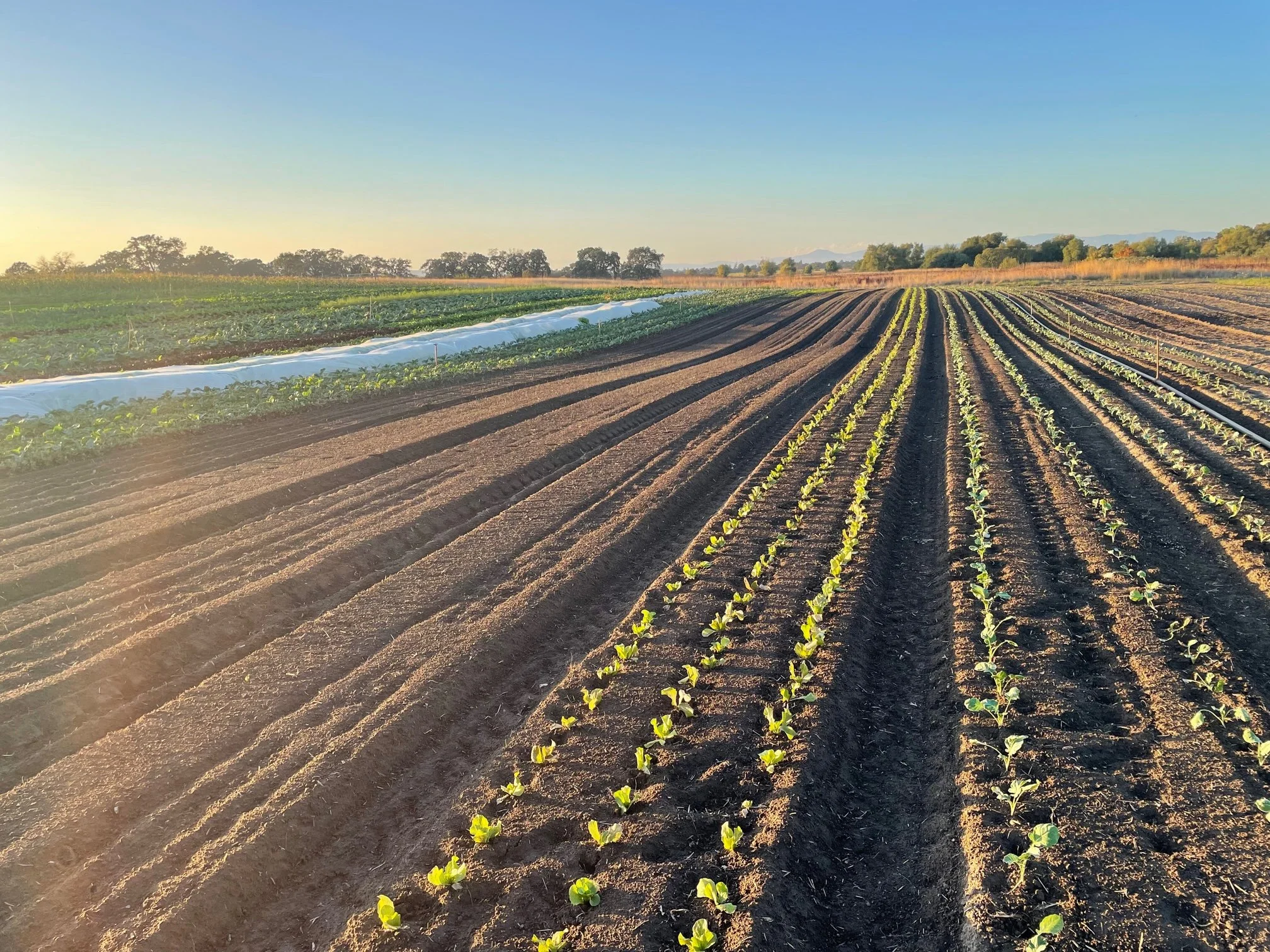
Watering in the last big Fall transplanting of the year

Watering in the last big Fall transplanting of the year

Smoke and news of the myriad blazes begin to roll in Tuesday. On Wednesday we heard news of neighbors and members to the North and East being forced to evacuate. We ran to Harmony Farm Supply to get electric solenoid valves so that in case of evacuation the crops would still get water. On Thursday the crew powered through the last large field translating of the year: Beets, Dandelion, Collards, Kale, and Cauliflower in the thick smoke of the Wallbridge Fire.

Friday morning around 10am, mid-harvest, our “zone” was placed on Evacuation Warning, with the fire moving slowly down just 6 miles to the North. We decided to halt harvest to prep our house and the farm for evacuation.

Mind you, this is all while going through the regular motions tending future food — seeding lettuce; watering the greenhouse, direct seeding, checking moisture in the fields. We have been through this before, with the Tubbs firestorm of 2017, 2018’s camp fire smoke, 2019’s evacuation. We’ve done the work in masks, replaced the music with KRSO, watched the fine ash coat the leaves. But in truth, we’ve never farmed through something like this so early in the season, with so much left to do, with so much still to be tended and enjoyed: The tomatoes just starting to explode; potatoes approaching harvest; winter squash coloring up vividly; corn ears swelling; baby transplants going in the ground.

A lot is unknown. I would be lying if I said we weren’t scared. When will our members be able to return home? When will the smoke clear? How can we take care of the farm and our lungs?

Some things might be a little funky on the farm as we sort through these questions: Less items to choose from at pick-up as we cut out early to avoid hazardous air; collapsing cherry tomatoes as we prioritize other things; ash on the dahlias.

But one thing we do know is that this community is immensely caring and resilient. Flowers will still open; the cherry tomatoes will ripen in great clusters; bees will still forage; and great abundance and great friendship still await us in the fields.

See you out there,
David and Kayta

8/15/2020 - Week 10 - "The Peace of Wild Things"

THIS WEEK’S HARVEST

Galia Melons, Assorted Eggplant, Early Tomatoes, Metechi Hardneck Garlic, Red Russian Kale, Cabbage, Fennel, White Satin Carrots, Summer Squash & Zucchini, Poblano Peppers, Lemon Cucumbers, Striped Armenian Cucumbers, Fresh Torpedo Onions, Purple Box Choi, Salad Mix (Arugula, Lettuce + Mustard Greens), Cherokee Summer Crisp Lettuce and Baby Iceberg Lettuce

Early AM harvest to beat the heat

Early AM harvest to beat the heat

U-PICK

Check the u-pick board for updated weekly limits

  • Wild Blackberries See Week ‘s newsletter for harvest locations

  • Husk Cherries: Located just above the gnome homes in the garden. See Week 9’s newsletter for harvest tips

  • Amethyst Green Beans

  • Albion Strawberries

  • Pickling Cucumbers: 5 gallon per share season limit. See Week 8’s newsletter for picking instructions and a pickle recipe

  • Cherry Tomatoes: See below for tips

  • Frying Peppers: Shishito, Padrón / See Week 5’s Newsletter for harvest tips

  • Jalapeños: Located below the Padróns

  • Yellow Thai Hot Peppers: Located next to the Jalapeños

  • Herbs: Rosemary, Thyme, Dill, Tulsi Basil, New Italian Basil, Thai Basil, Purple Basil, Oregano, Marjoram, Tarragon, Onion Chives, Garlic Chives, Vietnamese Coriander, Culinary Lavender, Culinary Sage, French Sorrel, Lemon Verbena, Lemon Balm, Perilla & Purple Shiso, Chamomile, Green Coriander, Mints, Anise Hyssop

HARVEST NOTES

  • Yellow Thai Hot Peppers: Our Yellow Thai Peppers are ready for some harvesting. These are HOT and flavorful with a hint of citrus. Pick the yellow ones (low on the plant) and let the green ones remain to ripen. Kate, our resident Thai cooking master, gave us this amazing special sauce recipe using these peppers — see below.

  • Fresh Torpedo Onions: These onions are mild and delicate. Use like a normal onion or try slicing very thin and using raw.

  • Green Coriander: When Cilantro goes to flower it starts making seed — the green seed pods are Green Coriander. Green Coriander is used in a bunch of different cuisines. Try a taste, and try using some in the Thai Special Sauce recipe below!

WEE’S THAI PEPPER SPECIAL SAUCE

IMG_9623.JPG

Ingredients:

  • 4-5 cloves of garlic 

  • 1 TBS minced ginger

  • 1 Yellow Thai Pepper*

  • 1/2 cup cilantro (roughly chopped , stem and all — we are between Cilantro successions, try using the Green Coriander in the garden or the Vietnamese Cilantro)

  • 5 TBS fish sauce (or soy sauce if vegetarian) 

  • 6-7 TBS lemon juice 

  • 1-2 TBS brown sugar (optional) 

Add all ingredients in a blender and blend until smooth. Put in a jar and store in the fridge. Great as a dipping sauce, marinade, or add oil to make dressing for a salad or slaw! 

* I used one whole large pepper with the seeds and ended up with a medium-hot spice level but you could remove the seeds if you want it to be more mild or add more peppers for more spice!

LOOKING FOR VIVIAN HOWER

Congratulations to Vivian Hower the winner of our Flower Share raffle drawing! If Vivian was a guest of yours at the farm, please have her get in touch with us to claim her prize — we do not have her contact info.

Thanks to everyone who participated in the raffle — we were able to raise $440 in support of Kiley’s farm capital fundraiser. If you missed the raffle but would like to support the creation of a Black led, regenerative farm, you can donate directly to Kiley’s GoFundMe campaign by clicking here.

2020 CHERRY TOMATOES

The first tomatoes in our u-pick cherry tomato path are just starting to ripen. This week’s slow trickle will become a deluge of sun sweetness in just a couple of weeks.

Here is a brief synopsis of the six varieties of cherry tomato we planted this year.

Top row, left to right: Pink Princess, Copper Beauty, Sungold // Bottom row, L to R: Supersweet 100, Pink Bumblebee, Green Zebra

Top row, left to right: Pink Princess, Copper Beauty, Sungold // Bottom row, L to R: Supersweet 100, Pink Bumblebee, Green Zebra

Note: Like the sugar snap peas, the first ripe ones will be found very low on the plants, near the ground, and they will ripen higher and higher up as the season progresses.

  • Supersweet 100: A classic red cherry tomato for a shock of red sweet tang in your salad. Ripest when deep scarlet red. The secret to Supersweet’s is to leave them out on the counter for a day or two after you pick them — they sweeten up off the vine.

  • Copper Beauty: We fell in love with this one last year. A gorgeous, oblong variety. Mellow, very low acid, sugar sweet. Ripe when auburn red, with copper gold streaks. These are slower to ripen, lots of green fruit now, just a few are ready.

  • Pink Princess: Developed by an oxen-driving, seed-saving wizard in Massachusetts, this gem is becoming a GVCFarm favorite. These seeds are very hard to find so we only have a few plants this year. Mellow, slightly grapfruited flavored, quirky sizes and egg shapes, in a firm, matte, soft pink skin. Ripe when pink.

  • Sungold: The sun... captured. An unbeatable classic. Ripe when deep orange. Candy sweet, super productive, it's not really summer until you've had a handful of Sungolds.

  • Pink Bumblebee: This beauty is one we’re trialing this year. They are ripe when pink with golden stripes. Let us know how you like them!

  • Green Zebra: We usually grow these in our field tomatoes that we harvest but they put out so many small ones we thought we’d put them in the cherry tomatoes this year. Skip the big ones, we’ll pick them for you. A perennial favorite, this beautiful, striped green tomato is ripe when it’s usual light green tinge shifts to yellow, stripes turn dark green, and is slightly soft to the touch. For people who like a tangy tomato this is a favorite.

ADD-ONS

  • Revolution Bread: Fresh bread is back this week!

  • Moonfruit Mushrooms: Limited quantities of shiitakes available this week. First come first serve out of the fridge next to the bread. Cash only.

  • Bramble Tail Homestead Creamery: Stocked with pastured eggs, Bramble Tail frozen yogurt, 100% grass-fed beef, Green Star chicken, Oz Family Farm heritage rabbit and more. Become a member of the weekly dairy herdshare by emailing Aubrie at brambletailhomestead@gmail.com.

  • The Marketplace: Stocked with Froyo, coffee, soaps, honey, Moonfruit Mushroom dressing and seasoning, beverages, and much much more. Across from the Bramble Tail Creamery.

VOLUNTEER WEDNESDAYS

Need some farm therapy? Come out for our weekly volunteer morning. Find us in the garden or fields from 9am - 11am on Wednesday mornings and we’ll find a nice, socially distant thing for you to do to beautify the farm and garden. All ages and abilities welcome!

FARMER’S LOG

The Peace of Wild Things
by Wendell Berry

When despair for the world grows in me
and I wake in the night at the least sound
in fear of what my life and my children’s lives may be,
I go and lie down where the wood drake
rests in his beauty on the water, and the great heron feeds.
I come into the peace of wild things
who do not tax their lives with forethought
of grief. I come into the presence of still water.
And I feel above me the day-blind stars
waiting with their light. For a time
I rest in the grace of the world, and am free.

Animals of West Marin.jpg

See you in the fields,
David and Kayta

8/7/2020 - Week 9 - Farm Pests

THIS WEEK’S HARVEST

Galia Melons, Assorted Eggplant, Early Tomatoes, Metechi Hardneck Garlic, Dino Kale, Kohlrabi, Purple Daikon Radish, Loose Carrots, Summer Squash & Zucchini, Lemon Cucumbers, Green Magic Broccoli, Fresh Onions, Salad Mix (Chicory + Lettuce + Mustard Greens), Arugula, Cegolaine Little Gem and Rouxai Oak Leaf Lettuce

Orange “Sulfur” Cosmos and bumble bee enjoying the evening sun

Orange “Sulfur” Cosmos and bumble bee enjoying the evening sun

U-PICK

Check the u-pick board for updated weekly limits

  • 🚩Wild Blackberries See below for tips

  • 🚩Husk Cherries: Located just above the gnome homes in the garden / See below for tips

  • Amethyst Green Beans

  • Albion Strawberries

  • Pickling Cucumbers: 5 gallon per share season limit. See Week 8’s newsletter for picking instructions and a pickle recipe

  • Cherry Tomatoes: See below for tips

  • Frying Peppers: Shishito, Padrón / See Week 5’s Newsletter for harvest tips

  • Jalapeños: Located below the Padróns

  • Herbs: Rosemary, Thyme, Dill, Tulsi Basil, New Italian Basil, Thai Basil, Purple Basil, Oregano, Marjoram, Tarragon, Onion Chives, Garlic Chives, Vietnamese Coriander, Culinary Lavender, Culinary Sage, French Sorrel, Lemon Verbena, Lemon Balm, Perilla & Purple Shiso, Chamomile, Cilantro, Mints, Anise Hyssop

HARVEST NOTES

  • Husk Cherries: Also known as cape gooseberries, or ground cherries; these are a delightful, extremely sweet little nightshade fruits wrapped inside a cool little "wrapper". Kids love them. Just peel the papery wrapper off and pop them in your mouth! Husk Cherries are ripe when the wrapper is golden or white and the fruit is yellow. (Green = unripe). Look low down under the canopy of leaves for the ripe ones. In fact, the ones fallen to the ground are often the sweetest. Located just above the gnome homes.

  • Wild Blackberries: Offering wild blackberries to someone in Sonoma County at this time of year is like offering sand to someone at the beach. But if you live in an area without good access to wild blackberry brambles, we’ve got some good ones here on the farm! They are are starting to go off and you're welcome to pick them. The best patches are located in the Northeast back fence-line, behind the fields; if you’re standing at the head of the cherry tomato rows facing east, they are to your left devouring the far fence.

  • Galia Melons: Originally developed by growers in Israel, Galia melons were the first hybrid of intensely perfumed Middle Eastern melons. The Galia melon looks like a cantaloupe on the outside and a honeydew on the inside. Its light green, smooth-textured flesh, and honey sweet.

  • Green Magic Broccoli: We aim for our broccoli plantings to last two harvest weeks — but because of the heat last week, this patch of broccoli is coming on hard and fast. Unlimited in-bag broccoli this week!

  • Kohlrabi: These little aliens coming out of Field 5 are the best tasting Kohlrabi we’ve ever grown: Super sweet, buttery, crispy brassica goodness. Delicious raw eaten with dip or on salads; or sautéed with soy sauce, garlic and ginger. Kohlrabi is a relative of cabbage and broccoli.

  • New Italian Basil: There is a beautiful patch of new Italian Basil ready for picking on the West Side of the garden above the orange Cosmos.

  • Flower Garden: Try incorporating the white-purple, delicate cilantro flowers in your bouquet this week — they hold up great in a vase and are stunning. Make sure to visit the orange “Sulfur” Cosmos on the West side — they have just exploded in bloom. Also, the seed pods on the old agrostema (East side) and Nigella (West side) work great in a bouquet and dry beautifully.

FLOWER SHARE RAFFLE WINNER: VIVIAN HOWER!

Congratulations to Vivian Hower the winner of our Flower Share raffle drawing! Welcome to the flower garden, Vivian! If Vivian was a guest of yours at the farm, please have her get in touch with us to claim her prize — we do not have her contact info.

Thanks to everyone who participated in the raffle — we were able to raise $440 in support of Kiley’s farm capital fundraiser. If you missed the raffle but would like to support the creation of a Black led, regenerative farm, you can donate directly to Kiley’s GoFundMe campaign by clicking here.

Top row, left to right: Pink Princess, Copper Beauty, Sungold // Bottom row, L to R: Supersweet 100, Pink Bumblebee, Green Zebra

Top row, left to right: Pink Princess, Copper Beauty, Sungold // Bottom row, L to R: Supersweet 100, Pink Bumblebee, Green Zebra

2020 CHERRY TOMATOES

The first tomatoes in our u-pick cherry tomato path are just starting to ripen. This week’s slow trickle will become a deluge of sun sweetness in just a couple of weeks.

Here is a brief synopsis of the six varieties of cherry tomato we planted this year.

Note: Like the sugar snap peas, the first ripe ones will be found very low on the plants, near the ground, and they will ripen higher and higher up as the season progresses.

  • Supersweet 100: A classic red cherry tomato for a shock of red sweet tang in your salad. Ripest when deep scarlet red. The secret to Supersweet’s is to leave them out on the counter for a day or two after you pick them — they sweeten up off the vine.

  • Copper Beauty: We fell in love with this one last year. A gorgeous, oblong variety. Mellow, very low acid, sugar sweet. Ripe when auburn red, with copper gold streaks. These are slower to ripen, lots of green fruit now, just a few are ready.

  • Pink Princess: Developed by an oxen-driving, seed-saving wizard in Massachusetts, this gem is becoming a GVCFarm favorite. These seeds are very hard to find so we only have a few plants this year. Mellow, slightly grapfruited flavored, quirky sizes and egg shapes, in a firm, matte, soft pink skin. Ripe when pink.

  • Sungold: The sun... captured. An unbeatable classic. Ripe when deep orange. Candy sweet, super productive, it's not really summer until you've had a handful of Sungolds.

  • Pink Bumblebee: This beauty is one we’re trialing this year. They are ripe when pink with golden stripes. Let us know how you like them!

  • Green Zebra: We usually grow these in our field tomatoes that we harvest but they put out so many small ones we thought we’d put them in the cherry tomatoes this year. Skip the big ones, we’ll pick them for you. A perennial favorite, this beautiful, striped green tomato is ripe when it’s usual light green tinge shifts to yellow, stripes turn dark green, and is slightly soft to the touch. For people who like a tangy tomato this is a favorite.

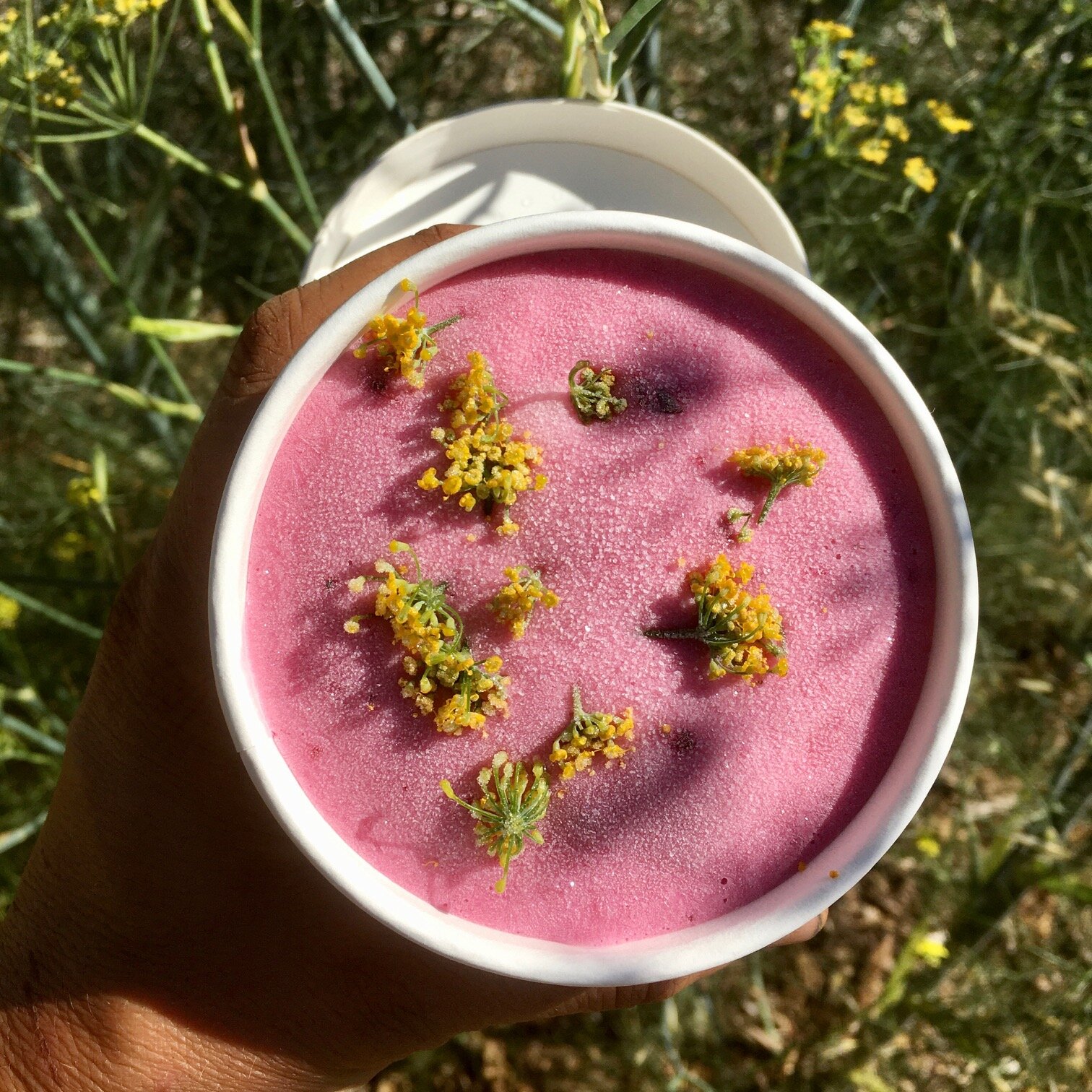
Blackberry fennel fro-yo! Always pays to check the Marketplace and Creamery to see what fro-yo flavors Kim and Aubrie have in store.

Blackberry fennel fro-yo! Always pays to check the Marketplace and Creamery to see what fro-yo flavors Kim and Aubrie have in store.

ADD-ONS

  • Revolution Bread: Fresh bread is back this week!

  • Moonfruit Mushrooms: Limited quantities of shiitakes available this week. First come first serve out of the fridge next to the bread. Cash only.

  • Bramble Tail Homestead Creamery: Stocked with pastured eggs, Bramble Tail frozen yogurt, 100% grass-fed beef, Green Star chicken, Oz Family Farm heritage rabbit and more. Become a member of the weekly dairy herdshare by emailing Aubrie at brambletailhomestead@gmail.com.

  • The Marketplace: Stocked with Froyo, coffee, soaps, honey, coffee, Moonfruit Mushroom dressing and seasoning, beverages, and much much more. Across from the Bramble Tail Creamery.

VOLUNTEER WEDENSDAYS

Need some farm therapy? Come out for our standing volunteer morning. Come find us in the garden or fields from 9am - 11am on Wednesday mornings and we’ll find a nice, socially distant thing for you to do to beautify the farm and garden. All ages and abilities welcome!

FARMER’S LOG

“PESTS” ON THE FARM

Well, the crazy Turkeys are back at it. This week was supposed to be a week of Romaine lettuce and “Deer Tongue” Little Gems, but dang-it the Turkeys do seem to love green lettuce!

Fortunately, the fields and garden we tend here are home to many many friends. Unfortunately, some of them fancy the human food we grow as much as we do —  but neglect to sign-up for a CSA share! Fortunately, due to the wildness of this place, these “pests” are kept relatively in check by myriad lifeforms that fancy to eat them. Unfortunately, the pests still cause semi-severe losses and your farmers must muster a resistance.

We thought we’d talk this week about pests and their management on the farm. For organization’s sake, we’ll start with the biggest and go down to the smallest.

*  *  *  *  *

Turkeys: Aye, the Turkeys. We love them. They are chunkiest pests at Green Valley Community Farm. Turkeys are a non-native species in California and they seem to be have a strong foothold in Sonoma County — at least in this valley! They are beautiful, intelligent creatures with intricate and seasonally changing social networks. They are omnivores, and cruise the landscape morning and evening, browsing for seeds, insects, the occasional frog, and juicy leaves. Most of the year we live in happy co-habitation with our fine feathered friends. They eat weed seeds, cucumber beetles and pill bugs for us just feet from our Spring lettuce and couldn’t care less about it. Once the “Dog Days” of summer come and the landscape dries out, however, they start to re-think the that juicy lettuce. We usually look the other way and don’t mind a lost lettuce or two or twenty. But sometimes it gets bad. Over the last couple weeks the Turkeys annihilated a months worth of lettuce. (Lucky we have been over-planting it.) As for keeping the turkeys in check, we have tried everything — from running and screaming like a crazy person to a plastic coyote that scared more people than turkeys to warning shots. Unfortunately it seems the only thing that keeps them away from the crops for an extended period is to shoot to kill. We usually have to kill one or two Turkey’s a year.

Gophers: The next (dimensionally) largest “pest” on the farm is the mighty gopher. There is an old NorCal adage that gophers are what chased the Russians away from Fort Ross. Lucky for us, Green Valley Community Farm lies mostly in a wet valley that sees long periods of standing water in the winter. Gophers, therefore, cannot make year-round runs in our main fields. They do tunnel there in the dry months and cause a fair bit of damage, but winter rains flood whatever inroads they make so they live in higher concentrations up in the hills. Also lucky for us, Green Valley Community Farm is a wild place and we have tons of gopher predators: Coyotes digging for them at night and bobcats pouncing; hawks, kestrels, and owls swopping from above; gopher snakes spelunking their burrows. In 2018, a Great White Egret named Ingrid took up residence on the farm from August through December and ate two or three gophers a day! We miss you, Ingrid!

 
Mice in Nest.jpg
 

Rats and Mice in the Greenhouse: We flew under the radar our first two years here, but starting last year, rats and mice eating seeds and seedlings from our greenhouse trays became a huge problem. We lost nearly two melon successions to them. Over the winter we brought in two feral cats from the Sonoma County organization “Forgotten Felines". Since then, we have had ZERO problems. Thanks, Meeko and Goose, we love you!

Slugs: On which day of creation were slugs created? Monday morning!? Just kidding, slugs are beautiful in their own special way (to other slugs?). Slugs get crazy for us in the Spring and late Fall, which is when their populations surge due to moisture. In the Spring we must put down “Sluggo”, an organic iron phosphate pellet in order to germinate carrots, otherwise they would all get gobbled up. Other than that, it’s live-and-let-live with the pretty little slugs and the ugly little holes they make on the bottom of our lettuce. Big props to all the frogs on the farm enjoying slug escargot.

Insects: Our insect pests offer a textbook example of the natural ecology of food sources. Our first year we had very few classic garden insect pests. The farm had been fallow for a couple years and their populations were scant. As soon as we started planting they started eating… and breeding…and now we have flea beetles and cucumber beetles in good supply — but less, I think, than other farms because of our relatively wild location. Flea beetles, for example, who feed on brassicas and make the little pin holes on the arugula and mustard greens, are relatively low here. This may be because we aren’t close to a large vineyard. A lot of local vineyards plant mustard as a cover crop in the winter for its anti-fungal properties. Large flea beetle populations over-winter on this cover crop. Come Spring, the vineyards mow the mustard, and the flea beetles jump on the nearest kale, broccoli, or cabbage they can find! Singing Frogs farm, next to a large Dutton vineyard, has a famously epic Spring flea beetle attack when Dutton mows. We’re lucky to have just a normal attack. As for the cucumber beetles (who look like green ladybugs), they would do a lot of damage were it not for the organic Kaolin clay (that white stuff) we spray on all our new cucurbit plantings until the plants grow strong enough to repel them on their own. And, again, the myriad birds, frogs, lizards, turkeys, and predatory insects who feed on the pest insects help us so much. One of the most beautiful things to watch on the farm is the swarms of swallows and dragonflies swooping over the fields and feeding on insects in the evenings.

Garden Symphylans: They who shall not be named. Of all the antagonists written about above, none are smaller and none are scarier than the garden symphylan. Garden symphylans are quarter-inch long, blind, super fast-crawling, soil dwelling arthropods that look like tiny white centipedes. They thrive in soils with high organic matter, good soil structure, and earth worms (for they cannot dig  themselves). They feed on decaying organic matter and, tragically, the fine white root hairs of growing plants. In high enough concentrations they annihilate everything growing in their biosphere, even weeds. We have garden symphylans in high concentrations in fields 1 and 3. Like a photo-negative, they are where the crops are not. In our 200 foot bed of Purple Daikon this year, 100 feet grew happily, the other 100 feet was bare ground. Not even any weeds. Garden symphylans cause more crop loss, affect the harvest share, and determine the placement of our plantings more than any other creature on the farm. They responsible for why we haven’t had more Beets and Celery yet this year. Unfortunately, there are no known biological, organic, or even inorganic controls for garden symphylans. We are in decent company, both Santa Rosa Junior College’s Shone Farm and UCSC’s Farm have them. One known plant deterrent is potatoes (they do not eat potato roots). That is why we planted potatoes where we did this year — in an area hard hit by them last year.  And so, we will continue to experiment with plant allies as deterrents in our dance with the little white ghosts of Green Valley Community Farm.

*  *  *  *  *

Hopefully wild pigs don’t cross the Russian River because that’s all folks — a pretty short list of other beings that we must vie with for Green Valley Community Farm fare!

In the end, we are eternally grateful for them. They keep us in check. They humble us and remind us of our place in the grand scheme of things; not above anyone; not below; but woven firmly within of the web of interrelation and inter-dependence that sustains us all.

See you in the fields,
David and Kayta