7/31/2020 - Week 8 - August Emptiness

THIS WEEK’S HARVEST

Poblano Peppers, Bel Fiore & Sugarloaf Chicories, Fresh Cabernet Onions, Fairytale + Asian + Italian Eggplant, Slicing Tomatoes, Lorz Softneck Garlic, Red Russian KaleLoose Carrots, Summer Squash & Zucchini, Olympian Cucumbers, Lemon Cucumbers, Salad Mix, Rosaine Little Gems, Arugula, Bok Choi, Rainbow Chard

IMG_0472.jpg

U-PICK

Check the u-pick board for updated weekly limits

  • Pickling Cucumbers (See below for tips and instructions)

  • Amethyst Green Beans

  • Albion Strawberries

  • Purple Snow Peas (Gleanings)

  • Sugar Snap Peas (Gleanings)

  • Frying Peppers (See our Week 5 & 6 Newsletter for harvest tips)

  • Jalapeños

  • Herbs: Rosemary, Thyme, Dill, Tulsi Basil, Italian Basil, Thai Basil, Purple Basil, Oregano, Marjoram, Tarragon, Onion Chives, Garlic Chives, Vietnamese Coriander, Culinary Lavender, Culinary Sage, French Sorrel, Lemon Verbena, Lemon Balm, Perilla & Purple Shiso, Chamomile, Cilantro, Mints, Anise Hyssop

HARVEST NOTES

  • Amethyst Green Beans: Amethyst Green Beans are a beautiful purple varietal green bean that is delicious both raw and cooked. (They will turn green when cooked, FYI. Magic!)

  • Poblano Peppers: The poblano chili pepper is the beloved mild chili, originating in the state of Puebla, Mexico that when dried it is called “ancho” or chili ancho and when roasted and stuffed with cheese biomes the magnificent chili relleno.

  • Bel Fiore & Sugarloaf Chicories: We usually reserve these beauties for the Fall but we couldn’t wait that long this year. Chicories (which include Frisee, Radicchio, Dandelions and Escarole) are sometimes thought of as an acquired taste because they are bitter — but we highly recommend you acquire that taste for their bitterness masks a hidden sweetness. The chicories in the share this week are delicious both raw and cooked. For a raw chicory salad try pairing with plums or pears and pecans with a honey-lemon dressing, or, for a more savory twist, a mustardy dressing topped with this week’s daikon radish. Another great way to eat chicories is to roast them: We quarter them, toss them generously with olive oil and garlic and broil them until the outer leaves are slightly crisped and blackened the leaves are melted. Top with salt and/or grated parmesan and eat as a side.

PICKLING CUCUMBERS

Each year, we plant a large patch of pickling cucumbers so interested members can u-pick them fresh from the field to take home to pickle!

See below for instructions on where to find them, how to pick them, and our favorite pickle recipe from CSA member Kate Seely.
IMG_0296.jpg

PICKING PICKLING CUCUMBERS

  1. Bring a bucket or bag from home to take your cukes home in.

  2. Check the u-pick board for the current season limit. Grab a GVCFarm five gallon bucket from under the u-pick board. We’ve marked the limit on the inside of the bucket with tape.

  3. Find the pickling cucumber patch out on the farm. They are located in Field 1, behind the massive wall of corn if you look to your left from the frying peppers. The beds are marked with a double pink flag. 

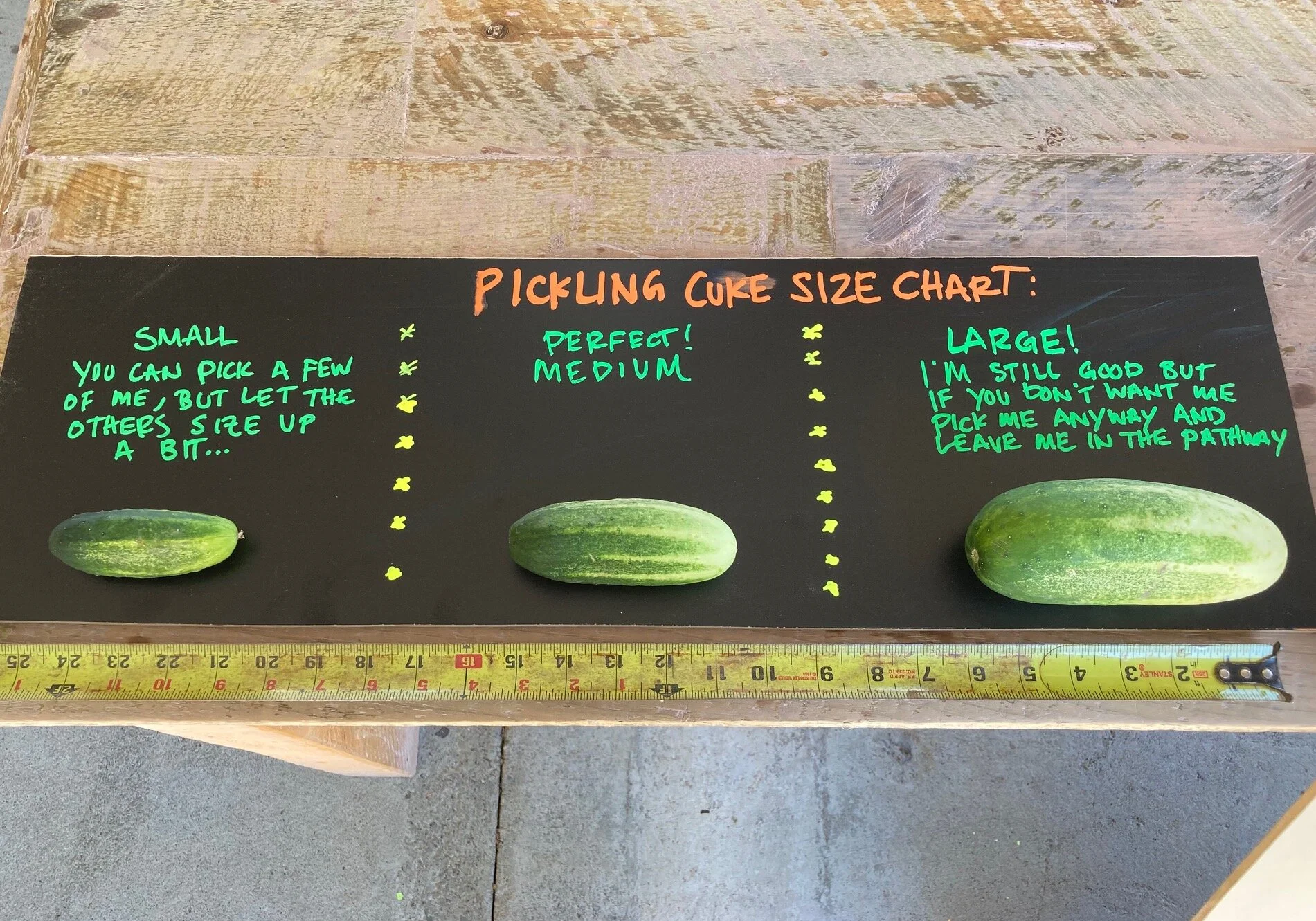
  4. Comb through the plants doing your best not to step on cucumber vines or the adjacent beds. The ideal sized pickling cucumber is around 4 inches long and 1 inch thick. Please don't pick too many that are smaller than this. If you see a monster cucumber (7 inches long and 3 inches wise) please pick it anyway and leave it in the pathway. This will help the plant produce many more nice small ones.

  5. Pick however many you want up to the Season Limit (currently 3 gallons per share). Please note that this is a season limit rather than weekly limit.

  6. Transfer your cukes to your container and return the GVCFARM bucket to the barn for other members to use!

MAKING PICKLES

The following recipe is from CSA member Kate Seely. It is a tried and true pickling method that can be used not just on cucumbers. Pickled Daikon, anyone? Thanks, Kate for sharing your wisdom!

******

For crunchy pickles, Kate has found that the trick is to pickle them as fresh as you can — i.e. as soon after picking as possible. (Some people swear by putting grape leaves or citric acid in with the pickles to make them crispy, but Kate hasn’t found that to work.) If you can’t get to pickling right away, try getting them into the ice water / salt bring as soon as possible. Another helpful trick for crunchier pickles is to pick your cucumbers in the morning rather than the heat of the day.

BRINE INGREDIENTS

  • 1:1 ratio water : organic distilled white vinegar

  • 1/3 cup pickling salt for every 8 cups liquid

  • **If you like it a little less vinegary, go 2/3 water : 1/3 vinegar instead of 1:1. Also, you really can use this brine to vinegar pickle any vegetable.

PICKLE INGREDIENTS

  • Fresh GVCFarm pickling cucumbers!

  • GVCFarm Garlic!

  • Fresh spicy peppers (a jalapeño works, or any spicy pepper) or red pepper chili flakes

  • Yellow mustard seed

  • Fresh dill (if you don't have fresh, dried is fine). Try using the dill flowers in the garden.

  • Peppercorns

EQUIPMENT

  • Canning Pot

  • Pint Jars (or Quart if you want to go big!)

  • New lids for sealing

  • Tongs and/or can removers

STEP-BY-STEP

CAUTION: Canning can be dangerous. If it is is not done properly, bacteria that can make you very sick, even kill you, can develop in the jars. If you have never canned before, make sure you do your homework and feel confident in your ability to can safely before starting.

Step 1 - Soak Cucumbers: Cut your cukes, removing ends and sizing the slices to the size of the jars you will use, and set in water, salt and ice. Use about three TBSP of salt for 5 pounds of cukes. Let sit anywhere between 4 and 24 hours.

Step 2 - Make Brine: Begin this step when you're ready to pickle. Put the brine measurements into a separate pot and bring to a boil. 1:1 water to white vinegar, and 1/3 cup salt for every 8 cups of liquid. Once boiling, reduce to a simmer.

Step 3 - Sterilize Jars: Fill canning pot with water, bring to a boil. To sterilize, wash jars with soap and water, then place in boiling water for 10 minutes. Remove and set aside. Be mindful not to touch the insides of the jars with your hands as that will de-sterilize them. Sterilize lids in a smaller pot as well.

Step 4 - Fill Jars: Drain the cucumbers you have soaking in the ice / salt mixture. Trim them to the length of the jar as needed.. Jars should have 1/4 inch of space between liquid and jar top. Pack cucumbers, dill (1-2 sprigs), and garlic (one clove for a pint jar). Really, PACK them in there.

Add spices: Pour 1 tsp yellow mustard seed, 3/4 tsp (or more or less depending on the spice you want, I like them spicy!), 6 peppercorns on top of cucumbers.

Step 5 - Pour Brine: Pour your brine over pickles, covering them, but leaving 1/4 inch until top of jar. Remove lid from small pot with tongs, being mindful not to touch lids. Screw on cap so that it is not tight, so that air can escape from jars as you water process them.

Step 6 - Seeling Jars: Place jars in canning pot and water process for 15 minutes. (If you do not have a canning pot with a metal insert to hold cans, make sure to put a buffer between your glass jars and the bottom of the metal pot, like an old dish towel. Your jars will break if they touch the hot metal. Heck, they might break anyways if you're reusing jars. That's just the way it goes.

Step 7 - Remove Jars: Remove jars and let cool. As they cool the lids should seal tightly. Once cooled and sealed, tighten the jar lids down. Any jars that did not seal properly should be kept in the fridge and eaten first. Store your sealed pickles in a cool dark place and enjoy for many months!

C5F8A2FC-F553-4BB6-8BEB-6FA5DE125255.JPG

FLOWERS for KILEY

CSA member and fellow farmer Kiley Clark is well on her way to raising money to start her regenerative farm. In just a few short weeks she has raised over $86,000. She’s now aiming at a new milestone — $125,000 — which is awesome because getting secure land access and properly capitalizing a regenerative farm is expensive. The world needs more regenerative farms owned and operated by women and people of color. To support Kiley’s campaign we are holding a raffle. A raffle for what, you say?

A Flower Share! If you have a friend, family member, or co-worker nearby who you think would love to come to the farm each week to pick a bouquet, enter to win them the gift of a Flower Share! $15 gets you a ticket. Buy two! Or ten! Winner gets free access to the flower garden to pick-bouquets from early August until the last blooms expire in October. Need a place to meet up with your Hinge date? Enter to win them a Flower Share. How romantic. Have a friend waiting forlornly on the waitlist! Win them a Flower Share!

To buy tickets, Venmo Kayta Plescia @greenvalleyfarmers in $15 increments based on how many tickets you want. The drawing will be Wednesday, August 5th. All proceeds go to Kiley’s GoFundMe campaign.

ADD-ONS

  • Bramble Tail Homestead Creamery: Stocked with Bramble Tail frozen yogurt, 100% grass-fed beef, Green Star chicken, eggs, Oz Family Farm heritage rabbit and more. Become a member of the weekly dairy herdshare by emailing Aubrie at brambletailhomestead@gmail.com.

  • The Marketplace: New products this week include bone broth and gluten free breads! Also stocked art, soaps, honey, coffee, Moonfruit Mushroom dressing and seasoning, beverages, and much more. Across from the Bramble Tail Creamery.

  • Revolution Bread: Our baker Eli is still dealing with some (non-COVID) health challenges. Fresh bread and cookies should be back next Saturday.

  • Moonfruit Mushrooms: Mushrooms are a mysterious fruit. Cory and Ryath report that there next flush looks to be about two weeks away.

Thanks so much to everyone who came out this Wednesday to help with this carrot harvest and garlic harvest!

Thanks so much to everyone who came out this Wednesday to help with this carrot harvest and garlic harvest!

VOLUNTEER WEDENSDAYS

Need some farm therapy? Come out for our standing volunteer morning. Come find us in the garden or fields from 9am - 11am on Wednesday mornings!

FARMER’S LOG

AUGUST EMPTINESS

This time of year it is hard to find time to write one’s thoughts down… the rhythm of the steady, bulky harvests drowns them out with an ever increasing tempo. The sun blares down. It’s hard to think about anything but the farm. To sneak in planting and seeding and other tasks in the margins, your only thoughts are farm thoughts, your only feelings are farm feelings. You must remain disciplined, focused… you can’t miss a beat.

This week we turned the farm another turn towards Fall. Kayta seeded our 5,600 ft of Fall carrots. We cultivated our Fall Brussels sprouts and planted Romanesco for our Fall selves. We trellised tomatoes and planted our last cucumber succession.

Kayta seeding over a mile of carrots for the Fall.

Kayta seeding over a mile of carrots for the Fall.

Our internal lives — our emotions, dreams, and whimsies — feel far away at this time or year; shoved aside by harvest and urgent needs in the field. But at the same time we never feel more full.

There is a strange fullness in being so busy as to be empty.

Then, the swelling corn stalks can lift you up to the eaves. The heat is your sorrow. The flowering potatoes are your whimsical thoughts. And the simple things — a good sip of coffee, a crew mate’s joke, a good harvest — can fill you to the brim.

See you in the fields,
David and Kayta

7/24/2020 - Week 7 - The Dog Days of Summer

487ACAEE-DA85-4552-AA55-0A75F3A45482.JPG

THIS WEEK’S HARVEST

Bel Fiore & Sugarloaf Chicories, Cipollini Onions, Fairytale + Asian + Italian Eggplant, Slicing Tomatoes, Lorz Softneck Garlic, Farao Green Cabbage, Purple Daikon, Dino KaleLoose Rainbow Carrots, Summer Squash & Zucchini, Olympian Cucumbers, Lemon Cucumbers, Salad Mix (with Mizuna, Baby Bok Choi, Little Gems, and Frisee), Summercrisp and Red Butter Head Lettuces

U-PICK

Check the u-pick board for updated weekly limits

  • Pickling Cucumbers (See below for tips and instructions)

  • Albion Strawberries

  • Purple Snow Peas

  • Sugar Snap Peas (Gleanings)

  • Frying Peppers (See our Week 5 & 6 Newsletter for harvest tips)

  • Jalapeños

  • Herbs: Rosemary, Thyme, Dill, Tulsi Basil, Italian Basil, Thai Basil, Purple Basil, Oregano, Marjoram, Tarragon, Onion Chives, Garlic Chives, Vietnamese Coriander, Culinary Lavender, Culinary Sage, French Sorrel, Lemon Verbena, Lemon Balm, Perilla & Purple Shiso, Chamomile, Cilantro & Mints, Anise Hyssop

HARVEST NOTES

  • Bel Fiore & Sugarloaf Chicories: We usually reserve these beauties for the Fall but we couldn’t wait that long this year. Chicories (which include Frisee, Radicchio, Dandelions and Escarole) are sometimes thought of as an acquired taste because they are bitter — but we highly recommend you acquire that taste for their bitterness masks a hidden sweetness. The chicories in the share this week are delicious both raw and cooked. For a raw chicory salad try pairing with plums or pears and pecans with a honey-lemon dressing, or, for a more savory twist, a mustardy dressing topped with this week’s daikon radish. Another great way to eat chicories is to roast them: We quarter them, toss them generously with olive oil and garlic and broil them until the outer leaves are slightly crisped and blackened the leaves are melted. Top with salt and/or grated parmesan and eat as a side.

  • Eggplant: We have a nice eggplant year ahead of us featuring three eggplant varieties, one from East Asia (long thin and dark purple), India (striped white and light purple), and Italy (classic deep purple pear shaped).

  • Purple Snow Peas: Likely the last week for these beauties. Beauregarde purple snow peas are an open-pollinated, recently-bred variety from Row 7 Seed Company, "bred to bring more flavor (and more purple) to purple peas, these high-anthocyanin, wavy-podded snow peas hold their vibrant color when cooked. Wait for small peas to develop in the pod to reach full flavor potential." Snow peas are delicious raw, stir-fried, steamed or braised.

GARLIC & CARROT HARVEST THIS WEDNESDAY, 9:00 am

This week, for volunteer day we are going to harvest our Metechi Garlic and, if we have time, do our first bulk carrot harvest of the year. Come find us in the fields anytime from 9:00am-11:00am. Bring a face covering por favor!

PICKLING CUCUMBERS

Each year, we plant a large patch of pickling cucumbers so interested members can u-pick them fresh from the field to take home to pickle!

See below for instructions on where to find them, how to pick them, and our favorite pickle recipe from CSA member Kate Seely.

IMG_0296.jpg

PICKING PICKLING CUCUMBERS

  1. Bring a bucket or bag from home to take your cukes home in.

  2. Check the u-pick board for the current season limit. Grab a GVCFarm five gallon bucket from under the u-pick board. We’ve marked the limit on the inside of the bucket with tape.

  3. Find the pickling cucumber patch out on the farm. They are located in Field 1, behind the massive wall of corn if you look to your left from the frying peppers. The beds are marked with a double pink flag. 

  4. Comb through the plants doing your best not to step on cucumber vines or the adjacent beds. The ideal sized pickling cucumber is around 4 inches long and 1 inch thick. Please don't pick too many that are smaller than this. If you see a monster cucumber (7 inches long and 3 inches wise) please pick it anyway and leave it in the pathway. This will help the plant produce many more nice small ones.

  5. Pick however many you want up to the Season Limit (currently 3 gallons per share). Please note that this is a season limit rather than weekly limit.

  6. Transfer your cukes to your container and return the GVCFARM bucket to the barn for other members to use!

Two pink flags marks the spot!

Two pink flags marks the spot!

MAKING PICKLES

The following recipe is from CSA member Kate Seely. It is a tried and true pickling method that can be used not just on cucumbers. Pickled Daikon, anyone? Thanks, Kate for sharing your wisdom!

******

For crunchy pickles, Kate has found that the trick is to pickle them as fresh as you can — i.e. as soon after picking as possible. (Some people swear by putting grape leaves or citric acid in with the pickles to make them crispy, but Kate hasn’t found that to work.) If you can’t get to pickling right away, try getting them into the ice water / salt bring as soon as possible. Another helpful trick for crunchier pickles is to pick your cucumbers in the morning rather than the heat of the day.

Brine INGREDIENTS

  • 1:1 ratio water : organic distilled white vinegar

  • 1/3 cup pickling salt for every 8 cups liquid

  • **If you like it a little less vinegary, go 2/3 water : 1/3 vinegar instead of 1:1. Also, you really can use this brine to vinegar pickle any vegetable.

PicklE INGREDIENTS

  • Fresh GVCFarm pickling cucumbers!

  • GVCFarm Garlic!

  • Fresh spicy peppers (a jalapeño works, or any spicy pepper) or red pepper chili flakes

  • Yellow mustard seed

  • Fresh dill (if you don't have fresh, dried is fine). Try using the dill flowers in the garden.

  • Peppercorns

EQUIPMENT

  • Canning Pot

  • Pint Jars (or Quart if you want to go big!)

  • New lids for sealing

  • Tongs and/or can removers

STEP-BY-STEP

CAUTION: Canning can be dangerous. If it is is not done properly, bacteria that can make you very sick, even kill you, can develop in the jars. If you have never canned before, make sure you do your homework and feel confident in your ability to can safely before starting.

Step 1 - Soak Cucumbers: Cut your cukes, removing ends and sizing the slices to the size of the jars you will use, and set in water, salt and ice. Use about three TBSP of salt for 5 pounds of cukes. Let sit anywhere between 4 and 24 hours.

Step 2 - Make Brine: Begin this step when you're ready to pickle. Put the brine measurements into a separate pot and bring to a boil. 1:1 water to white vinegar, and 1/3 cup salt for every 8 cups of liquid. Once boiling, reduce to a simmer.

Step 3 - Sterilize Jars: Fill canning pot with water, bring to a boil. To sterilize, wash jars with soap and water, then place in boiling water for 10 minutes. Remove and set aside. Be mindful not to touch the insides of the jars with your hands as that will de-sterilize them. Sterilize lids in a smaller pot as well.

Step 4 - Fill Jars: Drain the cucumbers you have soaking in the ice / salt mixture. Trim them to the length of the jar as needed.. Jars should have 1/4 inch of space between liquid and jar top. Pack cucumbers, dill (1-2 sprigs), and garlic (one clove for a pint jar). Really, PACK them in there.

Add spices: Pour 1 tsp yellow mustard seed, 3/4 tsp (or more or less depending on the spice you want, I like them spicy!), 6 peppercorns on top of cucumbers.

Step 5 - Pour Brine: Pour your brine over pickles, covering them, but leaving 1/4 inch until top of jar. Remove lid from small pot with tongs, being mindful not to touch lids. Screw on cap so that it is not tight, so that air can escape from jars as you water process them.

Step 6 - Seeling Jars: Place jars in canning pot and water process for 15 minutes. (If you do not have a canning pot with a metal insert to hold cans, make sure to put a buffer between your glass jars and the bottom of the metal pot, like an old dish towel. Your jars will break if they touch the hot metal. Heck, they might break anyways if you're reusing jars. That's just the way it goes.

Step 7 - Remove Jars: Remove jars and let cool. As they cool the lids should seal tightly. Once cooled and sealed, tighten the jar lids down. Any jars that did not seal properly should be kept in the fridge and eaten first. Store your sealed pickles in a cool dark place and enjoy for many months!

FLOWERS for KILEY

CSA member and fellow farmer Kiley Clark is well on her way to raising money to start her regenerative farm. In just a few short weeks she has raised over $86,000. She’s now aiming at a new milestone — $125,000 — which is awesome because getting secure land access and properly capitalizing a regenerative farm is expensive. The world needs more regenerative farms owned and operated by women and people of color. To support Kiley’s campaign we are holding a raffle. A raffle for what, you say?

A Flower Share! If you have a friend, family member, or co-worker nearby who you think would love to come to the farm each week to pick a bouquet, enter to win them the gift of a Flower Share! $15 gets you a ticket. Buy two! Or ten! Winner gets free access to the flower garden to pick-bouquets from early August until the last blooms expire in October. Need a place to meet up with your Hinge date? Enter to win them a Flower Share. How romantic. Have a friend waiting forlornly on the waitlist! Win them a Flower Share!

To buy tickets, Venmo Kayta Plescia @greenvalleyfarmers in $15 increments based on how many tickets you want. The drawing will be Wednesday, August 5th. All proceeds go to Kiley’s GoFundMe campaign.

C5F8A2FC-F553-4BB6-8BEB-6FA5DE125255.JPG

ADD-ONS

  • Bramble Tail Homestead Creamery: Stocked with Bramble Tail frozen yogurt, 100% grass-fed beef, Green Star chicken, eggs, Oz Family Farm heritage rabbit and more. Become a member of the weekly dairy herdshare by emailing Aubrie at brambletailhomestead@gmail.com.

  • The Marketplace: New products this week include bone broth and gluten free breads! Also stocked art, soaps, honey, coffee, Moonfruit Mushroom dressing and seasoning, beverages, and much more. Across from the Bramble Tail Creamery.

  • Revolution Bread: Our baker Eli is still dealing with some (non-COVID) health challenges. Fresh bread and cookies are on hold for the time being. Get well soon, Eli!

  • Moonfruit Mushrooms: Mushrooms are a mysterious fruit. Cory and Ryath report that there next flush looks to be about three weeks away.

FARMER’S LOG

The sun beats down, the hills are bleached gold, and the wind blows hot… the dog days of summer are here.

The term “dog days”, for the late summer, traces back to the ancient Mediterranean, where people connected the night sky return of the brightest star, Canis Majoris (aka Sirius, aka “Orion’s Dog”), to the sultry days of late July-August when, as Virgil said, “the Dog-star cleaves the thirsty ground.” These ancient people associated the dog days with fever, bad luck, and heat.

As Marin naturalist and tracker Richard Vacha brilliantly observes of our own Mediterranean climate in his book The Heart of Tracking, the dog days can be a raucous, frolicking time for wild canines as they feast on the fattened prey and tree fruit of summer and as canine pups leave the den and come into their own. (Perhaps this is the wild origin of the naming of the star?)

But, in Mediterranean climates like ours, the dog days are also a scarce time, a spent time. They are the beginning of a great dry down and a great dormancy.

“For an animal,” Vacha writes, the late-Summer-early-Fall “can be as tough to endure as an East Coast winter. Food is scarce, water is scarce, and green vegetation is crowded into riparian corridors, drawing the animals that depend on these resources closer together. The animals who prey upon them have shifted correspondingly. Territorial patterns are all in great flux as the expansive cycle of the summer season slowly winds down.”

On the farm, this shift into the dog days — their abundance and scarcity — has been clear.

Screenshot 2020-07-24 17.00.31.png

Our harvests are more and more heavy with fruit: Cucumbers, squash, eggplant; the first poblanos and sweet peppers are on their way; we picked the first few field heirloom tomatoes this week; our first melons are swelling; the wild blackberries are laden. In the garden the first flowers and herbs are following the wild grasses, tapping out and throwing seed. Even our Jack-O-Lantern pumpkins are turning from green to orange.

In our staple field crops, if July was an outward explosion of verdant green growth, the dog days are the beginning of a hunkering down, a drawing nigh, a focused inward stare toward the serious work of setting fruit, forming bulbs and tubers, and setting seed. The corn is tassling. The jubilant winter squash flowers are beginning to wilt and metamorphosize — green and gold orbs now swell in the shade of sun battered leaves. The potato flowers are beginning to pop and with them the plants will now look to swelling their secret orbs in the black earth.

And as the wildland plants dry out and are scorched to gold, her wild inhabitants turn more and more to the farm — an irrigated green oasis — for moisture and succulent meals. The wild turkeys and their fluffy younglings visit the fields every morning and evening, snipping off hydrating bits of lettuce and broccoli leaves. They annihilated a whole patch of Romaine in just one evening this week. Song birds are raiding the greenhouse now, right on schedule, eating juicy germinating beets and Fall chicories. Gophers take bites out of our drip irrigation lines nightly, seeking the cool water flowing within. 

The sweet relief of the first Fall rains will come to us all sooner than we think. Until then, keep cool, move slow, and enjoy the fruitful abundance of the dog days of summer.

See you in the fields,
David & Kayta

“Fox in a Coyote Bush” illustration by Kayta from The Heart of Tracking by Richard Vacha from Mount Vision Press

7/17/2020 - Week 6 - Ode to the Onion

THIS WEEK’S HARVEST

Bunched Rainbow Carrots, Fresh Cabernet Onions, Purple Daikon, Red Russian Kale, Celery, Summer Squash, Olympian Cucumbers, Persian or Lemon Cucumbers, Arugula, Salad Mix (Mustard Greens, Frisee and Radicchio), Mixed Little Gems, Romaine Lettuce, Greenhouse Tomatoes, Eggplant

D201EE85-78CC-47ED-944B-D20B9AE4CBEC.JPG

U-PICK

Check the u-pick board for updated weekly limits

  • Albion Strawberries

  • Purple Snow Peas

  • Sugar Snap Peas

  • Frying Peppers (see below for harvest tips)

  • Jalapeños

  • Herbs: Rosemary, Thyme, Dill, Tulsi Basil, Italian Basil, Thai Basil, Purple Basil, Oregano, Marjoram, Parsley (last legs), Tarragon, Onion Chives, Garlic Chives, Vietnamese Coriander, Culinary Lavender, Culinary Sage, French Sorrel, Lemon Verbena, Lemon Balm, Shiso, Chamomile, Cilantro & Mints

HARVEST NOTES

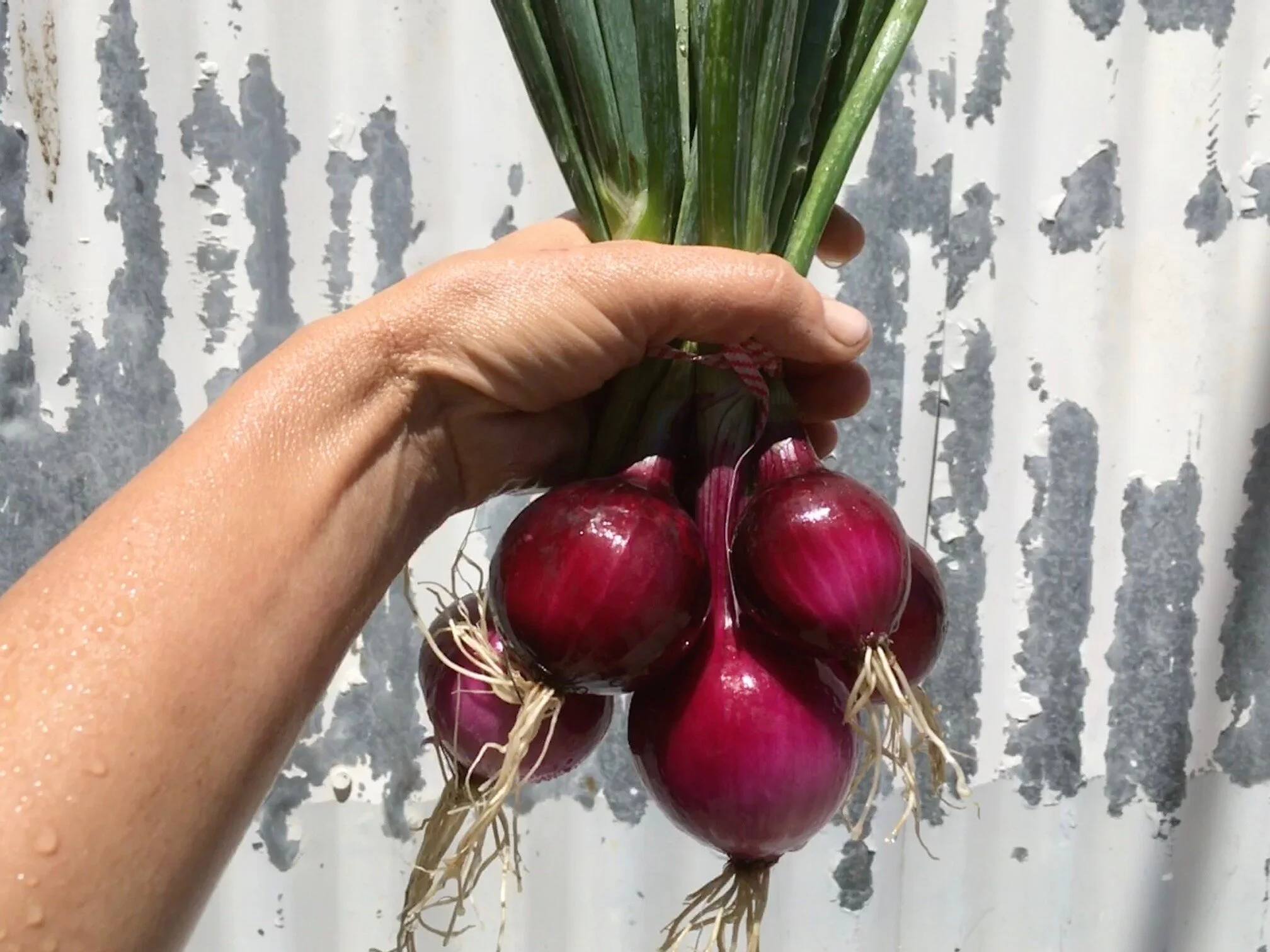
  • Fresh Cabernet Onions: “Round roses of water.” Fresh, turgid, a summer treat. The innocent, uncured form of the onion.

  • Purple Snow Peas: These Beauregarde purple snow peas are an open-pollinated, recently-bred variety from Row 7 Seed Company. As they say, Beauregarde was "bred to bring more flavor (and more purple) to purple peas, these high-anthocyanin, wavy-podded snow peas hold their vibrant color when cooked. Wait for small peas to develop in the pod to reach full flavor potential." Snow peas are delicious raw, stir-fried, steamed or braised.

  • Nigella: The Nigella (aka Love-in-the-Mist") flowers are particularly special in the garden this week. Make sure to check them out above the snapdragons above the picnic table.

  • Green Coriander: Green Coriander is the green flowering seeds of cilantro. It is delicious and used often in Asian dishes. It can also be infused into vinegar.

  • Frying Peppers: Frying peppers are little peppers commonly eaten pan-fried. A little olive oil, a little salt, a little seared til black, and voila, an amazing hors d'oeuvre!

    • Shishitos: A wonderfully mild (no heat), green frying pepper. Popular in Japan where its thin walls make it particularly suitable for tempura. Also very good in stir fries or sautés, or just seared in oil and salt. Ideally harvest at 2 to 4 inches, but bigger is fine. Older peppers turn red but are 99% mild.

    • Padróns: The famous Spanish heirloom, named after their town of origin. Padróns are served sautéed in olive oil with a little sea salt, and eaten as tapas in Spain. Ideally harvest when they are 1" to 1 1/2" long. About 1 out of 10 fruits will be hot. All the fruits become hot if allowed to grow 2-3" long.

    ADD-ONS

  • Revolution Bread: Our baker Eli is dealing with some (non-COVID) health challenges. Fresh bread and cookies are on hold for the time being. Get well soon, Eli!

  • Moonfruit Mushrooms: Cory and Ryath report that there will be no shiitakes this week but they see a flush coming for next week! Moonfruit Mushrooms, will now be sold self-serve from a fridge next to the bread freezer. Cash only.

  • Bramble Tail Homestead Creamery: Stocked with Bramble Tail frozen yogurt, 100% grass-fed beef, Green Star chicken, eggs, Oz Family Farm heritage rabbit and more. Become a member of the weekly dairy herdshare by emailing Aubrie at brambletailhomestead@gmail.com.

  • The Marketplace: New products this week include bone broth and gluten free breads! Also stocked art, soaps, honey, coffee, Moonfruit Mushroom dressing and seasoning, beverages, and much more. Across from the Bramble Tail Creamery.

VOLUNTEER WEDNESDAYS, 9:00 am

A biiiig thanks to everyone who came out this Wednesday to tackle the weeds in our storage onion patch! For anyone who’d like a little farm-work therapy, come one, come all to our weekly Volunteer Wednesday! Come find us in the garden or the fields anytime from 9:00am-11:00am. Depending on your interest and ability we can find a nice socially distant something for you to help keep this ship afloat and nice and tidy.

IMG_0145.jpg

OUR MASK POLICY

There has been some confusion around our policy surrounding masks on the farm and as we are underway we wanted to refine it and flesh it out. Generally people are doing a great job! Thank you! And thank for for your patience as we navigate creating our policies.

MASKS ARE REQUIRED ON THE FARM WHEN…

  • You are inside any enclosed space on the farm: the CSA barn, the Marketplace and Creamery, the bathroom, etc.

  • U-picking any crop, including flowers

  • Near u-pick areas or other high-traffic areas (so that you don’t prevent others from entering safely)

  • Traversing high traffic outdoor spaces like the staircase or main pathways, where you will likely come close to other members.

YOU CAN REMOVE YOUR MASK WHEN….

  • You are in an outdoor area of the farm where it is easy to be socially distant from other members and you are away from u-pick areas and other high-traffic zones.

PINT BASKET SIZES

One more piece of housekeeping: I don’t think we ever explained what a pint actually looked like. The clear clamshell pictured below is 2 pints. The little green netted baskets are 1 pint. Thanks everyone for being so careful about u-pick limits each week. This makes sure everyone gets a share of the harvest!

IMG_0117.jpg

FARMER’S LOG

This week on the farm, in between the harvests, we tackled some messes! We enjoyed spending time with a great volunteer crew Wednesday morning cleaning up our storage onion patch that had grown thick with emerging bindweed, purslane and some grasses. You all made quick work of it! Thanks everyone! We then transitioned to cleaning up the Purple Snow Pea patch and the cherry tomatoes.

We also got around to mowing the beds that hosted the first crops of the year, which had become overgrown with bolting lettuce and bolting bok-choi and bolting weeds (oh, my!). The heat of last weekend really made all the weeds that we thought were safely still in vegetation mode turn the corner into seed creation. Nothing like a few thousand packets of purslane seed to motivate you to clean house!

Today was a fun harvest. Lots of new things to share with you all.

It is always a happy day the day we harvest the first fully formed onion bulbs of the year, their bellies “grown round with dew”. So this week, in honor of our amazing onion weeding team and the year’s first Cabernet Onions, we'll leave you with the one-and-only, Pablo Neruda.

IMG_3847.jpg

* * * * * * *

Ode to the Onion
by Pablo Neruda

Onion,
luminous flask,
your beauty formed
petal by petal,
crystal scales expanded you
and in the secrecy of the dark earth
your belly grew round with dew.
Under the earth
the miracle
happened
and when your clumsy
green stem appeared,
and your leaves were born
like swords
in the garden,
the earth heaped up her power
showing your naked transparency,
and as the remote sea
in lifting the breasts of Aphrodite
duplicating the magnolia,
so did the earth
make you,
onion
clear as a planet
and destined
to shine,
constant constellation,
round rose of water,
upon
the table
of the poor.

You make us cry without hurting us.
I have praised everything that exists,
but to me, onion, you are
more beautiful than a bird
of dazzling feathers,
heavenly globe, platinum goblet,
unmoving dance
of the snowy anemone

and the fragrance of the earth lives
in your crystalline nature.

* * * * * * *

See you in the fields,
David & Kayta