8/25/17 - Week 11 - Oaks

Top (L to R): Canyon live oak, Tan oak, Coast live oak, Interior live oak. Bottom (L to R): Blue oak, Oregon White oak, Valley oak, Black oak, Oracle oak (Hybrid of Black oak x Interior live oak)

Top (L to R): Canyon live oak, Tan oak, Coast live oak, Interior live oak. Bottom (L to R): Blue oak, Oregon White oak, Valley oak, Black oak, Oracle oak (Hybrid of Black oak x Interior live oak)

FARMERS LOG:

There was a chill in the air this morning. (Of course it is 90 out now but...) this morning, it felt like Fall. The chill made me think of Fall -- of orange leaves, of fires, and of Oaks and acorns.

Kayta and I became very interested in the Oaks tree species of California a few years ago. From a farmers perspective, it is nothing short of miraculous to witness thousands of pounds of food falling from the sky every year. We dreamt then as we do now of bringing the abundance of the acorn into a our lives and into a CSA share someday...

First though, thought we, we must learn about the oak, and first still, to identify what we were looking at.

Our goal was simple: To be able to approach an Oak tree in Sonoma or Marin County and proclaim, with assurance, "This is a Black Oak tree!" or, "This is a Coast Live Oak tree!" or, "This is one of the other 6 species of Oaks."  We packed our hiking bags with Tree Identification books, laced up our boots, and marched proudly into our future of Knowledge.

Life had other plans.

The first oak tree we approached, the "Wedding Tree" as our little neighborhood called it then, was a giant Quercus next to a tributary of Salmon Creek. It shaded and cooled us as we peered into our books. "See here, the leaf is lobed." "Yes, but not too deeply and not too shallowly." "Are there many lobes." "Yes, but they are rounded and not squared." "Hmmm." "The leaf seems as if it were a perfect amalgam of an Oregon White oak and a Valley Oak." "But what about the bark, is it gray or white?" "There seems to be a gradient from gray to white." "Is that possible?" "Evidently" "What about the texture of the bark?" "There, it is smooth. But here, it is ridged." "There it is like an alligator's hide, and there like an elephant's leg?"

The bark of the Wedding Tree seemed to match the descriptions of the barks of all the oaks. We scratched our heads. Wedding Tree swayed gently in the wind.

Foiled, but intrepid, we found another Oak. This tree, on a dry, south facing hill, had small, tough, dark green leaves that were armed with little spikes on the edges. A Live Oak, our guide books told us. But which? Again, we analyzed the tree; its shape, its leaf, its bark, its colors, we peered into our books --- and again, we could not ID it.

"Perhaps we are missing something?" we thought. "The acorn?" "We will wait for the acorn. We will wait for the Fall."

Late summer. The acorns grew. They filled out. Fall came. They turned from green to brown. They fell.

We returned to the Wedding Tree and searched the duff below her branches for our little fallen answers. Finding an acorn we held it high, admiring its perfection. We turned it over and over in our fingers and felt its weight in our palms. We busted out the books. "The cup is warty, rather than scaled, wouldn't you say?" "I don't know, there are tiny scales growing out of the warts." "Definitely egg shaped though, right?" "Too thin." "A thin egg?" 

Fall deepened. So did our confusion. 

We stood under countless Oaks up and down the State. We looked for the trees described in the books but we could not find them. Buoyed by a few victories (the unmistakable cupped leaf leading us to the Coast Live Oak and the iconic star shaped leaf leading us to the Black Oak) we journeyed on, but every tree seemed to defy the language in the books in one way or another.

Around Thanksgiving, a breakthrough came to us in the form of a website describing the Oak families of California, or "the Clades", footnoted by a simple yet profound statement that trees within the same Clade can and do hybridize, and that there could be such thing as an "Oregon Valley Oak". We knew, we had seen them everywhere. 

We began leaving our books at home. We stood under more Oak trees. And finally, it began to click, we began to see what we had always seen.

Every tree had its own face, every hillside and every valley, its own tribe. There were the Blue Oaks of the Sierra Nevada foothills along Highway 49, long trunked, long acorned, leaves thick and grayish blue, shaped by their land and place. And then there were the light green leafed, egg shaped acorned Blue Oaks of Annadel Park in Santa Rosa, modest and protected in the rolling hills they called home. And there were the Interior Live Oaks on the upper ridges in the Ventana Wilderness near Mount Carmel with their squat, arrowhead acorns, and tightly wound branches, and then their brethren down the ridge with pin pointed acorns and languid branch. But each tree so unique.

In the end we found something. We found leaves and acorns that more or less matched the descriptions of what they should look like. We found some shortcuts for distinguishing California Oak species from one-another. But we didn't find what we thought we would. And we are glad.

What is out there, growing on the grasslands and in the canyons, is a reality more vast and incomprehensible than any book can hold. It is life. Ever changing, combining, and expressing. And every tree has its own face. 

Perhaps it is up to us to give those special to us a special name.

See you in the fields, 

David & Kayta

IMG_2807.jpg

THIS WEEK'S HARVEST: Heirloom Tomatoes, New Girl Slicing Tomatoes, San Marzano Sauce Tomatoes, Italian Eggplant, Cured Cabernet Red Onions, Scallions, Sweet Peppers, Summer Squash, Hakurei Turnips, French Breakfast Radishes, Lemon Cucumbers, "Sarah's Choice" Cantaloupes and French Chanterais Melons, Broccoli, Kraut Cabbages, Red Ace Beets, Rainbow Carrots, Fennel, Red Russian Kale, Dino Kale, Arugula, Spicy Mustard Mix, Little Gem Lettuces

U-PICK in the GARDEN: Amethyst Green Beans, Frying Peppers, Padrones, Jalapeños, Husk Cherries, Strawberry snacks, all herbs and flowers. No limit on dahlias. 

U-PICK on the FARM: Cherry Tomatoes, Wild Himalayan Blackberries, Raspberry Snacks

PRESERVES:

  • Pesto!: Our first planting of basil is ready to be retired into pesto, I'll be emailing those who signed up for pesto this evening with instructions. Are you interested in harvesting large quantities of basil to make into pesto? If so, please send us an email or let us know in person and we'll give you instructions.
  • Kraut Cabbages: We will put out boxes of older cabbage this week in the barn meant for kraut. These cabbages don't have to fit in your bag and you may take many. Check out last week's newsletter for our favorite simple kraut recipe.
  • Pickling Cucumbers: This will be the last week that we will have pre-harvested bags of pickling cucumbers available for pick up in the barn. Picking cucumbers will become a u-pick crop starting next.

8/17/17 - Week 10 - Poem

FARMERS LOG:

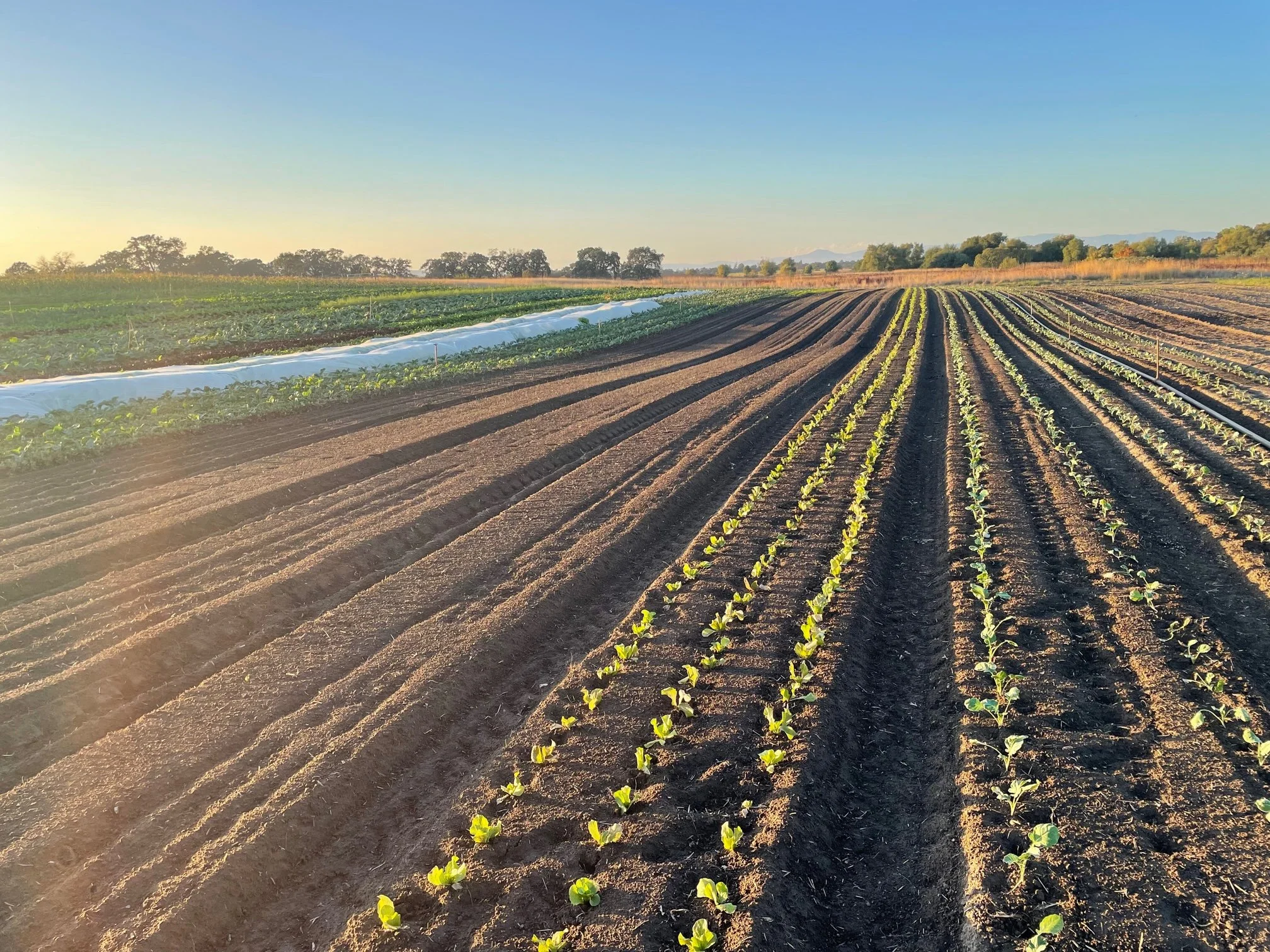
Big days in the fields lately. Plant, water, big harvest, sleep... repeat. We transplanted over 600ft of fall crops yesterday. Feels crazy to say that the winter kale is already in the ground, but because sunlight gets so low in October, it's important to get winter crops in early so they have enough time to grow while the sun is out. Things slow way down after September.

We need to catch up on some zzzz's so today we'll leave you in the hands of the one, the only, Wendell Berry:

Manifesto: The Mad Farmer Liberation Front

Love the quick profit, the annual raise,
vacation with pay. Want more
of everything ready-made. Be afraid
to know your neighbors and to die.
And you will have a window in your head.
Not even your future will be a mystery
any more. Your mind will be punched in a card
and shut away in a little drawer.
When they want you to buy something
they will call you. When they want you
to die for profit they will let you know.
So, friends, every day do something
that won’t compute. Love the Lord.
Love the world. Work for nothing.
Take all that you have and be poor.
Love someone who does not deserve it.
Denounce the government and embrace
the flag. Hope to live in that free
republic for which it stands.
Give your approval to all you cannot
understand. Praise ignorance, for what man
has not encountered he has not destroyed.
Ask the questions that have no answers.
Invest in the millennium. Plant sequoias.
Say that your main crop is the forest
that you did not plant,
that you will not live to harvest.
Say that the leaves are harvested
when they have rotted into the mold.
Call that profit. Prophesy such returns.
Put your faith in the two inches of humus
that will build under the trees
every thousand years.
Listen to carrion — put your ear
close, and hear the faint chattering
of the songs that are to come.
Expect the end of the world. Laugh.
Laughter is immeasurable. Be joyful
though you have considered all the facts.
So long as women do not go cheap
for power, please women more than men.
Ask yourself: Will this satisfy
a woman satisfied to bear a child?
Will this disturb the sleep
of a woman near to giving birth?
Go with your love to the fields.
Lie easy in the shade. Rest your head
in her lap. Swear allegiance
to what is nighest your thoughts.
As soon as the generals and the politicos
can predict the motions of your mind,
lose it. Leave it as a sign
to mark the false trail, the way
you didn’t go. Be like the fox
who makes more tracks than necessary,
some in the wrong direction.
Practice resurrection.

“Manifesto: The Mad Farmer Liberation Front” from The Country of Marriage, Harcourt Brace Jovanovich, Inc. 1973. Also published by Counterpoint Press in The Selected Poems of Wendell Berry, 1999; The Mad Farmer Poems, 2008; New Collected Poems, 2012.

THIS WEEK'S HARVEST: Heirloom Tomatoes, New Girl Slicing Tomatoes, San Marzano Sauce Tomatoes, Italian Eggplant, Cured Cabernet Red Onions, Sweet Peppers, Summer Squash, Hakurei Turnips, Striped Armenian Cucumbers, Crane Crenshaw and Sarah's Choice Cantaloupe Melons, Cauliflower, Kraut Cabbages, Chioggia Beets, Rainbow Carrots, Komatsuna, Red Russian Kale, Dino Kale, Arugula, Spicy Mustard Mix, Little Gem Lettuces

U-PICK in the GARDEN: Amethyst Green Beans, Frying Peppers, Padrones, Jalapeños, Husk Cherries, cut flowers, perennial & annual herbs.

U-PICK on the FARM: Cherry Tomatoes, Wild Himalayan Blackberries

Kraut Cabbages: Over the next few weeks we will put out a bins of cabbage meant for kraut. These cabbages don't have to fit in your bag and you may take several. Below is our favorite simple kraut recipe to inspire....

Lemon-Dill Kraut

From the book Fermented Vegetables by Kristen and Christopher Shockey

This recipe yields about 1 gallon of kraut

2 heads (about 6 pounds) cabbage
1 1/2-2 tablespoons unrefined sea salt
4 tablespoons lemon juice
1-2 tablespoons dried dill
4-5 cloves of garlic, finely grated

1. To prepare the cabbage, remove the coarse outer leaves. Rinse a few unblemished ones and set them aside. Rinse the rest of the cabbage on cold water. With a stainless steel knife, quarter and core the cabbage. Thinly slice with the same knife or a mandoline, then transfer the cabbage to a large bowl.

2. Add the dill, lemon juice, and 1 tablespoon of the salt and, with your hands, massage it into the leaves, then taste. You should be able to taste the salt without it being overwhelming. Add more salt if necessary. The salt will soon look wet and limp, and liquid will begin to pool.  At this point, add the garlic. If you've put in a good effort and don't see much brine in the bowl, let it stand, covered, for 45 minutes, then massage again.

3. Transfer the cabbage to a crock or 2-quart jar, a few handfuls at a time, pressing down on the cabbage with your fist or a tamper to work out air pockets. You should see some brine on top of the cabbage when you press. Leave 4 inches of headspace for a crock, or 2 to 3 inches for a jar. Top the cabbage with one or two of the reserved outer leaves. Then, for a crock, top the leaves with a plate that fits the opening of the container and covers as much of the vegetables as possible; weigh down with a sealed, water-filled jar. For a jar, use a sealed, water-filled jar or ziplock bag as a follower-weight combination.

4. Set aside the jar or crock on a baking sheet to ferment, somewhere nearby, out of direct sunlight and cool, for 4 to 14 days. Check daily to make sure the cabbage is submerged, pressing down as needed.

5. You can start to test the kraut on day 4. You'll know it's ready when it's pleasingly sour and pickle-y tasting, without the strong acidity of vinegar; the cabbage has softened a bit but retains some crunch; and the cabbage is more yellow than green and slightly translucent.

6. Ladle the kraut into smaller jars and tamp down. Pour in any brine that's left. Tighten th kids, then store in the refrigerator. This kraut will keep, refrigerated, for 1 year.

8/11/17 - Week 9 - Fall is here

Week 9 sample harvest share

Week 9 sample harvest share


FARMERS LOG:

This is a complex time of year on the farm. Summer is here in full force, but Fall is everywhere. Even next season is in the works out there.

Half a years worth of planning, seed starting and plant tending is paying off as the set pieces of summer are in full fruit; the slow developing nightshades (tomatoes, eggplant, peppers) and their cucurbit comrades (melons, cucumbers, squash) adorn our tables, the corn is high, and we are in that special time of year where one can make fresh salsa straight from the farm (jalapeños, onions, tomatoes, cilantro).

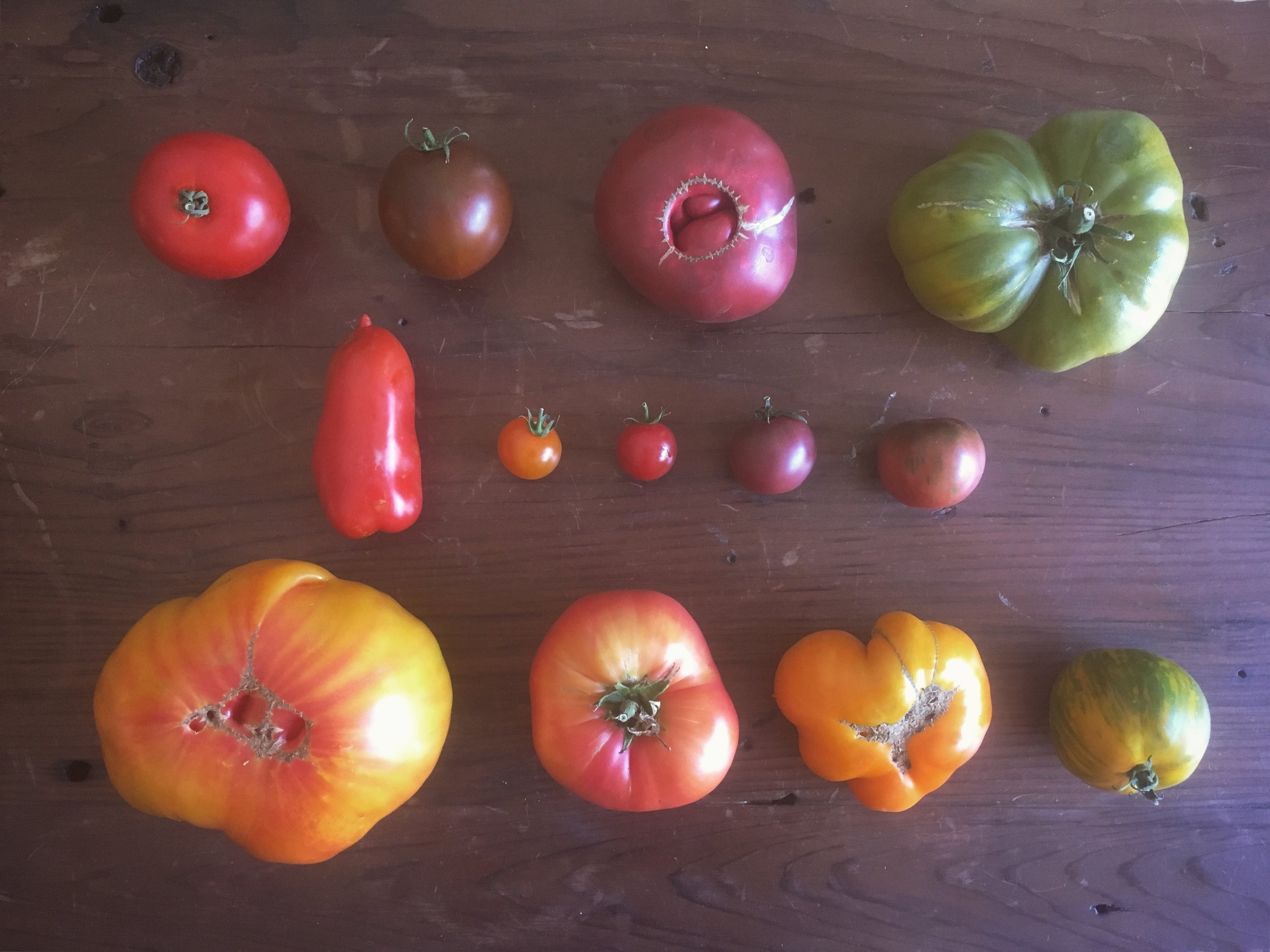
2017's Tomato Varieties: (Top to bottom like reading a book) New Girl, Black Prince, Cherokee Purple, Aunt Ruby's German Green, Paisano San Marzano, Sungold, Supersweet 100, Black Cherry, Black Vernissage, Striped German, Brandywine, Yellow Brandywi…

2017's Tomato Varieties: (Top to bottom like reading a book) New Girl, Black Prince, Cherokee Purple, Aunt Ruby's German Green, Paisano San Marzano, Sungold, Supersweet 100, Black Cherry, Black Vernissage, Striped German, Brandywine, Yellow Brandywine, Green Zebra. Which is your favorite?

But in the the greenhouses and increasingly in the fields, it is all Fall. Our Fall brassica plantings (kales, cabbage, cauliflower, Brussells sprouts and the broccoli we will be picking off of on into December) are all bursting out of their seeding trays and ready to go in the ground. We planted the Fall storage carrots last Sunday. Parts of the fields, you will notice this week, are bare and ready to be planted into or are in the process of being prepared for what's next. These beds provided our earliest farm meals (spring lettuces, mustard greens, turnips and radishes, the first carrots, beets, and first cauliflower, broccoli and cabbage) and, depending on what was in them before, will see a second crop before being put to cover crop bed in the fall or will be planted into a summer cover crop now. And you would hardly notice but, just underfoot, 8 or 10 inches below the surface of the soil, our potatoes are mostly fully formed, their skins hardening off.

2018 is here in the four beds next to the raspberries. These beds will get a brief summer cover crop of buckwheat, the buckwheat will be occulated, and then these lucky beds will be planted into 2018's garlic in late September / early October. 

We hope you are enjoying the summer bounty coming out of the fields and this season of transition on the farm.

See you in the fields, 

David & Kayta

THIS WEEK'S HARVEST: Heirloom Tomatoes, New Girl Slicing Tomatoes, San Marzano Sauce Tomatoes, Italian Eggplant, Fresh Yellow Spring Onions, Sweet Peppers, Summer Squash (Italian Zucchini, Crookneck and Patty Pan), Radishes, Striped Armenian Cucumbers, Melons, Broccoli, Savoy Cabbage, Chioggia Beets, Rainbow Carrots, Tatsoi, Red Russian Kale, Dino Kale, Arugula, Spinach, Hearts-Aglow Lettuce Leaf Mix

U-PICK in the GARDEN: Amethyst Green Beans, Frying Peppers, Jalapeños, Husk Cherries, cut flowers, perennial & annual herbs.

U-PICK on the FARM: Wild Himalayan Blackberries, Cherry Tomatoes

PRESERVING THE SUMMER: 

IMG_2759.jpg

Pickling Cucumbers: The 20lb per season quota has been lifted, let the pickle free-for-all commence! If you are interested in more pickling cucumbers, we've got you covered. We'll have 10lb ready-to-go bags in the glass fronted fridge in our barn. Help yourselves. First come first serve. Pickling cukes will be tapering off over the next 2 to 3 weeks.

Green Beans: One of Kayta's and my favorite preserves is pickled green beans aka "Dilly Beans". They are a garlicy, tangy treat to throw on the plate next to pretty much any meal. Our patch of Amethyst Green Beans is loaded and picking is not limited. Here is a great, simple dilly bean recipe (from foodinjars.com) to inspire you.