
Harvest Week 18 - An Ode to Winter Squash

THIS WEEK’S HARVEST

In a nutshell: Kim-chi week! And the Winter Squash train starts rolling

Arugula, Mustard Mix, Little Gem Lettuces, Assorted Head Lettuce, Rainbow Chard, Bok Choi, Celery, Nabechan Scallions, Napa Cabbage, Daikon Radish, Sweet Peppers, Romance Carrots, Sunshine Kabocha Winter Squash, Summer Squash & Zucchini, Elsye Yellow Onions, Bintje Potatoes, Heirloom & Red Slicing Tomatoes

U-PICK

  • Jack-O-Lantern Pumpkins: 1 pumpkin per person in your share — season limit

  • Albion Strawberries: 2 pints per share

  • Cherry Tomatoes: 3 pint per share

  • Jalapeños: 5 peppers per share | If you like your jalapeños hot, look for peppers with checking (little cracks) on them

  • Buena Mulata Peppers: 1 peppers per share | Usable at any color, but with more fruity flavor when ripe red or orange

  • Habanero Peppers: 5 pepper per share | Ripe when orange

  • Aji Limo Peppers: 4 pepper per share | Ripe when yellow. This citrusy Peruvian pepper is traditionally used in ceviche. Sometimes called Lemon Drop in the US.

  • Goldilocks Beans: Gleanings

  • Herbs: Italian Basil, Thai Basil, Tulsi Basil, Parsley, Onion Chives, Garlic Chives, Tarragon, Oregano, Marjoram, Culinary Sage, Lemon Balm, Lemon Verbena, Vietnamese Coriander, Shiso (Perilla), Culinary Lavender, French Sorrel, Violas, Thyme and Mints.

  • Flowers!

HARVEST NOTES

  • This is likely the last week for Tomatoes and Summer Squash! We hope you’ve indulged in Summer to its fullest and are now ready to enjoy the rich bounty of Fall.

  • Sunshine Kabocha: The village beauty. A fiery-red Kabocha squash with sugar-sweet and flaky flesh. An all time farmer favorite and down for anything. Exceptional for pumpkin pie and straight roasted eating. Beautiful in soups, curries and pumpkin bread. See the Farmer’s Log below for a description of all the varieties of Winter Squash we’re set to enjoy this year!

  • Napa Cabbage & Kimchi: Welcome to Kimchi week, the week when Kayta’s magical crop planning skills make Napa Cabbage, Scallions, and Daikon Radish align together on the harvest table! We’ll include a recipe below for classic mak kimchi, where the cabbage is chopped before being seasoned. For a more mellow version without red pepper, check out this white Kim-chi recipe sent to us by CSA member Robin Kim. Robin made a vegan version of the white Kim-chi recipe for us last year that was one of our all-time favorite farm preserves. She substituted the salted shrimp and fish sauce with Bragg’s aminos / soy sauce and also omitted the alliums. It was mellow but still packed with flavor. For the jujubes, chestnuts, pine nuts, and rice flour, Robin recommends visiting Asiana Market in Cotati or Asia Mart in Santa Rosa.

KIMCHI Recipe

by Amy Kim of Kimchi Mom, via Steamy Kitchen

INGREDIENTS

  • 7 pounds of napa cabbage

  • about 1/3 cup kosher salt

  • 1 cup sweet rice flour (Mochiko is a popular brand)

  • 2 cups water

  • 3/4 cup red pepper flakes, medium coarseness

  • 1/4 cup chopped saewoo jjut (salted shrimp)

  • 3 tablespoons fish sauce

  • A scant 1/2 cup sugar

  • 5-7 stalks green onion, chopped

  • 2 ounces ginger (2-inch long, 1-inch diameter piece), minced

  • 8-9 medium garlic cloves, minced

  • 3 medium carrots, julienned

  • 1 medium-sized daikon or 1 small mu (Korean radish), thinly sliced in 2-inch sections

  • water

INSTRUCTIONS

 Preparing the sweet rice flour paste:

  • Whisk together the sweet rice flour and water in a small saucepan. Keep whisking the mixture until bubbles form on the surface. Once this occurs, take the saucepan off the heat and set aside to cool.

Preparing the cabbage:

  • Discard any wilted or discolored leaves. Starting at the base of the stem, cut the cabbage about one-third of the way down. Then pull apart the cabbage halves to completely separate them. Do the same with the halved portions - cut and pull apart. Repeat for all the cabbage heads. At this point, you can give the quarters a quick rinse under running water and shake off any excess water.

  • Trim the core at a diagonal. Cut the quarters into 2-inch wide pieces and place in an oversized bowl (I used a 12 qt. bowl) or use a couple of large bowls. Sprinkle generously with salt. Alternate layers of cabbage and salt. Once all the cabbage is cut, give the cabbage a toss and sprinkle more salt on top. Place a weight on top of the cabbage. Two dinner plates works well for me.

  • Let the salted cabbage sit for at least 3 hours. Don't worry if you go over (in the video, I let mine sit overnight since I couldn't tend to it at 3 hours). After 1 hour, give the cabbage another toss.

Preparing the sauce:

  • While the cabbage is close to being ready, prepare the red pepper sauce. In a medium bowl, mix kochukaru (red pepper flakes), water, saewoo jjut, fish sauce, green onions, sugar, ginger, garlic, rice flour paste, and about a 1/2 cup water. Mix thoroughly. Taste. It should be balanced – not too salty, not too fishy, not to spicy and not too sweet. Adjust seasonings at this point. The consistently should be akin to very thick batter. Add a bit more water if necessary. Mix in carrots and radish. Set aside.

  • Once the cabbage is ready (the volume of the cabbage should have decreased, and it should be a bit wilted), rinse the cabbage under cold running water and let drain in a colander. Once drained, place the cabbage in a large bowl.

  • At this point you may want to put clean plastic gloves on especially if you have sensitive skin. Add the sauce to the cabbage. Thoroughly mix the sauce and cabbage and make sure every piece of cabbage is coated with the red pepper sauce. Taste. If it needs more salt, add a bit of fish sauce. But you don’t want it to be too salty.

  • Transfer the cabbage mixture into a large glass jar. Press down on the cabbage as you are filling the jar. Leave about 1-inch of space from the top.

  • Don’t throw the empty bowl in the sink just yet. Pour in about 1 cup of water into the bowl. Add about a teaspoon of salt to start, and stir. Swirl the water around to make sure you get all the remaining pepper mixture. Taste. Again, you don’t want it too salty – just a hint of salt. Fill the jar with the water until it barely covers the cabbage.

  • Press down on the cabbage again and make sure the liquid has made its way throughout the jar. Close the lid tightly.

  • Leave the jars at room temperature** for about a day away from direct sunlight. I leave mine out for about 24-30 hours. This is when the magic happens. You may want to place the jar in a shallow bowl or plate in case there is leakage.

  • After those 24 or so excruciating hours, sample the kimchi. There should be a slight tang. At this point it is ready to be refrigerated. You can eat the kimchi right away, but I prefer to wait at least a week to indulge. The kimchi will continue to ferment at a much slower pace in the refrigerator and will keep for about 4 weeks. The kimchi will turn really sour at this point and if you have any left in the jar, it will be perfect for jigae, fried rice, ramen or jun.

Morning light on our Fall veg field with the dried sweet corn stalks in the distance.

FARMERS LOG

AN ODE TO WINTER SQUASH

Last week, we penned an ode to the mighty Potato. In few weeks we’ll serenade Corn. Both are New World crops that changed the world and inspired poets. But this week we save for the fairest of them all: The beloved oldest of the three sisters — the Winter Squash.

She takes on infinite forms, from voluptuous to svelte; from burning red to the palest blue. She has been kindling a bashful and loyal love in humanity’s heart for over 10,000 years.

The ancestral plants of what we call squash (the species including zucchini, melons, gourds, cucumbers, pumpkins and all winter squash) are millions of years old and native to the Americas. The earliest evidence for human domestication dates back 10,000 years to Southern Mexico… earlier than the domestication of corn or beans.

Word travelled fast and inspiration abounded. By 2,000 B.C., squash had became a part of life for almost every Native American culture from Southern Canada to Patagonia — varietals were kept and cherished for everything from the protein rich and medicinal seeds to the sweet flesh and winter hardy skins. Botanists note at least six separate domestication events. (The English word “squash” comes from the Narragansett word, askutasquash, meaning fresh vegetable, and similar words can be found in the Algonquian language family.)

Here at West County Community Farm, the human + squash love affair burns bright — and we’re lucky to have at our fingertips the unparalleled modern library of heirloom squash seeds to explore. Over the winter, Kayta hunkered down by a roaring fire with a seed catalogue and a good cup of coffee and laid out a season-long love sonnet to squash: We felt the summer wind with a cool slice of Persian cucumber; we dined by candlelight over pasta with Costata Romanesca Zucchini; and once we tasted a Sarah’s Choice Cantaloupe, we could never forget.

But in the Winter, our true love came — the Winter Squash.

We’ll have a new squash for you to get to know almost every week from now until December 19th. Allow us to introduce you…

2023’s Winter Squash crew: Top Row from L to R: Sunshine Kabocha, Winter Luxury Pie Pumpkin, Black Futsu, Butternut /// Bottom Row from L to R: Bonbon Buttercup, Delicata, Marina di Chioggia, Jester Acorn, Sweet Jade Kabocha

  • Sunshine Kabocha: The village beauty. A fiery-red Kabocha squash with sugar sweet and flaky flesh. An all time farmer favorite and down for anything. Exceptional for pumpkin pie and straight roasted eating.

  • Winter Luxury Pie Pumpkin: The supreme pie pumpkin in lacy lingerie. The only pie pumpkin that can compete with a Sunshine Kabocha. We'll distribute this one around Thanksgiving with our go-to pumpkin pie recipe.

  • Black Futsu: A beloved Japanese delicacy, this bite sized, mini Butternut relative has bright orange flesh with unique fruity flavor and edible skin. New to the farm this year!

  • Butternut: The solid, reliable, bring-’em-home-to-Daddy squash with a nutty charm.

  • Bonbon Buttercup: The girl next door. Unassuming, humble, and cute as a button. BonBon Buttercup is, in your farmer’s opinion, the best squash ever. Marriage material.

  • Delicata: A real heartbreaker. The sweetest. Easy to cook, even easier to eat.

  • Marina di Chioggia: Beauty is in the eye of the beholder for this warty wonder. A beloved squash of Venice, Italy, we'll include some tips on how to handle this bombshell when we distribute it later on.

  • Jester Acorn: A delicata type that looks like a fancy Acorn Squash. A good Jester can be among the sweetest of squashes.

  • Sweet Jade: A real stunner, we’re excited to taste this new to us, personal-sized grey green Kabocha.

So set the table, poor the wine, and light the candles — we hope you fall in love with one of these Winter Squash this Autumn!

See you in the fields,
David & Kayta

Harvest Week 17 - 7th Annual Potato Harvest Party

JOIN US FOR OUR 7th ANNUAL
POTATO HARVEST PARTY!

THIS Saturday, October 14th, 8:30 am - 11:30 am

Join us for our 7th annual potato harvest party! There’s nothing like watching potatoes shower up out of the ground behind the wake of the tractor and then getting dirty and bagging them with friends. It’s an unforgettable experience, especially for the kiddos.

All abilities and interests welcome. Feel free to bring non-members. We recommend a sunhat, water bottle, and clothes you don’t mind getting dirty. Some people prefer using gloves. We’ll have some light refreshments, music from the boombox, and agrarianly awesome time. (For new folks: This potato harvest is not required in any way for members to enjoy potatoes, we will be distributing the tuberous bounty all year whether or not you come to harvest!)

THIS WEEK’S HARVEST

In a nutshell:

Fancy Fall Braising/Salad Mix, Spinach, Newham Little Gem Lettuce, Panisse Oakleaf Lettuce, Brussel Sprout Tops, White Russian Kale, Fennel, Multicolored Beets, Poblano Peppers, Sweet Peppers, Romance Carrots, Murdoc Cabbage, Summer Squash & Zucchini, Elsye Yellow Onions, Harvest Moon Potatoes, Heirloom & Red Slicing Tomatoes

U-PICK

  • Jack-O-Lantern Pumpkins: Season limit 1 per person

  • Albion Strawberries: 2 pints per share

  • Cherry Tomatoes: 3 pint per share

  • Jalapeños: 5 peppers per share | If you like your jalapeños hot, look for peppers with checking (little cracks) on them

  • Buena Mulata Peppers: 1 peppers per share | Usable at any color, but with more fruity flavor when ripe red or orange

  • Habanero Peppers: 4 pepper per share | Ripe when orange

  • Aji Limo Peppers: 4 pepper per share | Ripe when yellow. This citrusy Peruvian pepper is traditionally used in ceviche. Sometimes called Lemon Drop in the US.

  • Goldilocks Beans: 4 pints per share

  • Herbs: Italian Basil, Thai Basil, Tulsi Basil, Dill, Chamomile, Parsley, Onion Chives, Garlic Chives, Tarragon, Oregano, Marjoram, Culinary Sage, Lemon Balm, Lemon Verbena, Vietnamese Coriander, Shiso (Perilla), Culinary Lavender, French Sorrel, Borage, Violas, Thyme and Mints.

  • Flowers!

There are still lots of gorgeous pumpkins! You’ll have the greatest selection if you venture a little further out into the field.

HARVEST NOTES

  • Jack-O-Lanterns for Pumpkin Pie? Lots of folks have asked us if the Jack-O-Lantern pumpkins are edible. While they are technically edible, they’ve been bred for their charming appearance rather than flavor, so we don’t recommend eating them. Don’t worry, we’ll be rolling out 9 different types of truly delicious winter squashes over the coming weeks.

  • Tomatoes: Our tomatoes are winding down! We’ll likely have one or two more weeks of a modest harvest.

  • Brussels Sprout Tops: Each year around this time we trim the tops off of the Brussel sprouts plants to encourage the sprouts to size up evenly. This annual necessity has the delicious benefit of giving us delicate bunches of cooking greens with that lovely Brussel Sprout flavor. Use as you would any of your favorite cooking greens like Kale or Collards.

  • Kimchi Week Next Week! Every year, we design our crop plan so that scallions, daikon, and Napa cabbage all line up so that members can make kimchi! We wanted to give you a heads up in case you want to stock up on the other ingredients or make room in your schedule for a delicious project.

Pickle Party!

We’ve recently fallen in love with a sandwich called The Scuttlebutt (think thick-sliced feta, aioli, hard-boiled eggs, and an herby, pickled-vegetable-filled salad with olives and capers on homemade focaccia!), and one delightful byproduct of this development is having a fridge full of these bright and beautiful pickles. Even if you’re not thinking of making a Scuttlebutt, we think you’ll love using these pickles to dress up other sandwiches or as a vibrant side to pretty up any plate.

If you’re on the fence, check out CSA member Kate Seely’s Scuttlebutt testimonial:

“This is the perfect sandwich! A little savory, a little sweet, with lots of herb and a perfect juiciness to it. It can look intimidating, but just do a little over two days: Prep your focaccia one day, your pickles the next, then bake your focaccia the morning of your first feast. Then, with your extra ingredients already prepped, you're set for sandwiches for the next few days!  DELISH! And so beautiful, too. “

You can find the entire recipe here!

pickled Beets & Onions

  • 1 bunch beets (about 5 or 6)

  • 1/4 cup olive oil

  • 2 large red onions, thinly sliced

  • 1 1/2 tablespoons kosher salt, divided

  • 2 cups red wine vinegar

  • 2 cups water

  • 1 cup sugar

  • 1 tablespoon whole black peppercorns

  • 1 tablespoon coriander seeds

  • 1 tablespoon mustard seeds

  • 2 whole star anise pods, broken up

  • 8 whole allspice berries

Roast the beets: Preheat the oven to 400° F. Put the beets in a roasting pan, add just enough water to the pan to evenly cover the bottom. Salt the beets with 1 tablespoon of salt and drizzle them with olive oil. Cover with foil and roast for about an hour, until they're tender when pierced with a knife. Let them cool, then peel the beets. Cut them into 1/4-inch slices and pack loosely in 2-3 heatproof quart jars with the onions.

In a saucepan, combine the red wine vinegar, water, sugar, and 1/2 tablespoon kosher salt, plus the peppercorns, coriander seeds, mustard, anise, and allspice. Bring to a boil over medium-high heat, stirring to dissolve the sugar and salt. Pour the brine over the beets and onions, then let them cool at room temperature. Transfer them to a plastic or glass container, cover them, and refrigerate for at least a day. They'll last up to 2 months.

Pickled Carrots

  • 8 medium carrots, peeled and very thinly sliced into rounds or on a bias

  • 2 cups apple cider vinegar

  • 2 cups water

  • 1 cup sugar

  • 1/2 cup kosher salt

  • 1 tablespoon coriander seeds

  • 1 tablespoon fennel seeds

  • 2 árbol chiles (or any of our hot peppers)

Place the sliced carrots in a heatproof quart jar. In a saucepan, combine the apple cider vinegar, water, sugar, kosher salt, coriander, fennel, and the chiles. Boil, stir, and pour over the carrots. Cool them, then store in the fridge for at least a day, and up to 2 months.

FARMERS LOG

7TH ANNUAL POTATO HARVEST

Tomorrow morning, we'll come together as a community to perform a quintessential agricultural ritual: The potato harvest. As we kneel down, on the Earth, bagging the cool, bulbous tubers, we will join in concert thousands of people around the world performing the same act. We will also join untold millions of ancestors who, in the late summer and fall, knelt together and harvested potatoes. We will be joined, by a real, living, breathing chain of seed potatoes to hundreds of historic potato harvests in Europe and Asia and to the thousands of harvests in the Andes and Northeastern Bolivia — the birthplace of this amazing plant.

There is nothing quite like an abundant potato harvest and the feeling, afterwards, of storing them away — in a pit, a cooler, a cave; the potatoes themselves alive, breathing slowly, promising food, promising life, throughout the winter months.

Potatoes are the highest caloric food crop per-acre of any crop (over maize, wheat, and rice). And they are the only one of these “staff-of-life” crops that grows (the food part, at least) deep in the Earth — shrouded in the dark and in mystery until they are harvested and lifted up into the light.

While we check the potatoes as they grow every so often, every potato harvest is a mystery until it happens: How will the crop turn out this year? Will it be an abundant?

If our first few small harvests are any indicator, it looks like we’ve been blessed with a healthy, abundant potato crop. The potato field in purple and white flower in June and July was a vision to behold. They scented the foggy mornings. The shimmering green foliage reached above your waist and covered every inch of ground so it was hard to walk. All that energy, all that delight, all that sunlight, was sent down below to the tubers, which are waiting for us now. They’ve been coming out of the ground “sound as stone” and will nourish us all through this fall and winter.

And that is cause for celebration.

Join us tomorrow for our 7th annual potato harvest as we "shower" up the living roots and scatter libations in remembrance and thanks.

See you in the fields,
David & Kayta

Harvest Week 16 - Pumpkin Patch Open!

JOIN US FOR OUR 7th ANNUAL
POTATO HARVEST PARTY!

NEXT Saturday, October 14th, 8:30 am - 11:30 am

Join us for our 7th annual potato harvest party! There’s nothing like watching potatoes shower up out of the ground behind the wake of the tractor and then getting dirty and bagging them with friends. It’s an unforgettable experience, especially for the kiddos.

All abilities and interests welcome. Feel free to bring non-members. We recommend a sunhat, water bottle, and clothes you don’t mind getting dirty. Some people prefer using gloves. We’ll have some light refreshments, music from the boombox, and agrarianly awesome time. (For new folks: This potato harvest is not required in any way for members to enjoy potatoes, we will be distributing the tuberous bounty all year whether or not you come to harvest!)

THIS WEEK’S HARVEST

In a nutshell: Pumpkins! Need we say more?

Fancy Fall Braising/Salad Mix, Assorted Lettuce, Rainbow Chard, Sugarloaf Chicories, Hakurei Salad Turnips, Celery, Purple Daikon, Bishop Cauliflower, Sweet Peppers, Romance Carrots, Delicata Winter Squash, Summer Squash & Zucchini, Elsye Yellow Onions, Harvest Moon Potatoes, Heirloom & Red Slicing Tomatoes.

U-PICK

  • 🌟 Jack-O-Lantern Pumpkins: Season limit 1 per person | See below for more details on the pumpkin patch!

  • Albion Strawberries: 2 pints per share

  • Cherry Tomatoes: 4 pint per share

  • Shishito & Padrón Frying Peppers: Gleanings — meaning the plants have mostly stopped producing but you’re welcome to forage for a few

  • Jalapeños: 5 peppers per share | If you like your jalapeños hot, look for peppers with checking (little cracks) on them

  • Buena Mulata Peppers: 1 peppers per share | Usable at any color, but with more fruity flavor when ripe red or orange

  • Habanero Peppers: 2 pepper per share | Ripe when orange

  • Aji Limo Peppers: 2 pepper per share | Ripe when yellow. This citrusy Peruvian pepper is traditionally used in ceviche. Sometimes called Lemon Drop in the US.

  • Goldilocks Beans: 4 pints per share

  • Herbs: Italian Basil, Thai Basil, Tulsi Basil, Dill, Chamomile, Parsley, Onion Chives, Garlic Chives, Tarragon, Oregano, Marjoram, Culinary Sage, Lemon Balm, Lemon Verbena, Vietnamese Coriander, Shiso (Perilla), Culinary Lavender, French Sorrel, Borage, Violas, Thyme and Mints.

  • Flowers!

Better get your pumpkins before Alice takes them all!

HARVEST NOTES

  • Delicata Winter Squash: Debuting as the first of 9 Winter Squash varieties we will enjoy this year, Delicata are a perennial favorite. Versatile, and sweet, they even have edible skins. For the easiest preparation, cut in half, scoop out the seeds and roast, face down, until soft enough that you can easily stick a fork in. They are also delicious cut into rings or half circles, tossed with an oil of your choice (coconut is particularly scrumptious) and then roasted until caramelized. Enjoy!

  • Harvest Moon Potatoes: Numerous crew and CSA members agree, Harvest Moons might be the best potato there is. The Burpee’s catalogue says it well: “Potatoes as objects of beauty? Let your eyes linger on ‘Harvest Moon’, with her velvety dark-purple skin and dense, sumptuous golden-yellow flesh. A seductively gorgeous purple potato princess, she’s as gorgeous to behold as she is tasty. Infused with creamy, nutty flavor, ‘Harvest Moon’ is a culinary triumph on her own, no butter or salt required.” Enjoy every which way: mashed, baked, boiled, fried—or adding color and flavor to a potato salad.

  • Canning Tomatoes: Our tomatoes are winding down — this is the last week that canning tomatoes will be available in limited quantities.

PUMPKIN PATCH!

Spooky season is here and so is our 7th annual WCCF pumpkin patch! The pumpkins did really well this year so there is a pumpkin out there for every kid and adult participating in the CSA. Even if you are alternating weeks with another share, you can all take a pumpkin!

To find the pumpkin patch, just look below the oak trees. You can’t miss it!

Season limit on Jack-O-Lanterns: 1 per person

FARMERS LOG

SPRING AND SUMMER IN REVIEW

While our harvest season is far from over, this time of year — the time of bulk harvests and the end of planting — is a great time of year to look back on the year. How did our crops do and how did we farmers do? What did the Farm Gods deal us and how did we play our hand? Who won and who lost in our fields this year?

A big question, yes — and an evolving question still — but let’s look back on the last three quarters of this football game.

Winter and Spring

The winter and spring were defined by one of the wettest rain years in recent history. The 2022 - 2023 rain year simultaneously blessed the land and the farmers of this drought-stricken state and caused untold farmer headaches, outright destruction, and crop loss.

We were spared the outright destruction.  

As far as the blessings go, just ask the frogs. The population of frogs on the farm this year has been astounding. There seems to be a Western Tree Frog in every harvest bin, under every seed tray, and hiding in every Sugarloaf Chicory we cut. And they are not alone — every plant from the oak trees to the year’s voracious weeds seem to have drunk from a deep well. There are wild grasses along the creek taller that my head. It is beautiful. 

The wet winter also caused perhaps the biggest crop loss in our farm’s history — the garlic. I remember planting our garlic during the year’s first Fall rain storm and it… did… not… stop. The ground was so saturated for so long into the Spring that our little garlic plants were never able to develop robust roots. While not a complete loss, I estimate we got about 1/6th of volume of garlic we usually do, the majority of which we need to save for seed for next year.

Finally, the wet winter-spring delayed our season by about 2 weeks as it was so wet we couldn’t get the tractors into the fields!

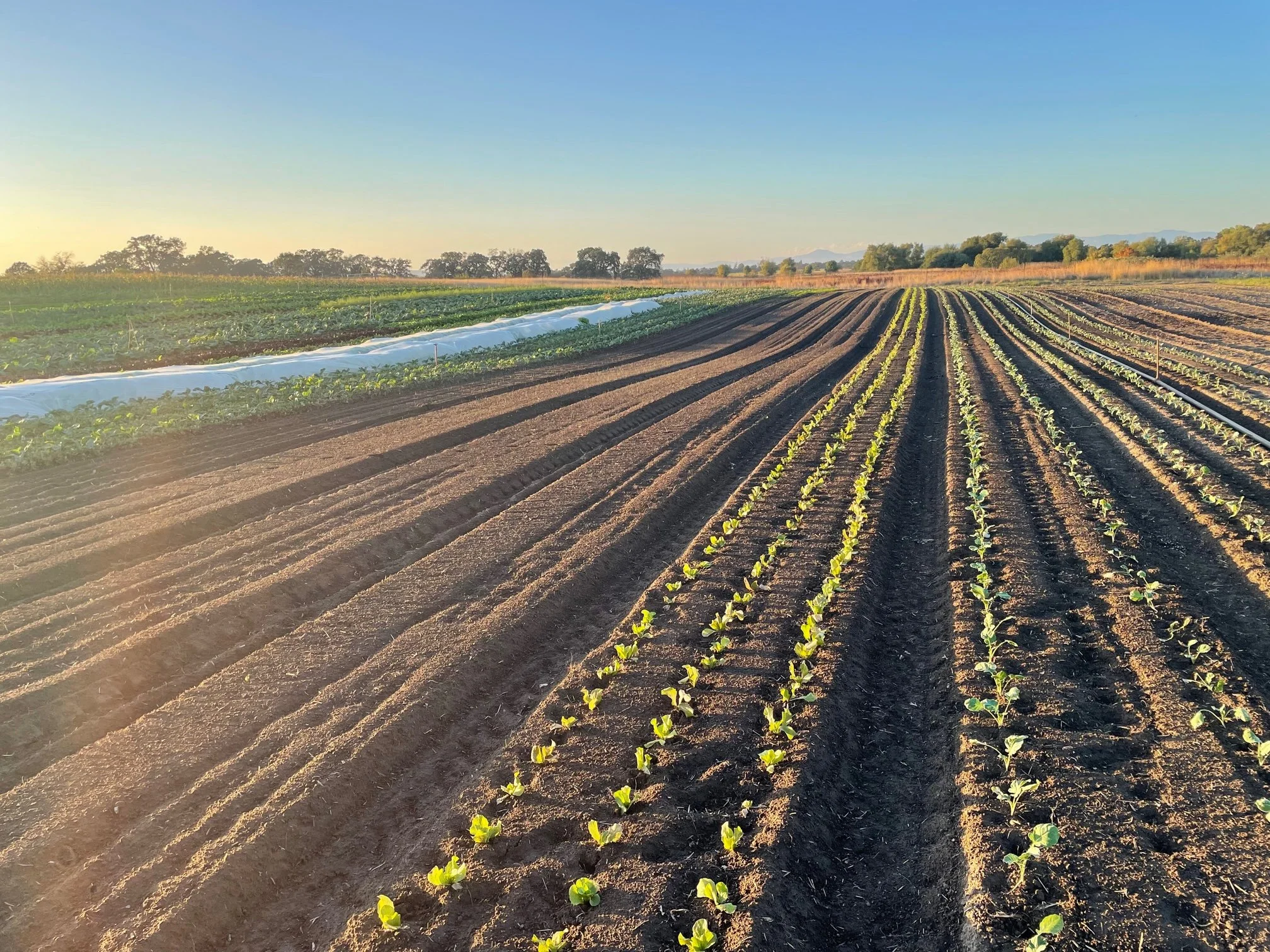
Fall veg is stacking up nicely out in Farfield.

Summer

Almost like a spiritual extension of the wet winter, this summer was unusually cool, which caused numerous more subtle winners and losers in the fields.

First and foremost, the strawberries loved it. There is a reason why 2 billion dollars worth of strawberries are grown in the foggy summers of Salinas and Watsonville. This summer here often resembled those foggy coastal towns and the strawberries felt right at home. It brought us immense joy to see all the strawberry-smeared toddler faces as the plants pumped out hundreds of pints a week. 

Also in the winner camp were all our summer greens, brassicas, and onions. Things like lettuce and celery usually struggle a bit in August and September as the dial on the thermometer creeps up, but they were happy as a clam all summer long. Our onion crop also had their hot-girl-summer and we are rich in softball sized onions to carry us through the end of the year.

The cooler summer shortened our tomato and pepper season a bit — those nightshades need heat to ripen fruit, so the fruiting season was delayed into a slightly shorter, more condensed avalanche. Last week and the week before it was the tomatoes. This week it’s the sweet peppers that are all coming on at once.

On the other hand, the cooler days preserved what fruits did ripen on the vine for longer, and caused less sunburn and loss, and may have contributed to a better, bulkier tomato year overall. These are the things we farmer ponder.

Aye, watching plants respond — in sometimes unexpected ways — to what nature throws at them is one of the coolest things about farming. 

Fall

Now we head out to the last quarter of this football game. What hand will be dealt? Will the rains come hard and early, or will it be a dry and hot fall? No one but the Farm Gods know.

But our fall field of greens and fresh vegetables looks stacked out there in Farfield; our potatoes are coming in round and sound; Kayta and I had the best Delicata of our lives last night; and this crew is top-notch. 

So I’d wager we’ll have a victoriously tasty Autumn. 

See you in the fields,
David