
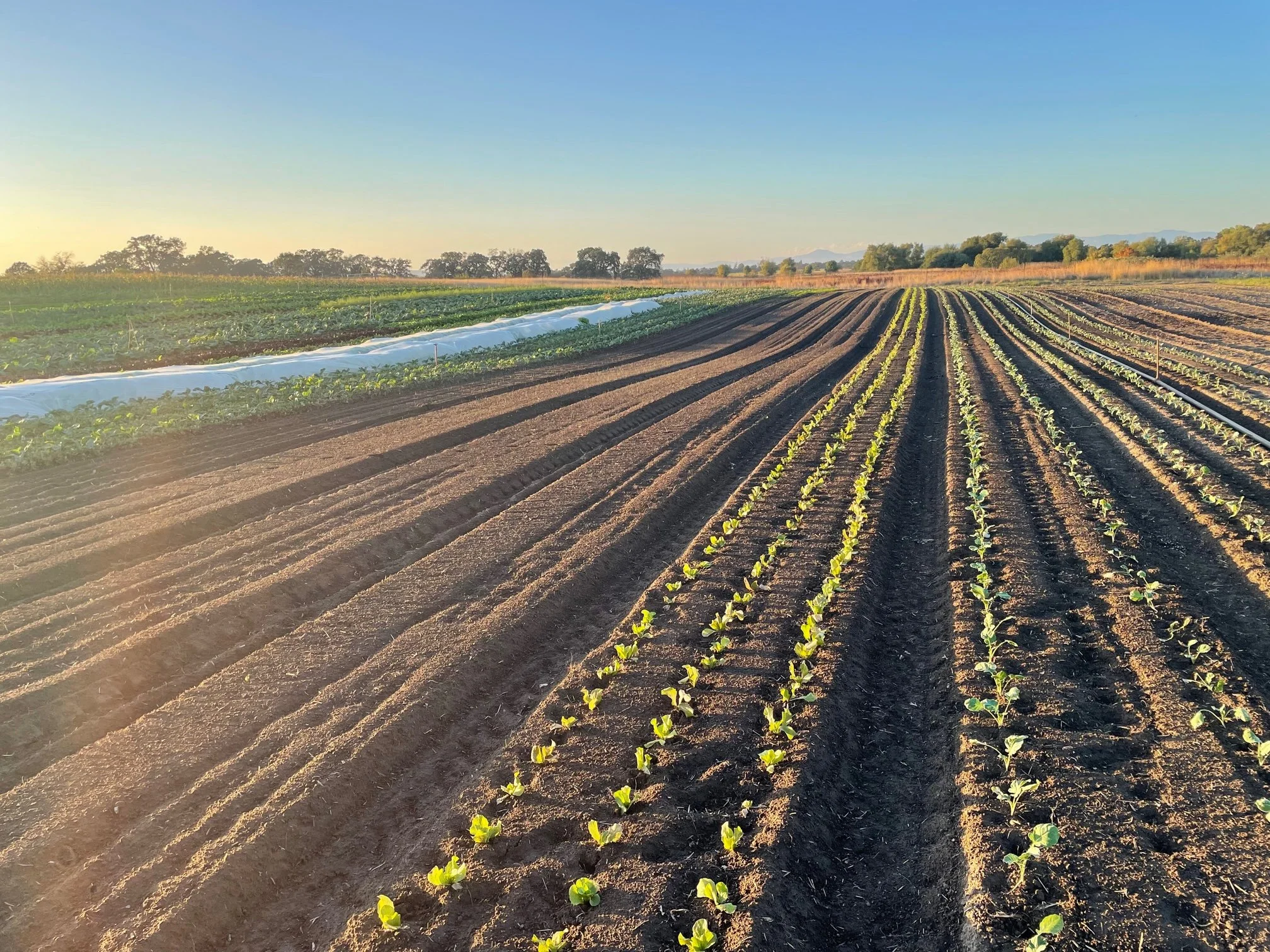
7/8/2022 - Week 5 - Veggie Choreography

THIS WEEK’S HARVEST

Cipollini Onions, Sunrise Carrots, Easter Egg Radishes, Garlic, Fennel, Olympian Cucumbers, Summer Squash & Zucchini, Dino Kale, Supernova Lettuce Mix, Mei Qing Bok Choi, Kohlrabi, Scallions, Arugula, and Mustard Mix

We hope you feel like this froggy in the garden this week. (Photo by CSA member Kim LaVere)

U-PICK

  • Albion Strawberries

  • Jalapeño Peppers

  • Frying Peppers: Shishitos and Padróns (see last week’s Newsletter for harvest and cooking tips

  • Herbs: Dill, Thyme, Oregano, Marjoram, Italian Parsley, Tarragon, Onion Chives, Garlic Chives, Vietnamese Coriander, Culinary Lavender, Culinary Sage, French Sorrel, Lemon Verbena, Cilantro, Tulsi, Various Mints, Catnip, Chamomile, Purple Basil, Genovese Basil, Thai Basil

  • Flowers!

HARVEST NOTES

Frying Peppers: Every year we grow two different varieties of these beloved peppers. Both are incredibly delicious fried in hot olive oil until browned, sometimes with a dash of lemon or smoked paprika, and always with a liberal sprinkle of salt. Because of their differing thicknesses, we recommend frying them separately so as to get each variety perfectly done. A plate of just-off-the-stove frying peppers is an irresistible appetizer or snack.

  • Shishitos: these Japanese frying peppers are long and wrinkled with delicate, thin walls. Best picked between 3-4” long, they are almost never spicy, and will eventually ripen to a sweet red. Also incredible as tempura.

  • Padróns: The famous Spanish heirloom, named after their town of origin. Padróns are served sautéed in olive oil with a little sea salt, and eaten as tapas in Spain. Ideally harvest when they are 1" to 1 1/2" long. About 1 out of 10 fruits will be hot. All the fruits become hot if allowed to grow 2-3" long.

Scallions: We’ll have another appearance of our beautiful Guardsman Scallions in the share this week. If you’re looking for some inspiration, and have time for a project, try these deliciously layered and flaky Chinese Scallion Pancakes!

Scallion Pancakes recipe

By Sue Li, FROM BON APPETIT

Ingredients

Makes 8 Servings

PANCAKES

  • 2½ cups all-purpose flour, plus more for surface

  • Kosher salt

  • 1 tablespoon toasted sesame oil

  • ⅓ cup chicken fat, warmed, or vegetable oil

  • 2 bunches scallions, thinly sliced (about 2 cups) — (or 1 bunch of our giant scallions)

  • 8 tablespoons vegetable oil, divided, plus more for brushing

SAUCE

  • 3 tablespoons unseasoned rice vinegar

  • 2 tablespoons soy sauce

  • 1 teaspoon chili oil

  • ½ teaspoon sugar

  • ¼ teaspoon crushed red pepper flakes

Preparation

PANCAKES

Step 1

Whisk 2½ cups flour and 1 tsp. salt in a large bowl. Mix in sesame oil and 1 cup boiling water with a wooden spoon until a shaggy dough forms.

Step 2

Turn out dough onto a lightly floured surface and knead, adding flour as needed to prevent sticking, until dough is smooth, about 5 minutes. Cover; let rest at room temperature 1 hour.

Step 3

Divide dough into 8 pieces. Working with one at a time, roll out on a lightly floured work surface as thin as possible (each should be approximately 10" in diameter). Brush about 2 tsp. chicken fat on dough and top with about ¼ cup scallions; season with salt. Roll dough away from you (like a jelly roll) into a thin cylinder, then, starting at 1 end, wind roll onto itself to create a coil (like a cinnamon roll). Cover and repeat with remaining dough. Let rest at room temperature 15 minutes.

Step 4

Working with 1 coil at a time, roll out on a lightly floured surface to a 5" round (keep other coils covered). Repeat with remaining dough and stack as you go, separating with parchment or lightly greased foil brushed with vegetable oil.

Step 5

Heat 1 Tbsp. vegetable oil in a medium skillet over medium-low. Working with one at a time, cook pancake, turning frequently to prevent scallions from burning, until golden brown and crisp on both sides and cooked through, 8–10 minutes. Transfer pancakes to a wire rack and let rest about 5 minutes before cutting into wedges.

SAUCE

Step 6

Whisk vinegar, soy sauce, chili oil, sugar, and red pepper flakes in a small bowl until sugar is dissolved. Serve alongside pancakes for dipping.

Agrostemma, Chamomile and Cosmos in the garden.

FOOD FOR THOUGHT

People sometimes asks what happens to leftover WCCFarm food at the end of pick-ups. We’re so happy that for the last few years it has gone to Food For Thought via a relationship setup and facilitated by CSA member Helen Myers. Food For Thought is a non-profit food bank that provides meals to people with serious illness in Sonoma County.

Thank you Helen, Kim and Laura, and everyone at Food For Thought!

FARMER’S LOG

VEGGIE CHOREOGRAPHY

We had a great, productive week out here in the fields! A big chunk of time was aimed at trellising our “how-did-you-get-so-big!?” tomato plants. We weeded our storage onion pathways and hand weeded our second succession of carrots. We set up an irrigation block for our 3rd and final fall storage carrot (and beet) beds across the creek. And on Thursday we transplanted our 3rd and final Fall cabbage patch and seeded our 5th of 13 arugula and mustard greens beds.

Sometimes people are curious, "How do you know what to plant and when?"

Crop planning, as we call it, looks different on every farm, here’s a little rundown of how it works at WCCF…

Working Backwards

Every Winter, since 2016, Kayta and I hone examples of the harvest shares we want to have for people in the Spring, Summer, and Fall. That goes something like…

“Well, we gotta have alliums every week. What’s life without alliums?”
“And snack crops! The kiddos gotta have snacks!”
“Lettuce and carrots = always.”
“And fancy salad greens too”
“Yeah, and some sort of hearty green for braising and sides.”
“And novelties to keep it fun: Corn, scapes, fennel, kohlrabi…”
“What flowers are possible in early June?”
“What are the most epic 9 Winter Squash varieties to dole out in the Fall?” Etc, etc….

From these envisioned harvests, we work backwards. Using harvest and planting logs (and memories) from seasons past regarding yields and how much people took, and taking into account each crop’s “days to maturity", heat and frost sensitivities, yield expectations, things like that, we can deduce a pretty good idea of how many seeds to sow in the greenhouse and fields and when.

A Dance of Time Scales

When things are sown so we have it when we want it depends on each individual crops days to maturity. For example, we like to have nice arugula and mustard greens every week from June-December. Arugula and mustards are a super fast maturing (~25 days from germination to harvest) so we sow 150 ft bed feet of arugula every other week from May 8th until September 25th. Carrots, on the other hand, take 75-90 days to mature. They also have a much larger harvest window (meaning we can harvest off the same planting for over a month). So for carrots we sow 3 larger blocks, the first on April 24th, and the last in mid-July, and that will give us fresh bunched and loose carrots all the way until mid-December. On the long end of the spectrum are crops like Hopi Blue Corn, Pumpkins and Winter Squash. These crops we plant once, as they take all season to mature, and we enjoy them in the Fall.

And so it goes that each Spring we embark with a neat greenhouse sowing and field planting schedule — a musical score to a carefully choreographed dance with the time-scales of plants. These schedules become the drum-beat of our weeks and eventually become the harvest shares you see each week!

Farfield (aka Food Field) across the creek with this year’s potato crop, storage onions, and dried corn and winter squash (not pictured).

Rubber Hits the Road

On our farm, greenhouse sowings begin in early February with slow maturing flowers, alliums, nightshades, and apiaceae and they continue with the last lettuce sowing in October; field seedings begin with the first Carrot sowing, April 24th and the last arugula and mustards sowing late September.

Harvest is when the real work of crop planning— namely the note taking and record keeping — begins. What actually happened? How many bed-feet of cabbage were transplanted? How much cabbage did we harvest and how much did people take home? Was it enough? Was it too much? How much too much? How did that variety hold up to the heat of July? Some things we don’t need to take notes on, like Sarah’s Choice cantaloupe being the best melon of all time. We remember that one.

Record keeping, planting, harvest and CSA pickup logs are the name of the game for us. Every Thursday Kayta and I take a walk through the fields looking to see what we can offer in the harvest that week. Kayta looks at how much people took home of various crops in the previous week (and previous years) to estimate how many bins to harvest. We also look at crops we’ve just finished harvesting from. Every year, for example, it seems we are uber rich in lettuce right around the summer solstice because of how quickly it grows. So we will adjust our future plantings down a notch around then and increase back to normal as the light fades.

Indeed, the most sacred objects on the farm are the famous scrumpled “Harvest Log” composition notebook and a dirty old binder that lives in the truck labeled “Planting Log”. These are outward symbols of our slowly amassing memory of successes and failures that will help us, each winter, to create a planting plan ever more refined and custom tailored to this soil and this micro-climate and this CSA.

Painting with Seeds

But the “art” and the heart of crop planning for us is in taking all of this business and planting for harvests that harmonize with the seasons, surprise, delight, and help CSA members fall in love with food and flowers every week.

If everything goes to plan this year, for example, you should experience a seasonal arc of alliums. The fresh garlic, scallions, and cipollini onions of Spring will soon give way to the full sized, rich Cabernet Red, Walla Walla Sweet, and Torpedo bulbs of Summer which will in turn give way to the solid, crispy-paper-cured orbs of late Summer and Fall. In this way we hope our allium crop plan, and our whole crop plan, is a love song to seasons and the soil.

They say, "If you want to make God laugh, make a plan." But, with some elbow grease and a little bit of luck, I think we are we're well on our way to pulling off our 400 row, 60 column “2022 Crop Plan.xlsx”!

Thanks to a little help from our friends...

See you in the fields,

David and Kayta

7/2/2022 - Week 4 - Ode to the Onion

THIS WEEK’S HARVEST

Cipollini Onions, Sunrise Carrots, Easter Egg Radishes, Garlic, Fennel, Olympian Cucumbers, Green Zucchini and Yellow Crookneck Squash, Collards, Cegolaine Little Gems, Green Butter Lettuce, Salanova Mini Lettuces, Arugula, and Mustard Mix

U-PICK

  • Albion Strawberries

  • Sugar Snap Peas

  • Jalapeño Peppers

  • Frying Peppers: Shishitos and Padrons

  • Herbs: Dill, Thyme, Oregano, Marjoram, Italian Parsley, Tarragon, Onion Chives, Garlic Chives, Vietnamese Coriander, Culinary Lavender, Culinary Sage, French Sorrel, Lemon Verbena, Cilantro, Tulsi, Various Mints, Catnip, Chamomile, Purple Basil, Genovese Basil, Thai Basil

  • Flowers!

David surveying the potatoes in the far field on a foggy morning.

HARVEST NOTES

Frying Peppers are here! Every year we grow two different varieties of these beloved peppers. Both are incredibly delicious fried in hot olive oil until browned, sometimes with a dash of lemon or smoked paprika, and always with a liberal sprinkle of salt. Because of their differing thicknesses, we recommend frying them separately so as to get each variety perfectly done. A plate of just-off-the-stove frying peppers is an irresistible appetizer or snack.

  • Shishitos: these Japanese frying peppers are long and wrinkled with delicate, thin walls. Best picked between 3-4” long, they are almost never spicy, and will eventually ripen to a sweet red. Also incredible as tempura.

  • Padróns: The famous Spanish heirloom, named after their town of origin. Padróns are served sautéed in olive oil with a little sea salt, and eaten as tapas in Spain. Ideally harvest when they are 1" to 1 1/2" long. About 1 out of 10 fruits will be hot. All the fruits become hot if allowed to grow 2-3" long.

Herb Inspiration: This is probably the last week to pick from our abundant cilantro succession before it begins sending up its white flowers (and later coriander seeds!). To take advantage of it before it goes, we highly recommend making a green sauce that’s a play on chimichurri or pesto. While you can use any combinations of herbs from the garden, we’ve been enjoying equal parts parsley and cilantro, with a little bit of mint, chopped or blended with raw garlic, lemon and lemon zest, olive oil and salt. Use as a zingy topping on any hearty food — roasted cipollini onions or grilled summer squash for instance. Will keep one week in the fridge, so if you make a big batch it’s best to freeze some for later use.

Fresh Cipollini Onions: “Round roses of water.” Fresh, turgid, a summer treat. The innocent, uncured form of the onion.

From left to right: Shishitos, Jalapeños, and Padrons.

FARMER’S LOG

ODE TO THE ONION

It was a busy week on the farm as we started to turn our attention to maintenance after Spring’s big planting push. In between harvests, we planted the last of the years melons (watermelons and Sarah’s Choice Cantaloupe); the 2nd to last cucumber succession; and our Fall leeks! We trellised lots of tomatoes and finally got around to hilling our potatoes, and we had some amazing help cultivating some overgrown areas of the farm.

Today was a fun harvest. Lots of new things to share with you all.

It is always a happy day the day we harvest the first fresh onions of the year, their bellies “grown round with dew”. So this week, in honor of this week’s Cipollinis, we'll leave you with the one-and-only, Pablo…

Schizanthus, also known as Poor Man’s Orchid, or Angel’s Wings.

Ode to the Onion
by Pablo Neruda

Onion,
luminous flask,
your beauty formed
petal by petal,
crystal scales expanded you
and in the secrecy of the dark earth
your belly grew round with dew.
Under the earth
the miracle
happened
and when your clumsy
green stem appeared,
and your leaves were born
like swords
in the garden,
the earth heaped up her power
showing your naked transparency,
and as the remote sea
in lifting the breasts of Aphrodite
duplicating the magnolia,
so did the earth
make you,
onion
clear as a planet
and destined
to shine,
constant constellation,
round rose of water,
upon
the table
of the poor.

You make us cry without hurting us.
I have praised everything that exists,
but to me, onion, you are
more beautiful than a bird
of dazzling feathers,
heavenly globe, platinum goblet,
unmoving dance
of the snowy anemone

and the fragrance of the earth lives
in your crystalline nature.

See you in the fields,

David & Kayta

FARM ORIENTATION TOURS

If you are a new or returning member who hasn’t had an orientation tour yet, please check in with one of the farmers when you come to a pickup.

FARM BASICS

Times & Dates: Our 2022 CSA harvest season will run from June 11th - December 6th.

  • Saturday harvest pick-ups run from 9:00am - 2:00pm

  • Tuesday harvest pick-up run from 1:00 pm - 6:00 pm

Members and their guests may visit the farm any time, 7 days a week, sunrise to sunset, to enjoy the farm and u-pick.

Where is the farm? The member parking lot is located at 1720 Cooper Rd., Sebastopol, CA 95472. It is the long gravel driveway to the left. Kiddos crossing. Please drive slowly.

Parking: Please find a parking spot under the solar panels to your left, or along the straw bales further down.

Where is the food! The pick-up barn is to your right with the beautiful mural on it.

What should I bring to the farm?:

  • Extra plastic produce bags (if you have them) to cut down on plastic waste

  • A pint basket or other pint measure and a basket for u-pick crops

  • A vase or water bottle to keep your flowers and herbs happy on the drive home!

  • Clippers to cut flowers and herbs

  • Water / sun hat / picnic supplies if you plan to stay awhile!

6/24/2022 - Week 3 - Apples to Oranges

THIS WEEK’S HARVEST

French Breakfast Radishes, Fennel, Scallions, Hakurei Turnips, Rainbow Chard, Green Zucchini and Yellow Crookneck Squash, White Satin Carrots, Kohlrabi, Rosaine Little Gems, Cherokee Summer Crisp Lettuce, Salanova Mini Lettuces, Arugula, and Mustard Mix

U-PICK

  • Albion Strawberries

  • Sugar Snap Peas

  • Herbs: Thyme, Italian Parsley, Tarragon, Onion Chives, Garlic Chives, Vietnamese Coriander, Culinary Lavender, Culinary Sage, French Sorrel, Lemon Verbena, Cilantro, Tulsi, Various Mints, Catnip, Chamomile, Purple Basil

  • Flowers!

STORING YOUR STRAWBERRIES

If you manage to make it home with a few pints of strawberries, you might wonder how best to store them. CSA member Lillie Dignan was kind of enough to share her tried and true method for storing ripe strawberries in the fridge so they last all week, or more!

Estimated kitchen time: 5-10 minutes

  • Step 1. Pick lots of delicious, red strawberries from the fields of your amazing CSA. (If any berries are almost over ripe, just eat them immediately. Yum.)

  • Optional: Cleanup the berries a bit by simply pinching off the leaves or totally hulling with a knife.

  • Step 2. Fill a pot, bowl, or sink basin with cool water. Add some vinegar to the water. (I’ve read directions for up to a 1:3 ratio of vinegar to water, but I just use a glug per quart of water and it works just fine.) Put all your berries into the vinegar-water for 1-5 minutes. They get a nice, cleansing rinse! And no lingering vinegar tang, I promise!

  • Step 3. Spread the berries out on a towel to dry a bit. I like to put a cooling rack underneath for max airflow. The drier the better, but often I just wait a few minutes.

  • Step 4. Line an airtight container with a cloth napkin or paper towel, and carefully tuck all the strawberries into it. Cover and store in fridge. The towel absorbs extra moisture, and the lid protects these gentle berries from your fridge.

  • Step 5. Eat ‘em all up! Every day! Enjoy the taste of these SWEET BURSTS OF SUMMER JOY.

FARMER’S LOG

APPLEs to ORANGES

Some curious members have asked us what differences we’ve noticed farming here compared to Green Valley. We are so new here that we’re still sorting it all out ourselves, but here are a few first impressions…

The soils: Like Green Valley, the topography here is complex. This isn’t Kansas, Toto. There are slopes and drainages, dips and mesas. So, like Green Valley, there is a gradient of soils ranging from light and sandy to sticky clay. Technically, the gradient is between two soils, Blucher loam and Wright loam. The Blucher loam (which hosts the garden, the strawberries, the u-pick field, and the upper part of our fields across the creek) is like a Sunday picnic in the park. It is so sandy, easy, light and forgiving. The gophers and the spades swim through it like water. I would give lots of things for the whole farm to be this soil. We didn’t have anything like Blucher loam in Green Valley, and farming it feels like a we’ve died and gone to heaven… except for the Dune sandworm sized gophers. But that would make things too easy, so the majority of the farmable land here in the flooding low lands is Wright loam, which is actually quite similar to the soil at Green Valley. It is good, rich soil, but not super easy to work. It has more clay and takes some skill to get good tilth. But we cut our teeth on similar stuff at Green Valley we feel right at home.

The critters: Green Valley was a relatively remote place, surrounded by forest. It was also quite a dry place being so high up in the watershed. The Laguna de Santa Rosa is the opposite, it is a veritable freshwater oasis. And an oasis is a busy place. Critters abound! We’ve noticed there are a lot more “pests” here than there were at Green Valley. Some of that has to do with this having been a vegetable farm for almost 40 years — classic farm pests like flea beetles, as well as classic farm weeds, are much more predominant. But the ecosystem also just feels busier here. With the Laguna so close, there are a lot more birds, deer, aforementioned gophers, and buggies all making their boisterous lives here. While it might mean a few more chomped lettuces, at the end of the day we are so grateful for the company.

The light: Our crops and the weeds have grown so astonishingly fast in the last couple of weeks it has us contemplating solar energy all over again. In our area, there is about 20% more daylight on June 21st than there is on March 21st. That’s not to mention the changing angle of the sun. Furthermore, at the new farm, we aren’t surrounded by hills to the East and West like we were at Green Valley which, we estimate, shaved off about %15 of the direct-sun day-length to our fields there. All that’s to say, stuff is growing faster than we’ve ever seen here right now! Case in point, the Jack-O-Lanterns growing right next to the parking lot were planted just 21 days ago.

Proximity: Perhaps the most exciting difference we’ve noticed about the new farm is how much easier it is for most of our members to access. That has meant more people than ever before just dropping in to enjoy the farm and garden on off-days, in the mornings, in the evenings, enjoying a solitary morning picking, bringing friends through to picnic, picking flowers with their kids, etc… which is basically the whole point of the farm, so we are over the moon about that.

That’s it for some off-the-cuff observations after our first few months farming here. Many more to come!

See you in the fields,

David & Kayta

FARM ORIENTATION TOURS

If you are a new or returning member who hasn’t had an orientation tour yet, please check in with one of the farmers when you come to a pickup.

FARM BASICS

Times & Dates: Our 2022 CSA harvest season will run from June 11th - December 6th.

  • Saturday harvest pick-ups run from 9:00am - 2:00pm

  • Tuesday harvest pick-up run from 1:00 pm - 6:00 pm

Members and their accompanied guests may visit the farm any time, 7 days a week, sunrise to sunset, to enjoy the farm and u-pick.

Where is the farm? The member parking lot is located at 1720 Cooper Rd., Sebastopol, CA 95472. It is the long gravel driveway to the left. Kiddos crossing. Please drive slowly.

Parking: Please find a parking spot under the solar panels to your left, or along the straw bales further down.

Where is the food! The pick-up barn is to your right with the beautiful mural on it.

What should I bring to the farm?:

  • Extra plastic produce bags (if you have them) to cut down on plastic waste

  • A pint basket or other pint measure and a basket for u-pick crops

  • A vase or water bottle to keep your flowers and herbs happy on the drive home!

  • Clippers to cut flowers and herbs

  • Water / sun hat / picnic supplies if you plan to stay awhile!