7/16/2021 - Catnip & Queen Anne's Lace

IN THE FLOWERS THIS WEEK

Of the new faces in the garden this week, we wanted to highlight two in particular.

  • Chocolate Queen Anne’s Lace: These beauties have been selected to enhance the delicate pinks and purples that are sometimes found in the wild strain. While beautiful at every stage, it’s best to harvest once the flowers are fully open and laying flat. If picked earlier they have a tendency to wilt. Find them just above the cilantro.

  • Breadseed Poppies: We are trialing a few very dramatic breadseed poppies this year. You’ll find them above the agrostemma on the side closest to the stairs. While glamorous, breadseed poppies have an incredibly short vase life as a cut flower, unless their cut stem is dipped in boiling water for 7-10 seconds. That said, they look stunning in the garden, the bees love them, and best of all, the seed heads, green and dried are a beautiful addition to bouquets.

On the left, Dara Queen Anne’s Lace and on the right Danish Flag Poppy.

On the left, Dara Queen Anne’s Lace and on the right Danish Flag Poppy.

Pro-tip: The vase life of flowers is affected in part by how far along they are in the process of blooming. While we love the exuberance and ephemerality of a flower in full-blown glory, it’s also fun to also experiment with picking them at earlier stages: a bud, a half opened flower, and then watching them come into bloom in your vase, changing before your eyes.

This Week’s Flower Challenge: A practice in simplicity. First of all, please pick an abundance of flowers. Make a giant bouquet. But, in addition, keep an eye out for individual stems that call to you. Place each one in a vessel of its own — a bud vase, a glass, a shapely kombucha bottle — and sprinkle through your house. For maximum enjoyment, consider the tip above.

IMG_2398.JPG

IN THE HERBS

  • Oregano, Marjoram, Thyme, Chives & Garlic Chives, Lemon Balm, Lemon Verbena, Chamomile, Tulsi Basil, Purple & Green & Bi-color Shiso (aka Perilla), Mints, Italian Basil, Purple Basil, Thai Basil, Cilantro, Dill, Anise Hyssop, Sage, Tarragon, and Vietnamese Cilantro, Culinary Sage

This Week’s Featured Herb: Catnip! As one of our favorite seed catalogs Wild Garden Seed put it: “Now really, who doesn't enjoy having a bit of a nip in the evening with the cat? Or watching the neighborhood felines sneak over to have a private party in the catnip patch? That's why we have it around. But catnip turns out to be as attractive to bumble bees and butterflies as to cats, and I enjoy their enjoyment as immensely as los gatos. I also find the smell refreshing, and the flowers are beautiful in their own right. Flower folks will find it useful as greenery and filler, and of course it makes a calming tea.” You’ll find our catnip freshly labeled and growing in a wine barrel near the lemon verbena.

NOTES & REMINDERS

  • Confused? Ask us! If you’re ever confused about anything in the garden, don’t hesitate to ask us in person or via email. We love helping you use the garden!

  • How do I find the herbs? All herbs that are ready to pick are marked with a colored stake with the name of the herb on it.

FARMER’S LOG

The Farm Gods and/or the Gnomes have been slightly angered with us this week (irrigation risers blowing up; tractors not starting; tools mysteriously walking away) so this week we must leave in you the soft yet weathered hands of an old Farmer’s Log:

EQUINOX TURNINGS - 9/15/2020

At 6:30 AM this Tuesday morning, the sun will cross the plane of the equator — the autumnal equinox.

It struck me today how the tasks of pulling off the farm year harmonize with the seasons in such a way that it always seems like there is just enough time to accomplish what needs to be accomplished by the skin on our chinny-chin-chins.

The Byrds were right: To everything, there is a season. 

In the Spring, you aren’t harvesting yet so you have all the time in all the medium-length days to prep the canvas and plant out the farm; to expand the propagation zone and build new irrigation systems; to fix gates; to seed 60 trays a week in the greenhouse; to pot up tomatoes, to stake tomatoes, to trellis tomatoes; to mow cover crop and turn soil and shape beds and plant! plant! plant!

Then harvest seasons starts and two, then three, then then four days of the week are consumed with reaping the fruit of Spring’s labor. You put down the hammer and take up the harvest knife. All other projects cease. Planting and harvesting are your life — some weeding if you’re lucky. The days are at their longest. If there is ever a time to be harvesting 1,000+ pounds of cucumbers, tomatoes and squash in the morning, prepping and planting out half mile in the afternoon, it is when there is 16 hours of daylight.

Before you know it, it’s late Summer. The tomatoes start exploding, the cucumbers already are, you’re still planting like crazy and then the melons come in — and just when you think you’ll break, that there isn’t enough time in the day, you scroll down on your crop plan and you see that plantings are nearly done. No more compost spreading; no more bed shaping; greenhouse seedings shrink. You plant the last Fall brassicas in the field, the tractor sits quiet for a minute, and you can spend all day amongst the vines and in the cooler playing Tetris with boxes of Summer fruit. 


Then comes the Autumnal Equinox.

The tomatoes are still pumping and the potatoes and winter squash start to die back; the corn fills out, crisps up. The big harvests are coming. Space needs to be cleared. Winter is just around the corner so you need to establish garlic and strawberries for next year; mow and hold over spent beds, lime new fields, and get ready for cover cropping — and just when you think you’ll break, that there isn’t enough time in the shortening days the heat ebbs, the tomatoes start to show signs of slowing down. A light frost will soon roll through the farm. Smiling friends will come to help you harvest your winter squash. Chilling morning air goes down like a draught of ambrosia. You seed the last lettuce of the season. You have a moment sit down and calculate your garlic seed and cover crop order.

All this is why you won’t ever hear a farmer say, “Shucks! Summer is over.” We are greedy for the turnings. We love nothing more than a first harvest. But first tomato harvest glory fades under the weight of tomato crates and we crave cold hands and cozy coats and the crisp snap of the stem of a plump radicchio glowing in morning sun. Lucky for us, when scolding kiddos for running through the corn becomes sad and hackneyed, Autumn comes, and we can yell, “Come! Knock it down! Gather armfuls of cobs!” 

Change is our tonic — one of the great sustaining elixirs of farm life.

Soon, Winter will come. It’s so close now we can almost taste it. The rains will fall and we will turn in — to rest, rejuvenation, and internality. We’ll clean up our books, do our taxes; we’ll look back on the year and create next year’s crop plan and next year’s budget. We’ll open CSA sign-ups. We’ll look at spreadsheets, sit, think, build, fix things, and sleep. 

But ample sleep turns into insomnia; too much internality into angst. We will get pudgy, our harvest muscles will atrophy, and we will forget for what we are doing out in the wet and the cold — and just when we think we’ll break, that there is too much open-endedness in the too short days, the sun will return. We will hear the Swainson’s Thrush calling us, beckoning us, “Come out! Build it up again! Plant! Turn! Turn! Turn!”

See you in the fields,
David for Kayta, Kate, and Anna

Click here for an archive of past newsletters

7/8/2021 - Space Walks

IN THE FLOWERS THIS WEEK

If the first month and a half of the flower garden were the lift off phase — the launch pad, the rockets pushing, then gaining speed, hurtling towards space — then we have now cleared the stratosphere. It is quiet now. We are surrounded by a galaxy of glittering stars; flowers flashing in and out of existence; each week a bed or two goes supernova… the full mass of its energy erupting in a blinding display of blooms just before the end: This week it’s the Lavatera, Nigella, and Agrostema in supernova. New star clusters flicker into existence: This weeks it’s the Marigolds, the Centaurea, and the Celosias. Bumble bees fly around us like space craft — landing on soft little moons to sleep each night.

IMG_2370.JPG

It’s a great time of year in the garden. We hope you enjoy your space walks.

Pro-tip: It’s best to pick flowers (and herbs) when it is cool out. They’ll last way longer. The ideal time to pick is in the garden is in the morning before it heats up, or the evening. It’s also really helps to put your flowers and herbs in water immediately after picking. So bring a vase or water bottle for the drive home.

This Week’s Flower Challenge: Try making picking a mono-chrome bouquet this week like Kayta’s meditation on white below.

IMG_2348.jpg

IN THE HERBS

  • Oregano, Marjoram, Thyme, Chives & Garlic Chives, Lemon Balm, Lemon Verbena, Chamomile, Tulsi Basil, Purple & Green & Bi-color Shiso (aka Perilla), Mints, Italian Basil, Purple Basil, Thai Basil, Cilantro, Dill, Anise Hyssop, Sage, Tarragon, and Vietnamese Cilantro, Culinary Sage

Pro-tip: The Cilantro and Dill are both looking like they’re about to bolt (go to seed) with the heat. They grow up so fast! We would appreciate it if you picked them hard this week to delay their seed phase.

This Week’s Featured Herb: Shiso (aka Perilla) is exploding in the garden now. It’s the perfect time to give this less common, delicious herb a try.

Shiso, in many cultivars, is eaten all over Asia. Each of the three kinds we are growing this year has a distinct flavor -- we recommend nibbling a little bit fresh to get a sense of which one you would like to use for what. Some ideas to get you started eating shiso:

  • Try putting it in spring rolls!

  • Try the green perilla simply chopped on a rice bowl

  • Make shiso pesto, just as you would a basil pesto

  • Try making this beautiful, bright red shiso juice from the Japanese purple shiso

  • Make a shiso simple syrup out of any type to add to summertime beverages like lemonade or cocktails!

The Shiso bed below the dill bed.

The Shiso bed below the dill bed.

NOTES & REMINDERS

  • Confused? Ask us! If you’re ever confused about anything in the garden, don’t hesitate to ask us in person or via email. We love helping you use the garden!

  • How do I find the herbs? All herbs that are ready to pick are marked with a colored stake with the name of the herb on it.

FARMER’S LOG

As you probably guessed last week, this section of the Newsletter — the Farmer's Log — is a journal of whimsical and practical musings from planet farm!

This week, we thought we'd offer a little compendium of past Farmers Logs for new members among us to get to know us better!

Did you know, Green Valley is really wild place? Read about it here, or hear tell of an Owl brood and the mysterious flight of the owlets, oak trees, or one quick little baby turkey!

Bumble bees asleep on flowers in the evening. Wouldn’t you?

Bumble bees asleep on flowers in the evening. Wouldn’t you?

Have you ever wondered about your farmers' super hero powers and their favorite Spice Girls, when they fell in love with farming, what they talk about in the field, or what a week in the life is like?

Ever wondered if there is a ghost on the farm?

Enjoy these stories from past years and we’ll see you next week for a new one.

See you in the garden,
David & Kayta

Click here for an archive of past newsletters

7/1/2021 - Plan F

Dear Members,

The cacophonous explosion of Summer in the garden is here.

Every time we walked through the garden this week it seemed to scream at us, “Hey Farmer! Look at me, it’s high-time for a Newsletter!” Even Nuthenroy the Gnome cast us a side eye today and he doesn’t even own a computer…

With this year’s vegetable production droughted-out, we wondered if we would continue our weekly Newsletter tradition. The truth is, it’s a ritual that connects us with you all, the garden, and ourselves — we couldn’t live without. And now, with the grip of June busyness fading, we can finally put pen to paper.

IMG_2224.JPG

These weekly Newsletters you will now receive (until the garden stops its long explosion in October or Nuthenroy says we can stop) will be little verbal odes to what is happening on the farm; little windows into our world; little baskets of tales, tips, and tricks to help you enjoy your year in the garden to the max.

These Newsletter’s will be a little smaller than usual veggie filled tomes, but they’ll be sweet like dessert. They are purely for enjoyment (and inside scoops) and we hope they tickle your fancy like the way Minarda must tickle on a breakfasting Bumblebee’s belly.

Enjoy!

THIS WEEK IN HERBS

  • Oregano, Marjoram, Thyme, Chives & Garlic Chives, Lemon Balm, Lemon Verbena, Chamomile, Tulsi Basil, Purple & Green & Bi-color Shiso (aka Perilla), Mints, Italian Basil, Purple Basil, Thai Basil, Cilantro, Dill, Anise Hyssop, Sage, Tarragon, and Vietnamese Cilantro

It’s ALL happening in herbs this week — especially check out our annuals Parsley, Dill, Basils, and Cilantro, who are at their best on the West side of the garden.

Pro-tip: Tea blends abound in the garden: Sun tea, iced tea or dried tea for winter! Kayta’s been drying little batches of tea herbs (chamomile, lemon balm, mints, tulsi, calendula) in open brown paper bags in the kitchen.

This Week’s Herb Challenge: Try making a chimichurri sauce this week with all exploding fresh parsley, dill, cilantro and basil!

THIS WEEK IN FLOWERS

It’s that special time of year in the garden when a new flower variety seems to start popping each day — check out the Marigolds above the gnome homes.

Pro-tip: This is a great time of year to start collecting the abundant drying flowers so you have a nice stash to brighten up your home in the winter: Strawflower, Statice, and Gomphrena (pictured above) are all great for drying. Just hang them in a cool, dry place out of the sun with good airflow. You can use these same dry flowers in garlic braids in a few weeks!

This Week’s Flower Challenge: Try picking a bouquet that’s twice as big as the bouquet you picked last week! The plants will thank ye for it!

IMG_2243-2.JPG

GARLIC FOR SALE SOON

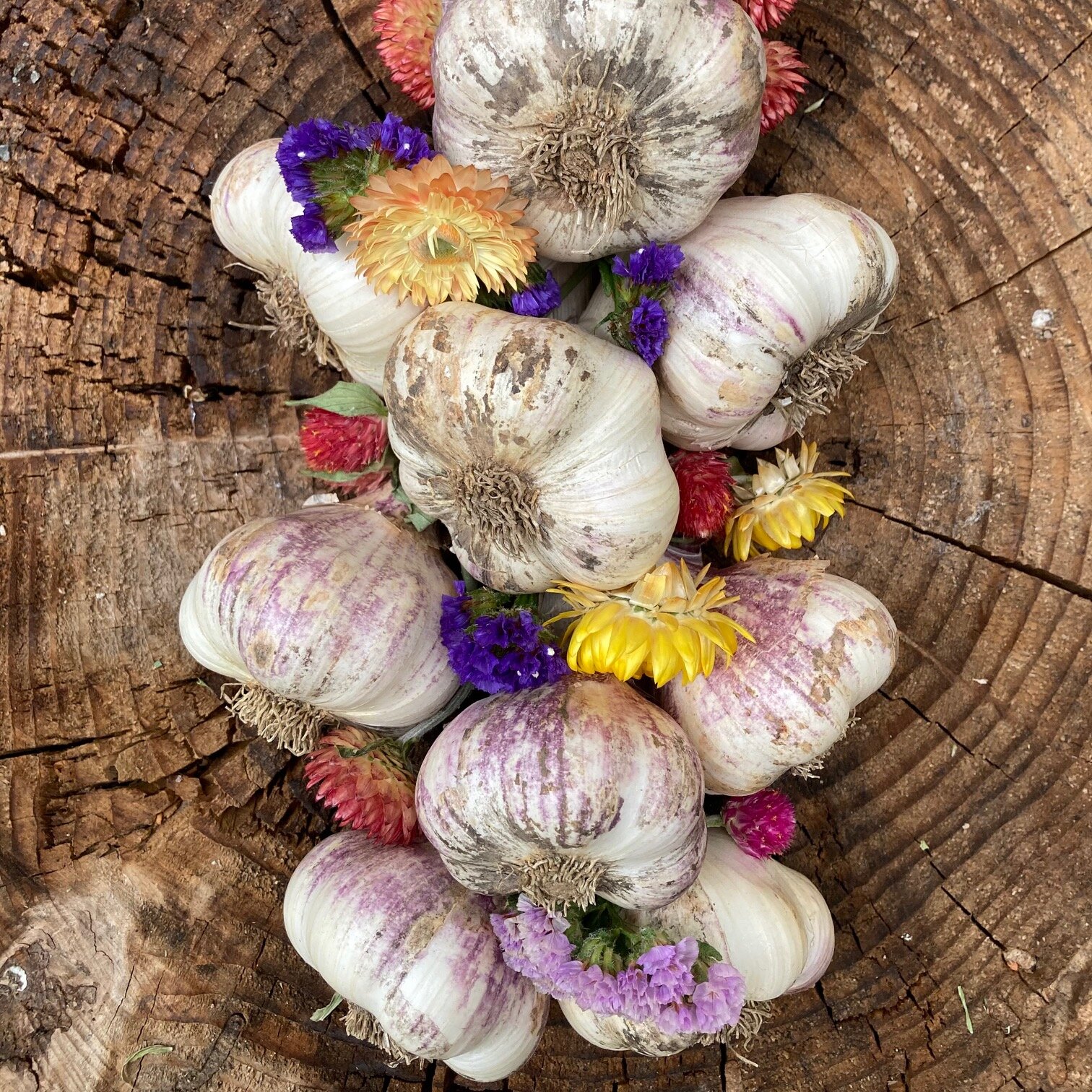
Yes, that is a giant hoard of heirloom Italian garlic drying in our pick-up barn (sorry, vampires). And yes, we will be selling it… as soon as the stalks dry down a bit more (2-3 weeks) we’ll start cleaning it up and offering it by the pound! Stay tuned!

NOTES & REMINDERS

  • Confused? Ask us! If you’re ever confused about anything in the garden, don’t hesitate to ask us in person or via email. We love helping you use the garden!

  • How do I find the herbs? All herbs that are ready to pick are marked with a colored stake with the name of the herb on it.

  • How do I find the flowers? All flowers (besides the ones in the hedgerow on the fence) are yours to pick. We do not label them because they label themselves!

  • How to I harvest the plants? Most of the plants in the garden are properly harvested by cutting above a branching point no lower than halfway down the plant. (This stimulates the plant and allows the branch points you left below to grow!)

  • How much can I harvest? Harvest an amount such that about ninety other shares could harvest the same amount — this will change by plant and by size throughout the life of each plant.

FARMER’S LOG

PLAN F

The first Farmer’s Log of each year is difficult.

The urge is to impart all that has happened over the Winter and Spring — an impossibility, especially with a Winter and Spring as crazy these were. At one point we had so many plans — Plan A, Plan B, Plan C… — that we almost went around the whole alphabet.

Whichever plan we are on now (F?) we are in a great place and feeling so grateful. We miss our vegetable friends dearly; our early morning harvests in the fog; conversations with the crew; the hustle and bustle of Tuesday and Saturday harvest pick-ups. But at the end of the day, we are doing what we love, tending a plants and Gnome Homes for you dear people.

FCCD1490-117E-477F-9D8E-05763A287FF2.JPG

Horticulturally speaking, it was a relatively easy Spring to farm with because it was so dry (ironically). Other years we’ve had to contend with Monster Storms as we worked the soil but this year the garden worked up nice and light. We are lucky that the garden is situated on a high hill though, as this Spring will be known to most farmers in our area as the Spring of late-frosts. Luckily we didn’t have a whole field of tomatoes out in the lower fields and only our Dahlia were singed.

In the Big News category, this Spring and Winter did not withhold! This drought-induced hiatus from vegetable farming has given us a window of opportunity to catch our breath and pursue some big moves for the long-term health of the Green Valley Community Farm sapling.

Firstly, Kayta and I have received approval from the Sonoma County Dept of Agriculture and the Cal Department of Food and Ag to grow a half-acre of cannabis as a row crop in our fields this summer. We’ll write more about that crazy process (and our decision to grow this crop) in next week’s Farmer’s Log. It’s a tale of paperwork, survival, and the love of farming.

And secondly, we’ve been in talks with the lovely Laurel Anderson and Scotty Mathieson (who founded Laguna Farm in the early 90’s) about farming their beautiful, water rich, Valley Oak studded land in South Sebastopol. So with any luck Green Valley Community Farm farmers and lovers shouldn't have to endure a drought year without farm fresh radicchios again. More on that in future newsletters too!

We’ll leave it at that for this year’s Winter and Spring re-cap.

We can’t wait to see what tales are in store for us in the garden and in this Farmer’s Log this quirky year.

Thank you for being our muses.

See you in the garden,
David & Kayta

Click here for an archive of past newsletters