
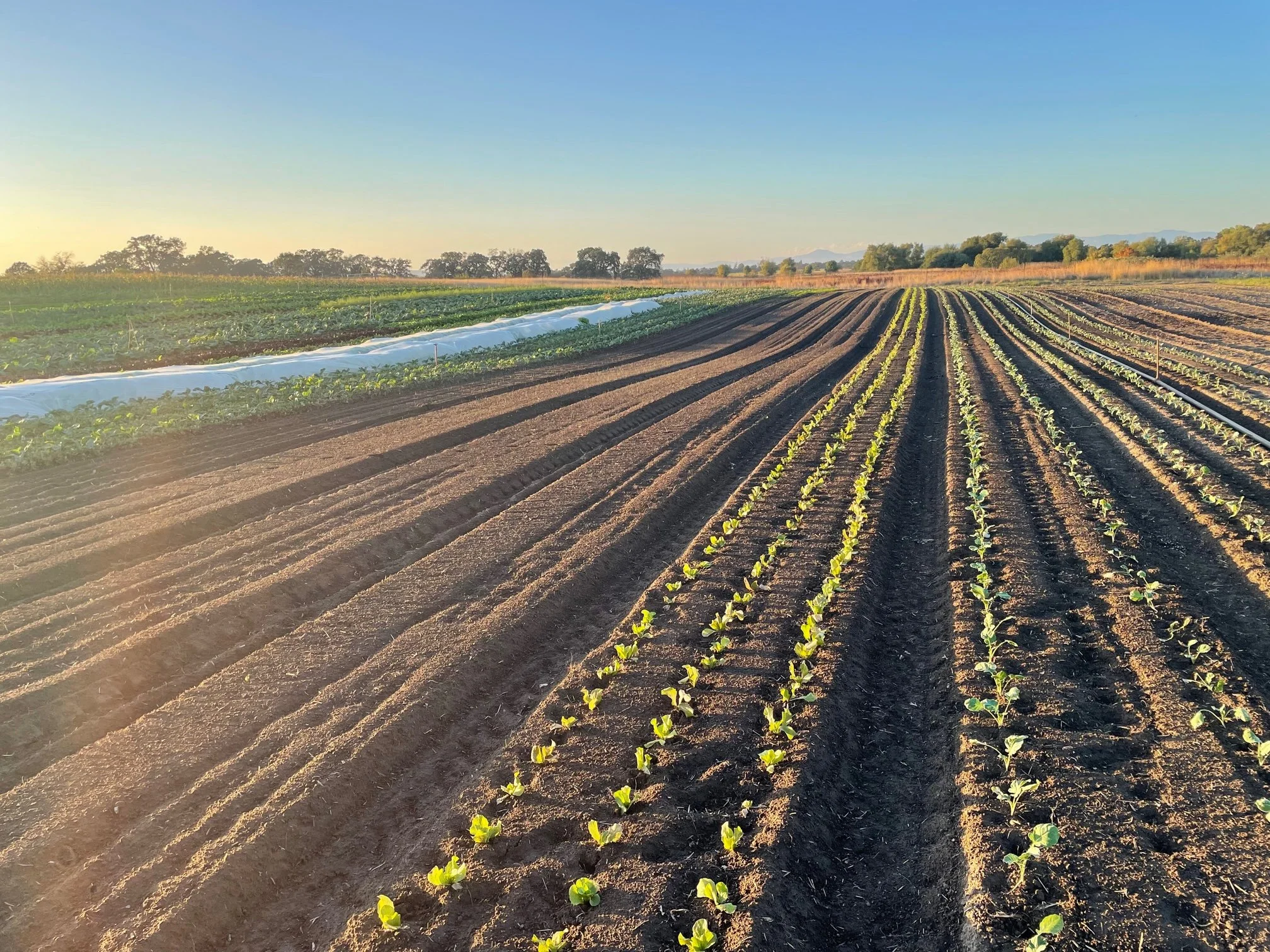
11/6/2020 - Week 22 - Letters from Patagonia

THIS WEEK’S HARVEST

Spinach, Braising/Salad Mix (with Radicchio, and Mustard Greens), Assorted Head Lettuce, Collard Greens, Mixed Loose Beets, Watermelon Radishes, Purple Cabbage, Celery, Green Magic Broccoli, Leeks, Desiree Red Potatoes, Carrots, Cured Zoey Yellow Onions, Bonbon Buttercup and Delicata Winter Squash, Metechi Hardneck Garlic

The flower garden is winding down. Thank you for a magical year of flowers, Kayta!

The flower garden is winding down. Thank you for a magical year of flowers, Kayta!

U-PICK

  • Albion Strawberries: Gleanings

  • Herbs: Italian Parsley, Rosemary, Thyme, Tulsi Basil, Thai Basil, Oregano, Marjoram, Onion Chives, Garlic Chives, Vietnamese Coriander, Culinary Lavender, French Sorrel, Lemon Verbena, Lemon Balm

  • Flowers Update: It is time for cover crop — and slowly but surely we will start taking out our beloved flowers and putting the garden to bed!

HARVEST NOTES

  • Watermelon Radishes: This is a hardy, dense, and gorgeous winter radish with a vivid magenta inner core. We love it on top of a green salads, rice bowls or highlighted as a small salad of its own — try ginger, garlic and lime or lemon juice on julienned or sliced watermelon radishes as a bright side dish.

LOGISTICS

  • The 2020 harvest season runs from Saturday, June 13th til Tuesday, December, 8th.

    Saturday pick-up runs from 9:00am - 2:00pm

    Tuesday pick-up runs from 1:00 pm - 6:00 pm

    The farm and u-picking are open 7-days a week, sunrise to sunset. Please close the farm gates behind you on off days.

IMG_1988.jpg

VOLUNTEERING

Thank you SO much, to everyone who came out to help harvest our Fall carrots. We simply could not have brought in that crop without your help. And it was a joy to spend time in the dirt with you all.

Join us for more fun in the dirt…

MORE CARROTS and GARLIC POPPING!
WEDNESDAY, NOVEMBER 11th: 9:00 am - 12:00 PM

CARROTS AND GARLIC PLANTING (PROBABLY!)
WEDNESDAY, NOVEMBER 18th: 9:00 am - 12:00 PM

FARMER’S LOG

LETTERS FROM PATAGONIA

The harvests keep on rolling! This week was all about carrots, carrots, carrots. With the help of a small classroom-sized flock of amazing kiddos, we harvested (and washed) all but one of our 6 beds of Bolero storage carrots — sweetened by frost and the loving hands of volunteers.

The Root Blaster 5000 was humming all Wednesday and Thursday morning washing them up, and now both of our coolers are stacked to the ceiling with ~4,000 lbs of orange crispness — we hope you like carrots! Fun fact: This carrot variety, Bolero, actually gets sweeter with frost and with storage.

We’ve got a lot going on this evening, so we’ll do a copy-and-paste of an old newsletter for your reading pleasure.

* * * * *

David here.

When I was 26, I took a trip to Patagonia, Argentina. Outwardly, I was traveling — backpacking in the Andes for the purposes of “adventure”. But inwardly I was searching for something I could not explain at the time: Rootedness. Meaningful work. Purpose.

I had never harvested a cabbage before in my life, but by luck I ended up on a tiny off-grid CSA farm on the Eastern slopes of the Andes and found what I was looking for. During that trip, I would write long, maté caffeinated letters to a friend from home. Down below is one from the end of my stay on the farm. It is angsty and verbose, but describes why and where I fell in love with harvesting cabbages.

* * * * *

June, 2011

“When the sun rises, I go to work.
When the sun goes down, I take my rest
I dig the well from which I drink,
I farm the soil that yields my food,
I share in creation. Kings can do no more.”
-Unknown Author, Ancient Chinese, 2,500 B.C.

Dear Theresa,

It is nearly winter here now. I can see my breath in the cabin. Things are quiet on the land. I am spending the days caring for the animals, trying to trap the wild hares eating our last crops, baking bread like an old Grandma, and doing other random projects to help Alex [the farmer] wrap up the season. A spokeswoman for the local Mapuche tribe just passed through and spent the night. A Gaucho folk guitarist the next. My friend Ponta, a Japanese orphan who has had the hardest life I have ever heard, just left for Peru. I will miss her. One of our dogs is very sick. Another is pregnant. The Puyehue-Cordón Caulle volcano is exploding 200 kilometers to the North. I can hear it in my cabin on still nights, like stampeding horses in the earth. Life and death are tangible forces out here.

It’s all quite primal and romantic, but I think it has done something deeper to me and made me realize some things. It might be hard to capture into words.

We have no electricity out here, no hot water, all the farming is done by hand. The only machines we have are a chainsaw, a weedwacker, and a dirt bike for town trips, “All you need!” says Alex. A sweet, spindly old horse named Petiso will pull a harrow for us in exchange for a bucket of oats and complete freedom to roam the valley with his feral friends the rest of the time. All the buildings and ovens here are cob and built by Alex and his brother. Three beloved dogs, Michay (wild like the native plant she is named after), her brother Pirata (a gentle pirate), and Tao (their mother), escort us everywhere. They sleep under my cabin at night and guard the garden from the feral horses. We harvest every Wednesday for the CSA members. Their children come and play with their food and chase the chickens. There is so much simplicity here; so much poetry..

You and I have always felt called by nature — to the tangy mountain air, to the oak meadows — these places have felt like home. But we inevitably find ourselves pulled back along auto-littered highways to the turmoil, cement, and grid of the city. There awaits the hidden pressure to specialize in one thing to pay for “necessities” that are piped to us. If we succeed, we make more and can spend more, so we travel back to visit the tangy mountain air, to run our eyes enviously over the ranging hills, only to come back. Did we share in creation?

On the road back to the farm. The Río Azul and the Andes in the background.

On the road back to the farm. The Río Azul and the Andes in the background.

Working on this farm has put me in forceful contact with the sources of my life — death, water, soil, the plants, the animals — and a realization that these things are not commodities, they are not necessities. They are us. They are our brothers, our sisters, our teachers. Kin. To work with them is to work with creation.

The farmer, Alex, is a goofy guy but he very serious about one thing: The farm is an organism but he does not create it. He may have a vision for the farm, but after that he is a vessel, a butler, a steward: And this is how he should work the land, coaxing it, observing, responding, moving this there, maybe taking that away. And then, one day, as if by magic, the organism reveals itself to him as he sits back peeling an apple, watching in awe the creativity and richness of life weaving itself through the fields, writing it's stories in the rows, playing it's song in the seasons. The blossoms, bees, fruits, fungi, bacteria, the animals, the people, the stars, the moon and the movements and arcs of all their lives, and all their far flung interactions, alight the farm. This symphony is also a dissonant song of chaos, poop, death and decay. But Death, the richest of masses (Mozart's richest Mass is his Requiem Mass), is the bed upon which joy and new life burst forth again and again.

Working here I’ve realized some things about culture, and art. Agriculture, or tending the wild, or however a group of people survive in their land is the root of that people — it is their original art. Take the Mongols: The art they developed for surviving that steppe is inextricably woven into the fabric of their lives. It is their houses (the collapsable yurt), it is the fiber of their walls and the clothes they wear; the tools they handle everyday. It is the animals they interact with and talk to, what they talk about with each other, what they dream about. It is the substrate of their myths, their legends, their stories and their songs and it is the material that makes up their instruments. Our art of survival is the stage and the prop and script of our lives. Although it may seem to be the case, we are no different today. We have not emancipated ourselves from the land under our feet and how we choose to cultivate it. It makes up the fabric of our lives too.

Before coming here, the word "farm" sent a chill down my spine. Why? To me, it meant mono crops; acres upon acres of almond trees. Endless fields of corn. Temp wage labor. Agribusiness. It was artless, fragmented, socially and environmentally exploitative. What it took from from the soil it did not give back. Anonymous desire.

This agricultural system is in the fabric of our culture. And it is global. Many people don't know their place, or where they come from, or their place and what they do is unknown to them. As American and Chinese agribusiness have slowly begun mono-cropping swaths of Argentina and Chile, so has American culture taken root in many South American cities. I don't think it's a coincidence that people started wearing the same clothes in Los Angeles, Buenos Aires, and Santiago, and started building similar houses, and started dreaming similar dreams, around same time that those countries adopted, or were forced to adopt, Western agribusiness, its methods, and its seeds. In a certain reverse way, the art of how a culture sustains itself is a mirror on that culture... I'm not saying the reflection I'm seeing is all bad, but is this how we want to live?
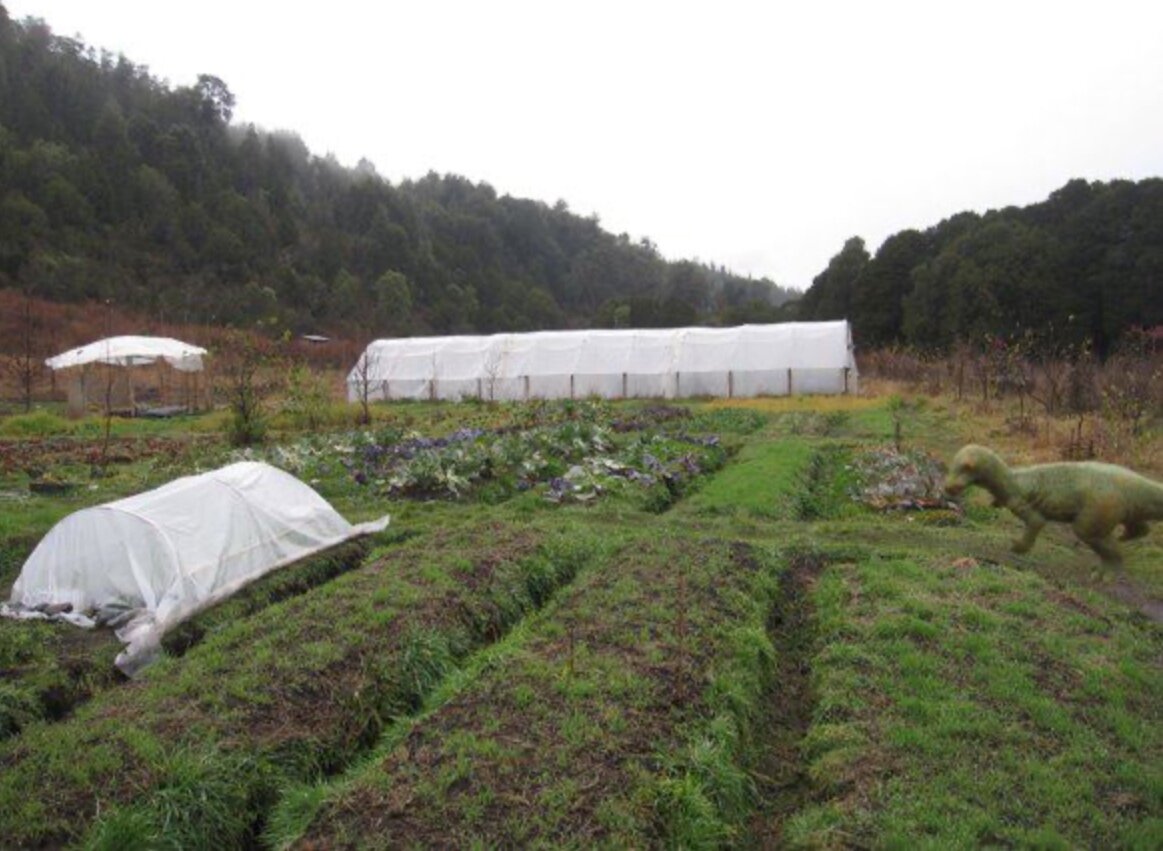
The raised bed garden of La Granja Valle Pintado. We had a dinosaur problem.

The raised bed garden of La Granja Valle Pintado. We had a dinosaur problem.

What I've seen here in the Painted Valley is beautiful art. It sustains many, and is sustained by the beings it sustains. The human culture around the farm hums with life. The farm has an identity, it is a home to so many. People seek refuge here almost daily. Economically and socially the farm works through mutualism. The association of families who support the farm are most concerned with the long term health of the farmland and the farmer — as they should be, it is their sustenance. And so the farm’s produce, its vegetables, are priced with that in mind. In this sense, they are priceless. The farm itself is an ecosystem. Nothing is wasted, waste becomes new life. The air and leaf litter and creatures of the surrounding wild permeate the farm — which is like a slightly more organized emanation of it.

One evening after work, I was putting away some tools, and Alex walked over, pumping his arms in the air and yelling, "I love life in the campo [field]! I love life in the campo!”

"Me too!" I laughed.

Alex got serious all of a sudden and stared inwardly out at the small winter field of rye spreading before us. He was silent for awhile. Finally, he said quietly to me, but also to himself, “It is the art of life and death, you know. Nothing more and nothing less."

* * * * *

See you in the campo,
David & Kayta

Click here for the newsletter archive

10/30/20 - Week 21 - The Season of Death

THIS WEEK’S HARVEST

Mustard Greens, Fall Braising Mix (with Radicchio, Frisee, Arugula, Ethiopian Kale, Red Russian Kale, Shungiku, and Baby Chard), Red Butter and assorted Head Lettuces, Indigo Radicchio, Dandelion Greens, Dazzling Blue Dino Kale, Daikon Radish, Cabbage, Fennel, Cauliflower & Romanesco, Green Magic Broccoli, Shallots, Red Thumb Fingerling Potatoes, Rainbow Carrots, Cured Cabernet Onions, Sunshine Kabocha Winter Squash

IMG_1883.jpg

U-PICK

  • Albion Strawberries: Gleanings

  • Cherry Tomatoes: Final gleanings | See below…

  • Frying Peppers: Final gleanings | See below…

  • Jalapeños: Final gleanings | See below…

  • Yellow & Red Thai Hot Peppers: Final gleanings

  • Herbs: Italian Parsley, Rosemary, Thyme, Tulsi Basil, Thai Basil, Oregano, Marjoram, Onion Chives, Garlic Chives, Vietnamese Coriander, Culinary Lavender, French Sorrel, Lemon Verbena, Lemon Balm

Some beautiful Green Magic Broccoli coming atchya Week 21!

Some beautiful Green Magic Broccoli coming atchya Week 21!

HARVEST NOTES

  • Sunshine Kabocha Winter Squash: Sunshine Kabocha is our farm crew’s unanimous all-time favorite squash. Excellent for eating straight roasted. Also excellent in pies, curries, etc. Super sweet, velvety smooth texture.

  • Dandelion Greens: A bitter green, in the chicory family (radicchio, escarole, etc.), try chopping these up in a nice rich omelet with Moonfruit Mushrooms and the last frying peppers. Also delicious lightly sautéed with garlic, bacon and red wine vinegar. Deeply nutritious and cleansing.

  • Shallots: We tried growing shallots for the first time this year, inspired by Anna’s Dad’s deep love of this delicacy allium. We’re not at quite the right latitude for this seed — but we did get a nice little fresh crop for you this week. To highlight them, try making a risotto, or slicing them thin, frying them, and then using as a topping for a rice bowl.

FINAL TOMATO AND PEPPER GLEANINGS

We’d like to invite any and all who wish to perform final gleanings on our Cherry Tomatoes, Shishito and Padrón frying peppers, Jalapeños and Thai Hot Peppers, as well as our main crop field tomatoes. Time permitting, we will begin ripping all of these plants out as soon as this coming Wednesday to make way for cover crop.

Our main crop tomatoes (of which there are still some yummy ones to be found) are the big patch of trellised tomatoes you having been passing, to your right, on your way to the cherry tomatoes. Ask one of us in the barn for directions if needed.

LOGISTICS

  • The 2020 harvest season runs from Saturday, June 13th til Tuesday, December, 8th.

    Saturday pick-up runs from 9:00am - 2:00pm

    Tuesday pick-up runs from 1:00 pm - 6:00 pm

    The farm and u-picking are open 7-days a week, sunrise to sunset. Please close the farm gates behind you on off days.

FALL CARROT HARVEST this WEDNESDAY | 9:00 am

Joins is this Wednesday morning to our great Fall carrot harvest! Wherein we kneel on the soft dirt and top carrots into bags for washing. There are a ton of them (literally). We can use all the help we can get!

These Bolero Carrots, sweetened by light frost, will get sweeter and sweeter in storage and nourish us all through the Fall and winter. Join us for this fun, kid friendly harvest!

IMG_2160.JPEG

FARMER’S LOG

THE SEASON OF DEATH


Rise and fall. Light and shadow. Summer and Winter. Life and death.

Halloween is an important time of year on the farm. It is the season of Death.

The Gaelic Samhain festival — the root of our Halloween — marked the end of the harvest season, "summer’s end”, the transition to the darkest half of the year, and the transhumance time when shepherds brought their livestock, fattened in the summer mountain pastures, down for the winter for shelter or for slaughter. There were feasts. People opened their burial mounds, portals to the Underworld, and lit cleansing bonfires. The borders between the worlds were thought to thin around the Samhain and supernatural spirits and the spirits of the dead walked amongst us. Spirits and fairies were to be appeased to survive the winter. Tables were set for deceased relatives at the Samhain dinner. People wore costumes to disguise themselves from evils spirits and carved turnips and placed candles in them (in lieu of pumpkins) to ward them off.

You can feel the Samhain in every nook and cranny on the farm these days. How different it looks from Spring’s jubilant green promise, from Summer’s colorful cacophony. The life cycles of the plants that showered us with riches all Summer are now at an end. Their bodies hang drawn, gaunt and ghostly on their trellises, or they lay shriveled, mildewed, and desiccated in the rows, awaiting the final stab of a killing frost or the furious whir of the flail mower.

The portal is open. Anna broadcasting cover crop in 2020’s potato field.

The portal is open. Anna broadcasting cover crop in 2020’s potato field.

This week, with our major harvests nearly complete, we started the liminal work of the Samhain. On Wednesday, we mowed and spaded under large sections of fields 1 and 2, transitioning our potatoes, squash, and Spring vegetables into the Underworld, where they are now being devoured by worms and bugs. On Wednesday night, there lay a bleak, deep brown maw of bare soil.

A great, pregnant silence. An open portal.

The next morning at sun rise, the four of us broadcast the first cover crop seed of the year, walking back and forth over the field, processionally, rhythmically tossing bell beans, peas, vetch, and grass seed — little prayers — into the black veil.

The rising sun was welcomely warm and good earth smells lofted up from the ground as it warmed. Later that afternoon we harrowed the seeds under, our little old tiller we use to “kiss” the seed into the ground whirring like a little demon.

One can only marvel at the wisdom of ancient agrarian festivals, born from bone deep relationship to the cycles of nature: How directly Death was confronted and dealt with.

Those people knew.

They knew that from death comes life. They knew that death and life were only thinly separated. They knew that the rotting, decaying, destructive forces were the building blocks and the gateways from which life would spring forth anew in the Spring and that the portals, the transitions, needed to be tended to, cleansed, and faced.

This Halloween, while you’re out there gleaning the last summer fruits, we invite you to cherish the ghoulish site of the dying cherry tomatoes, sagging limply, skeletal, and vacant; and the blocks of bare ground — portals, now pregnant with cover crop seed.

This death is the doorway. And on the other side are verdant Spring meadows, flower scented breezes, plump sugar snap peas, and bouquet after bouquet of Spring flowers.

See you in the fields,
David for Kayta, Anna, and Kate

Click here for the newsletter archive

10/23/20 - Week 20 - Fall Mode

THIS WEEK’S HARVEST

Mustard Greens, Arugula, Rosaine Little Gem Lettuces, Indigo Red Radicchio, Collard Greens, Poblano Peppers, Bishop Cauliflower, Romanesco, Red Ace + Chioggia + Golden Loose Beets, Eggplant, Leeks, Desiree Potatoes, Rainbow Carrots, Zoey Yellow Onions, Jester Acorn Winter Squash, Metechi Hardneck Garlic

B5E2E3C7-37AA-45DF-8F45-961411125BED.JPG

U-PICK

Check the u-pick board for updated weekly limits. With the ash that has settled on produce, we recommend washing all u-pick produce before consumption

  • Jack-O-Lantern Pumpkins: Season limit: 3 per share for shares with kids | Limit 1 per share for shares without kids

  • Green Beans: Gleanings

  • Albion Strawberries: Gleanings

  • Cherry Tomatoes: Gleanings

  • Frying Peppers: Shishitos, Padróns | See week 5’s newsletter for harvest tips

  • Jalapeños: Winding down | Located below the Padróns

  • Yellow & Red Thai Hot Peppers: Winding down | Located next to the Jalapeños

  • Herbs: Italian Parsley, Rosemary, Thyme, Tulsi Basil, Thai Basil, Oregano, Marjoram, Onion Chives, Garlic Chives, Vietnamese Coriander, Culinary Lavender, Culinary Sage, French Sorrel, Lemon Verbena, Lemon Balm

Late season Agrostemma in the flower garden

Late season Agrostemma in the flower garden

HARVEST NOTES

  • Jester Acorn Winter Squash: A true gem. The sweetest Acorn squash we've ever tasted. A hard ribbed shell hides pudding-sweet flesh. A good Jester can be among the sweetest of all winter squashes. David's favorite. Try halving long ways, scooping out the seeds, and roasting at 400 until you can poke a fork in the skin and the flesh is soft and creamy. Add a dash of water to the baking sheet while roasting to keep your squash moist. Eat straight out of the shell with a spoon like pudding! Try adding butter, coconut oil, and/or maple syrup to and eating out of the shell with a spoon.

We brought the last carving pumpkins into the barn so that we could transition that field into it’s Winter clothes. There are a few carving pumpkins left. Did everyone get one? Don't be shy! Season limit 1 per share, and for households with children…

We brought the last carving pumpkins into the barn so that we could transition that field into it’s Winter clothes. There are a few carving pumpkins left. Did everyone get one? Don't be shy! Season limit 1 per share, and for households with children the season limit is now 3 per share.

LOGISTICS

  • Tuesday pick-ups (especially the last hour) have become hectic — likely because we had to cancel a Saturday pick-up due to the fire and everyone switched to Tuesday. Just a heads up, if you are able, a more relaxed pick-up experience can be had on Saturdays and earlier on Tuesdays.

  • The 2020 harvest season runs from Saturday, June 13th til Tuesday, December, 8th.

    Saturday pick-up runs from 9:00am - 2:00pm

    Tuesday pick-up runs from 1:00 pm - 6:00 pm

    The farm and u-picking are open 7-days a week, sunrise to sunset. Please close the farm gates behind you on off days.

THANKS, VOLUNTEERS!

We’d just like to say a huge thank you to everyone who came out to help harvest all 7,000 lbs of this year’s potato crop! We rely on volunteer labor for these big harvest pushes and you all made this giant task easy and delightful.

We have one last big harvest — the Fall carrots — which we’ll let you know about, as well as our Garlic planting party. Stay tuned!

FARMER’S LOG

FALL MODE

This week was all about harvest, harvest, harvest…

After Monday and Tuesday’s share harvest, we enjoyed a sweet Wednesday morning potato harvest with about 15 volunteer members. All told, we brought in about 3,000 lbs of beautiful tubers, putting our total potato harvest for the year around 7,000 lbs — now tucked away in our trailer cooler, awaiting your belly.

On Wednesday and Thursday, we kept on harvesting: Loose Beets for storage; Napa Cabbage for storage; and today, bins and bins of beautiful Cauliflower and Romanesco for this week’s share. All this harvesting can only mean one thing….

We are smack dab in the middle of one of two major transition moments in our yearly farm cycle. You can feel it in the air (kind of?) and you can definitely see it in the fields. Almost all of the long-season crops have grown, matured, been harvested and are now dying back — their bounty curing in the greenhouses or in the cooler, or become a memory of a BLT. In the fields, the slate is being cleaned. The first frost is imminent. The farm is bare — awaiting it’s Winter cloak.

Potato harvest 2020 — part two!

Potato harvest 2020 — part two!

Bed by bed, field by field, the farm is changing from summer attire (veggie crops) to winter clothes (cover crop). For our cover crop, we seed a nitrogen fixing, organic matter building mixture of Bell Beans, Magnus Peas, Dundale Peas, Crimson Clover, Common Vetch and Triticale on pretty much every inch we planted this year. Soon you will see a green fuzz of Triticale covering the bare beds. Come spring a waist high sea of green will wave in the wind. This crop will feed, enrich, and build the soil for 2021 and for many years to come. (Indeed, a healthy cover crop stand can generate over 8,000lbs of biomass per acre. It's like growing compost out of thin air — right where you need it.)

This Fall’s transition into cover crop makes us think of one of the ways vegetable farming in Sonoma is very different than vegetable farming in New England or colder climates Northward. In colder places, Old Man Winter mandates that you initiate this process; i.e. frost comes in early October and kills the tomatoes and peppers and other cold sensitive crops. In our climate, hot crops can sometimes limp on into November. Here, instead, we must end them in order to germinate a great stand of winter cover crop.

In Sonoma county, it is best to broadcast your cover crop seed mid to late October. Any later and you risk colder temperatures inhibiting the germination of the cover crop seed and your fields laying relatively naked through the winter. So, it is time to say farewell to the cherry tomatoes, and the frying peppers — they must now make way for a dense, lush, life-giving cover crop.

We recommend taking a moment to appreciate the changing of the guard out there if you have a moment. The first blades of cover crop will soon poke up out of the soil, reaching for the sun, and waiting for the winter rains to transform the farm into a sea of green.

See you in the fields,
David for Kayta, Anna, and Kate

Click here for the newsletter archive