
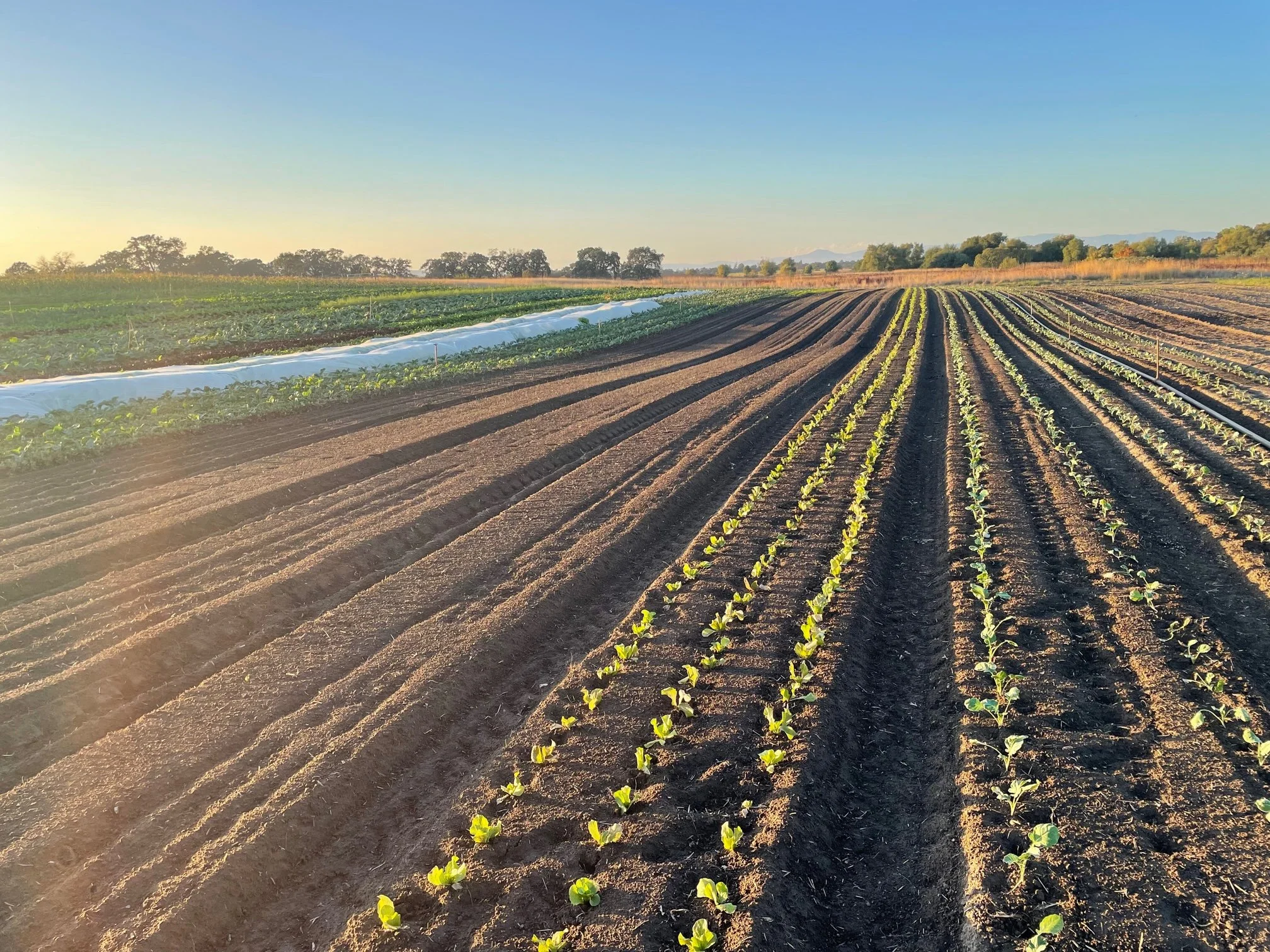
11/16/18 - Week 24 - A Farmer’s Thanksgiving Vol. II.

The first hard frosts have been rolling through the farm this week, killing our husk cherries, frying peppers, amaranth flowers, many of our zinnias, and nipping some of our field greens (though they recovered). The first hard frost is a milestone event of the harvest year; the beginning of a new chapter; the first salvo of Old Man Winter; a cause for reflection; a time for thanks.

Kayta and I both grew up in the suburbs and like all Americans, we encountered those odd, ubiquitous expressions speckled throughout out our vernacular — “three shakes of a lamb's tail”, “like a horse whose seen the barn”, “make hay while the sun shines”, "coming home to roost", “getting hitched”, etc. It wasn’t until we started farming that we began to viscerally understand the roots of these sayings. (Hint: A lamb shakes its tail really fast when it's nursing.)

And it wasn’t until we started farming that we began to understand — like really understand — the significance of giving thanks in the Fall.

The Fall is an incredible time of year in the temperate world. It is a season of unimaginable bounty. The plants of forest and field have spent all Spring and Summer harnessing the sun’s energy into fruits and seeds and roots and leaves and we have harvested. In the Fall the root cellar is full, the larder is full, the granary is full; the land has burst forth at its seams and we gathered the overflow.
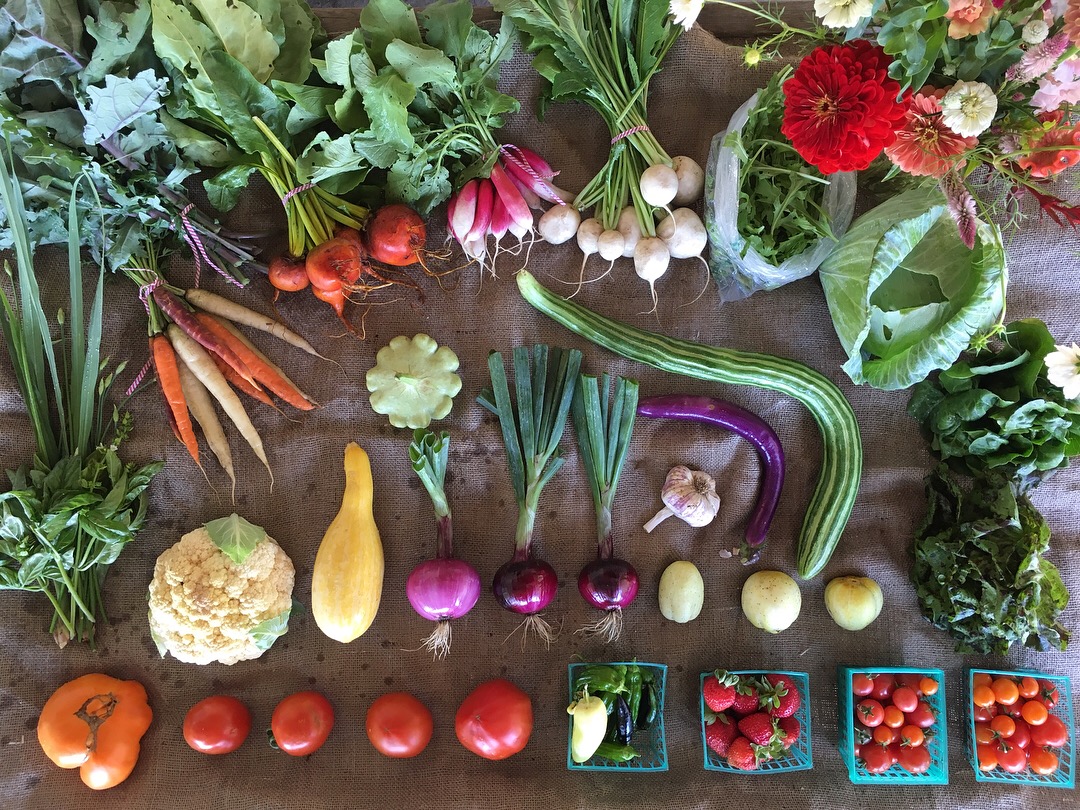
The land burst forth at its seems…

The land burst forth at its seems…

The farmer, sitting at home with her feet up next to the fire, is keenly aware of the bounty in the root cellar below. She feels a giddy contentment in this — but no pride. She realizes how little she did to create it all. Sure, she worked hard all summer — moving things here and there — but it was others, present now and before, and life itself, that filled that cellar. It was others who laid the roof over her head and dug the cellar. Others who forged her tools and taught her how to use them. Others who saved the seeds and taught others, who taught others, who taught others, who taught her how to care for them. And what, or who, made those seeds sprout? Not she.


For all this, there is nothing to give but thanks.

We’d like to take a moment to give thanks those who made this year's harvest possible.


To our landmates and neighbors here at Green Valley Farm + Mill: Temra, Jeremy, Teo and Quin Fisher, Aubrie Maze, Scott Kelley, Jeff Mendelsohn, Josiah Raison Cain, Genevieve Abedon, Michael Crivello, Lindsay Dailey, Cliff Paulin and Ateus, and everyone at Weaving Earth: Your work, attention, perseverance, appreciation and support for the farm, harvest help, simple daily interactions are an invaluable web of support and meaning that sustain us day-by-day.

To our friends and families: Your unconditional love and support as we go AWOL to tend this farm toddler in the growing season means the world to us. Let's hang out again.

To our farming mentors and the farming community in Sonoma County (too numerous to name here); to Andy and Julia Henderson at Confluence Farm down the road; you make the long-days shorter in solidarity, camaraderie, and much practical wisdom.

To all the volunteers who showed up this year, you’re many hands made light work when we needed it the most.

To Ingrid the Egret: Your capacity to devour gophers is truly astonishing and incredibly expedient. Thank you for being such a good listener.

To Anna Dozor and Kate Beilharz. No words. OK, some words: At the beginning of the year Kayta and I were trepidatious about embarking into the new frontier of managing people on our own farm. You have spoiled us. We couldn't have asked for kinder, harder working, lovelier people to spend our days with. This season would not have been possible, or nearly as fun, without you. Thank you. Here is to many Harry Potter marathons.


And finally, to you, our members. Whatever bounty we’ve enjoyed this year is because of you. Your trust and support paid for the seeds, the compost, the irrigation tape, the tomato trellising twine. You harvested our potatoes, our corn, our squash. You took a risk on a pair of young farmers and a farm and showed up every week with words of encouragement, cookies, kim-chi, and cute little doodles to put on the chalk board. You pickled cucumbers for us when we didn’t have time to pickle them ourselves.


You reminded us day after day, week after week, that real, life-sustaining bounty comes from people working together to accomplish something bigger than just themselves — from a community.

Thank you.

F2E5F079-AA74-4AF5-8528-35CA1C6FA1EF.JPG

11/9/18 - Week 23 - Dig, scrape, heave, plop!

Farming plants is a rhythmic craft. Some of the rhythms are quick: Shovel hits earth: Ding. Slices earth: Scrape. Heaves up. Plops down. Repeats… Ding, scrape, heave, plop!

Some rhythms are daily: Rise, open greenhouses, water at 10, work, water at 3, close greenhouses, sleep. Repeat...

Some rhythms are a year long and a little harder to hear. Plant garlic, wait. Garlic spires emerge. Winter becomes spring. Spring becomes summer. Garlic scapes. Garlic swells. Harvest garlic. Eat lots of garlic. Save seed. Repeat...

Some rhythms are many years long and can only be heard by the oldest trees...

One of the coolest things about all these rhythms is that they mark time, they weave time together. Like the holidays, you can remember back to where you were, who you were with, how you were feeling, the last time you were at that point in the rhythm.

Last year at this time we were just on the down beat of our first full year as a farm and feeling giddy. We had never planted garlic on this land before and picked the nicest spot we could.

We started the garlic planting drums on Nov. 5th, 2017: Prepped beds, called friends, popped cloves, readied mulch, planted, mulched beds, prayed. That little rhythm set into motion all of the garlic we've been munching this year.

IMG_6378.JPG

This Sunday we’ll strike it up again, with some of the same friends, and put a prayer in the ground for 2019's crop. We hope you'll join in!

Ding, scrape, heave, plop…

See you in the garlic field,

David & Kayta

11/2/18 - Week 22 - 2019 Winter Squash Ode

So far in this log, we’ve penned an Ode to Maize and an Ode to the Potato; two New World crops who changed the world and inspired poets.

It is time for for an Ode to the fairest of them all. One who kindles deep, lasting love and has for 10,000 years. The beloved oldest of the Three Sisters… the Squash.

The ancestral plants of squash (the species including zuchinnis, melons, gourds, cucumbers, pumpkins and all winter squash) are millions of years old and native to the New World. It was love at first sight once we came around.

The earliest evidence for human domestication dates back 10,000 years to Southern Mexico; earlier than the domestication of corn or beans.

Word travelled fast and inspiration abounded. By 2,000 B.C., squash had became a part of life for almost every Native American culture from Southern Canada to Patagonia — varietals were kept and cherished for everything from the protein rich and medicinal seeds of some, to the sweet flesh and tough, winter hardy skins of others. Botanists note at least six separate domestication events by Native peoples in the New World. (The English word “squash” comes from the Narragansett word, askutasquash, meaning fresh vegetable, and similar words can be found in the related languages of the Algonquian language family.)


Here at GVCFarm, the human + squash love affair burns bright... and we have at our fingertips the unparalleled modern library of heirloom squash seeds. Last winter, farmer Kayta hunkered down with a seed catalogue, a good cup of coffee, a roaring fire, and her seed selecting genius, and laid out a season long love sonnet to squash. We felt the summer wind with a cool slice of Striped Armenian cucumber; We dined by candlelight over pasta with Costata Romanesca Zucchini; Once we tasted Sarah’s Choice Cantaloupe, we could never forget; But in the Winter, our true love came -- Winter Squash.

2018's winter squash. Top row from L to R: Sunshine Kabocha, Marina di Chioggia, Winter Luxury Pie Pumpkin, Wintersweet Kabocha // Bottom row from L to R: Jester Acorn Squash, Racer Jack-O-Lantern Pumpkin, Delicata, Butterscotch Butternut, Red Kuri,…

2018's winter squash. Top row from L to R: Sunshine Kabocha, Marina di Chioggia, Winter Luxury Pie Pumpkin, Wintersweet Kabocha // Bottom row from L to R: Jester Acorn Squash, Racer Jack-O-Lantern Pumpkin, Delicata, Butterscotch Butternut, Red Kuri, Honeybear Acorn

Marina Di Chioggia: This year's weirdo squash, "deliziosa, especially for gnocchi and ravioli... a culinary revelation." We'll include some tips on how to cook it when we distribute this later on.

Delicata - A real heartbreaker. The sweetest. Easiest to cook, even easier to eat.
Honey Bear Acorn - Your personal size Acorn squash. Very sweet. Coming this week!
Jester Acorn - The sweetest Acorn squash we've ever tasted, and very creamy. David's favorite. We fell in love with it 3 years ago when Kayta first grew it on the vineyard farm.
Sunshine Kabocha - The village beauty. A gorgeous red Kabocha. Sweet and flaky. Kayta's favorite, exceptional for pumpkin pie.
Butterscotch Baby Butternut - A real winner. A sweet and flavorful butternut ready to eat right after harvesting. This years are tasting exceptionally sweet.
Winter Luxury - Beautiful, lacey, netted pie pumpkin. The only pie pumpkin that can compete with a Kabocha. We'll distribute this one around Thanksgiving with our go-to pumpkin pie recipe.
Wintersweet Kabocha: "Winter Sweet delivers a combination of sweetness, flaky texture, and depth of flavor that has made it a favorite on our research farm. "Unparalleled eating quality," says the legendary Johnny's seed catalogue. Best after two months of curing. We fell in love with this one eating it in January. We'll put out this one out toward the end of harvest pick-up.

Red Kuri: A baby red Hubbard squash, sweet and mild with smooth texture. Good for pies and purees, you can eat the skin.

Racer Jack-O-Lantern Pumpkin: Were a little small this year because we grew them in between two rows of corn, but we thought they made the perfect Jack-O pumpkins. The seeds were great too.

We hope you fall in love with a Squash this Fall.

See you in the fields,

David & Kayta