10/19/18 - Week 20 - Ahh, Fall...

Ahh, Fall...

We are smack dab in the middle of one of the major transition moments of the farm year. You can feel it in the air and see it in the fields. Almost all of the long-season crops have grown, and matured and been harvested by us all and are now curing in the greenhouses or stored away in the barn to be distributed to you over the next seven weeks!

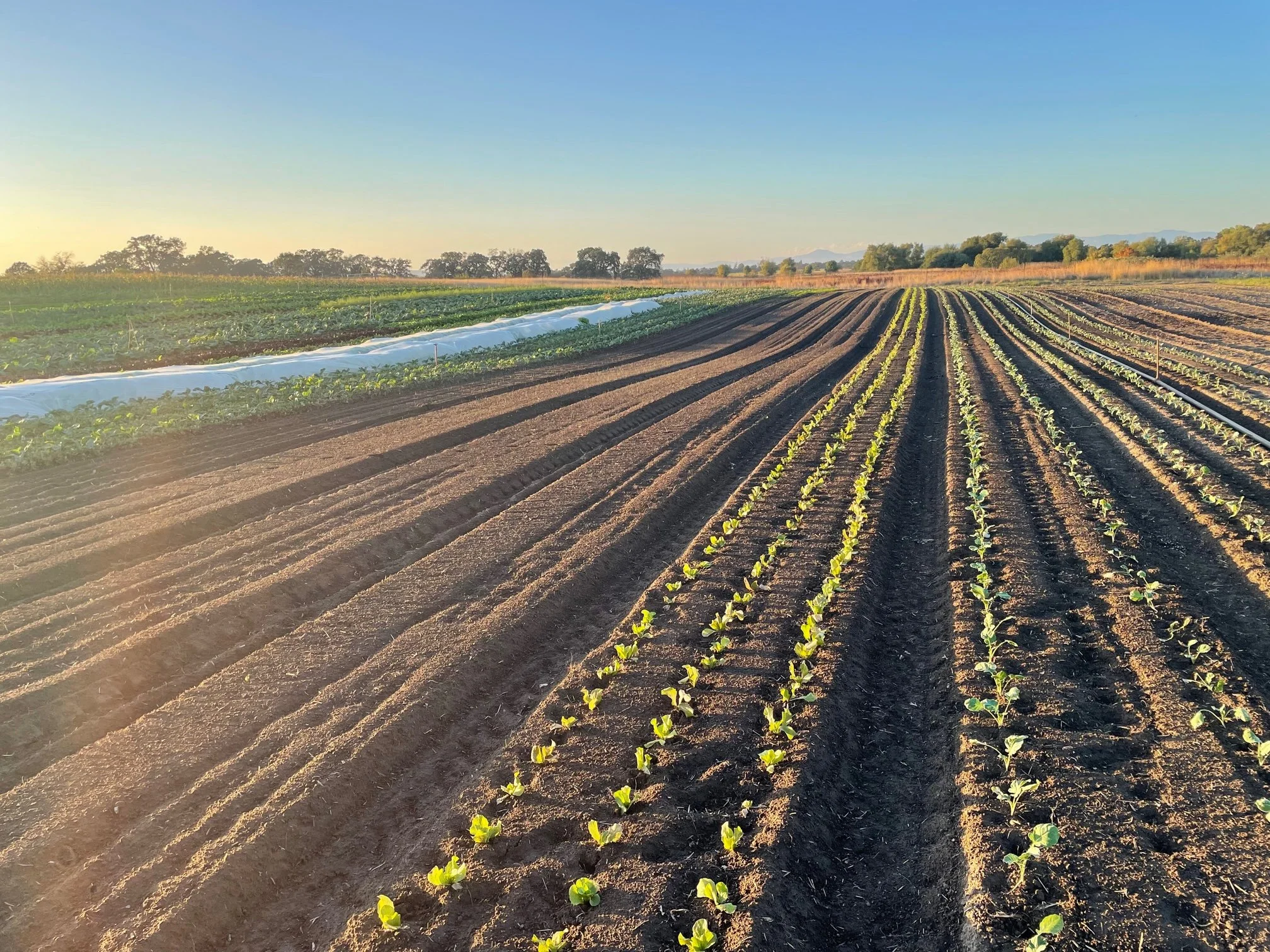
Bed by bed, field by field, the farm is moving from summer mode (veggie crops) to winter mode (cover crop). We seed a nitrogen fixing, organic matter building mixture of Bell Beans, Magnus Peas, Dundale Peas, Common Vetch and Barley and Oats as our cover crop. Soon a green fuzz of Barley and Oats will cover the land and come spring a waist high sea of green will wave in the wind. This crop will feed, enrich, and build the soil next year and many years to come. (Indeed, a healthy cover crop stand can generate over 8,000lbs of biomass per acre. It's like growing compost!)

From seed to fruit, full circle. Winter squash drying in the greenhouse where they were seeded.

From seed to fruit, full circle. Winter squash drying in the greenhouse where they were seeded.

This Fall transition into cover crop, which takes place on many to most organic veggie farms in temperate climates, makes us think of one of the ways vegetable farming in Sonoma is very different than vegetable farming in New England and colder temperate climates Northward. In colder places, Old Man Winter mandates that you initiate this process; i.e. frost kills the tomatoes and peppers and other cold sensitive crops definitively in October. In our climate, hot crops can sometimes be let to to limp into November. Here, instead, we must end them in order to germinate a great stand of winter cover crop. (So, it is time to say farewell to tomatoes, summer squash, and peppers in the share!)

In Sonoma county, it is best to broadcast your cover crop seed by the middle of October. Any later and you risk colder temperatures inhibiting the germination of the cover crop seed and your fields laying relatively bare through the winter. Here, we are able to leverage our overhead irrigation to pre-irrigate our cover crop before the rains, to ensure a dense, lush cover crop stand.

We recommend taking a moment to appreciate the changing of the guard out there if you have a moment. The farm is at it's barest. The first blades of pre-irrigated oat and barley will be poke up out of the soil soon, at attention, waiting for the winter rains to transform the farm into a sea of green.

See you in the fields,

David & Kayta

10/12/18 - Week 19 - 2018 Corn

This year, we planted two heirloom corn varieties for the CSA (as well as a small patch of the Tzutujil Maya Corn of Birth and Death brought here by CSA member Joshua Harris.)

Many of you met the Painted Mountain corn last year. This gorgeous variety was developed in Montana by Dave Christensen, a farmer who dedicated his life to breeding corn that could survive the the conditions and high altitudes there. He did this by gathering heirloom seeds from Northern Native Americans tribes and homesteaders, planting them together, letting them naturally cross pollinate, and carefully selecting for hardiness and nutrition. The result is Painted Mountain corn.

This year, our Painted Mountain corn didn't do very well. We think we either a) planted it a few weeks too late and it got the solar signal to tassel too early and/or b) in was affected negatively by the symphylans in our soil (little centipedes that eat roots hairs). As such, we will not distribute the Painted Mountain to members as flour in this year; instead we will save all of the precious kernels we get so that we can plant again next year (earlier and in a different spot!) and/or we are also considering switching to a variety that will do better in these soils, and then continue our community heirloom saving tradition. Sometimes the road to abundance is restraint.

Kayta in our first Floriani field in 2013

Kayta in our first Floriani field in 2013

Our other corn variety, drying out there in the fields, is Floriani Red Flint. The Floriani did quite well this year (hurray for diversity!) and we will be harvesting it together on Wednesday. Floriani Red Flint is a Northern Italian heirloom, saved for generations for the exceptional polenta it makes. Kayta and I have grown it in Sonoma County for 6 seasons now and we can confirm... it makes amazing polenta, especially when you add a little Bramble Tail cream to it. We’ll dry the ears in our greenhouse after we harvest them, and then grind the kernels it into a coarse flour and distribute it to the CSA late into the season.

Flint corn kernels are hard as flint, hence the name. They have a dense outer shell protecting the nutritious germ within. This shell, combined with the low water content of the kernels, make flint corns resistant to freezing and excellent for storage. Flint corns were the staff of life for Native American cultures in harsh climates on both hemispheres.

Indeed, since domestication in Southern Mexico some 10,000 years ago, maize has been the staff of life for much of humanity as we know it, from the Mississipian and Mayan civilizations to the supermarket aisles of today: Corn is king.

And a king demands an Ode...

Take it away, Pablo...

* * * * *

Ode to Maize

by Pablo Neruda

America, from a grain

of maize you grew

to crown

with spacious lands

the ocean foam.

A grain of maize was your geography.

From the grain

a green lance rose,

was covered with gold,

to grace the heights

of Peru with its yellow tassels.

But, poet, let

history rest in its shroud;

praise with your lyre

the grain in its granaries:

sing to the simple maize in

the kitchen.

First, a fine beard

fluttered in the field

above the tender teeth

of the young ear.

Then the husks parted

and fruitfulness burst its veils

of pale papyrus

that grains of laughter

might fall upon the earth.

To the stone,

in your journey,

you returned.

Not to the terrible stone,

the bloody

triangle of Mexican death,

but to the grinding stone

sacred

stone of your kitchens.

There, milk and matter,

strength-giving, nutritious

cornmeal pulp,

you were worked and patted

by the wondrous hands

of women.

Wherever you fall, maize,

whether into the

splendid pot of porridge, or among

country beans, you light up

the meal and lend it

your virginal flavor.

Oh, to bite into

the steaming ear beside the sea

of distant song and deepest waltz.

To boil you

as your aroma

spreads through

blue sierras.

But is there

no end

to your treasure?

In chalky, barren lands

bordered

by the sea, along

the rocky Chilean coast,

at times

only your radiance

reaches the empty

table of the miner.

Your light, your cornmeal,

your hope

pervades America’s solitudes,

and to hunger

your lances

are enemy legions.

Within your husks,

like gentle kernels,

our sober provincial

children’s hearts were

nurtured,

until life began

to shuck us from the ear.


* * * * *

See you in the corn fields,

David & Kayta

10/5/18 - Week 18 - A Week in the Life

We often wax philosophically in these logs -- diving into the heart and mind of farming here in Green Valley. This week we thought we'd go strictly practical, which might possibly be the most philosophical thing.

Have you ever wondered what a week in the life of Green Valley Community Farm is like? Have you ever pondered what your famers eat for 2nd breakfast? Wonder no more...

A week in the life during harvest season on the farm is very rhythmic. The week (and days) are dictated by the harvest and have a very predictable shape. (During the shoulder seasons here, early Spring and Winter, before harvest starts, the weeks are much more random as they are defined by special projects and the project of preparing for or breaking down the seasonal infrastructure in the fields.) But harvest season has its own clock.

Thursdays: Because our CSA week begins on Saturday, Thursdays really feel like the start of the week around here. The day begins just like any other: Kayta and David eat their cereal (with Bramble Tail milk of course) and make their 2nd breakfast to-go: Usually a protein rich wrap or toast (with Gaby's break of course) and Aubrie's cheese, Temra's eggs, and veggies and greens from the farm. Kayta heads off to her day job, managing the farm at Russian River Vineyards, where she works with Kate. Anna rolls in here around 7:30, flushes the water filters, opens the greenhouses, and meets David at the barn. We turn their Walkie Talkies on and the day begins! Anna usually begins harvesting the "hot-crops" Squash, tomatoes, cucumbers, etc. while David helps or is on the tractor prepping beds for the following week's transplanting. In the evening, Kayta and David walk the farm, look at each row, and design the share for the week ahead based on what is ready to harvest. The day ends with a big inventory and clean out of the cooler, a big bin washing, and the truck is loaded for the big day...

Fridays: Friday morning is our biggest harvest day. In high summer we start harvesting at 6:30 am for both CSA pickup on Saturday and the Occidental Farmer's Market, our only off-farm market. As the sun breaks the horizon, we each break off down the rows solo, harvesting crops that we've randomly specialized in this season: Kayta on loose greens; Anna on lettuces and kales; David on broccoli and cabbages. We meet up to bunch beets, carrots, and other roots together. The music is playing and it's festive. We break for coffee and eat 2nd breakfast off the tailgate of the truck around 9am. Their is much laughter and conversation over the rows as the harvest knives zing and twist ties twist. There is a certain satisfaction seeing the bins pile up in the shade of the Tacoma. When all the crops are checked off, we drive the truck back to the wash station. Kayta and Anna wash busily while David breaks away to water the farm and greenhouses, cook lunch, sort tomatoes, and prep the truck for Farmer's Market. 2:00 is curtain call, we load the truck chalk-full and Kayta heads off to slang vegetables at the Occidental Farmer's market! David stays homeside to keep the farm watered, clean the barn for CSA pick-up in the morning, and to write this very newsletter. Kayta returns around 9pm and we eat Lata's Indian Food and play with Bilbo the farm cat who missed us all day.

Saturdays: Saturday is a special day -- the rollout of a new CSA week! Kayta and David arrive at the barn and start laying out the week's harvest. It is so satisfying to see the produce all washed and on the table and to socialize with our members on Saturdays. We usually take it relatively easy that day; Kayta at the house or doing errands, and David making sure the harvest bins are full and abundant. Saturday evening we chill and share stories of CSA pick-up antics.

This crew makes the week fly by!

This crew makes the week fly by!

Sunday: Kayta spends Sunday tending her beautiful farm at Russian River Vineyards while David is off duty, puttering around the homestead, playing with Bilbo the cat, and keeping the farm watered.Monday: Monday is David's solo day on the farm as Kayta is making magic again at Russian River Vineyards. David starts the day with the daily ritual of cleaning of the irrigation filters and then does any errands that need doing (Harmony Farm Supply, bank, hardware store, etc.) and field work (clearing out harvested beds, fixing or tinkering with the irrigation system, doing any final bed prep for transplanting). In the evening Kayta does our greenhouse seeding for the week and preps bins and the truck for Tuesday morning harvest. We do the nightly irrigation filter cleaning and head home to dream of big broccoli heads.

Tuesday: Tuesday is our other big festive harvest morning. Because we don't have a Farmer's Market to harvest for, we harvest everything for Tuesday's CSA pickup that morning. Hopefully we remembered to download some new music for the boombox. We harvest until 10:30 am and then Kayta and Anna handle washing and CSA set-up. Anna usually takes over CSA once it is set-up while Kayta and David work the garden or fields. Sometimes Kate is with us on Tuesdays. We get another boost on Tuesdays chatting with CSA members and seeing you all interact with the farm. Kayta and David wrap up pick-up at 6pm and head in for a late dinner where we share stories of member antics and conversations.

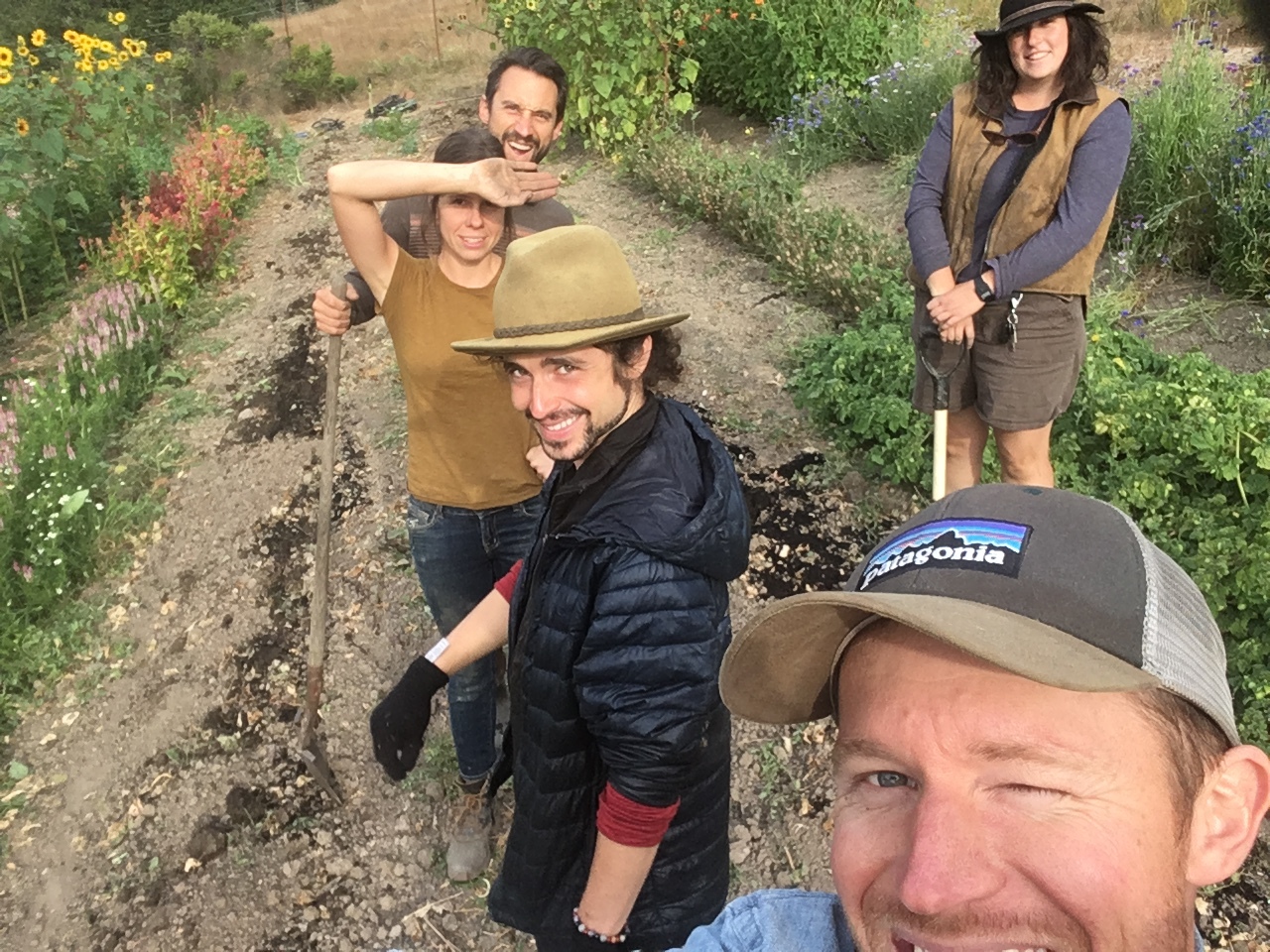
Weeding Wednesday!

Weeding Wednesday!

Wednesday: Wednesday is our biggest baddest field work day during harvest season. Lately, Kate has been with us all day and Kayta joins us just for the morning before heading to Russian River Vineyards. In the morning we are usually joined by a few volunteers for Weeding Wednesday. The farm crew is at its largest. We talk and laugh and kill weeds in the garden or on the farm. Once the volunteers leave, Kate, David and Anna focus on the week's big effort. Last week it was harvesting half the winter squash. This week is was harvesting storage onions. Earlier in the season it is usually a big planting. David usually seeds mustards, arugula, and other greens on this day. Anna and Kate head home around 5:30 just as Kayta is coming home. Kayta and David have a quiet moment looking out at the fields and anticipating the harvest week ahead. We are grateful. As the sun sets. We roll down the greenhouse sides, close the cold frame, close the gates, clean the filters and head home, where Bilbo greets us on the threshold.

A new week begins...

* * * * *

Hope to see you at the potato harvest tomorrow morning!

David and Kayta