
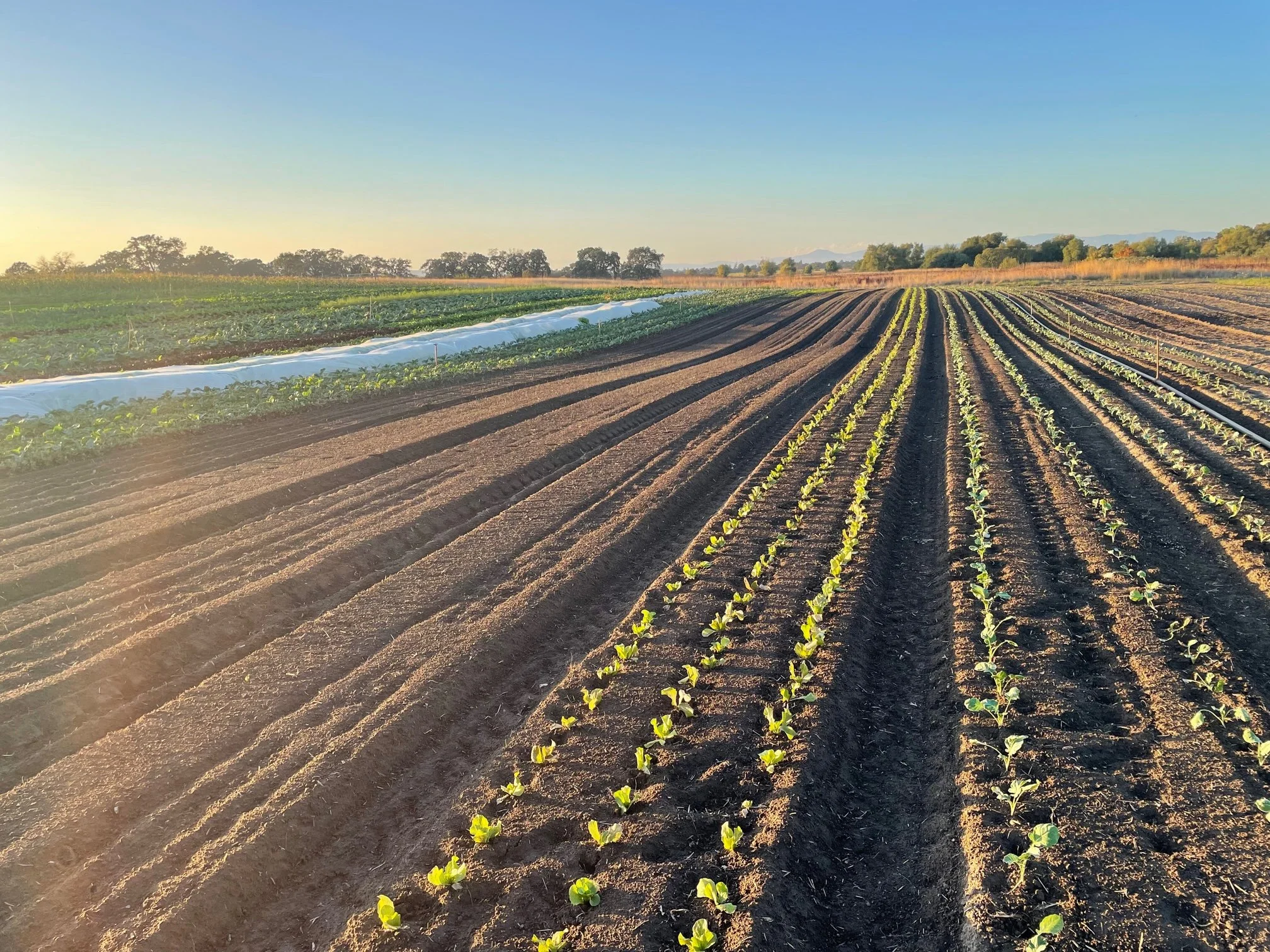
9/8/18 - Week 14 - Conversation in the Field

There are unexpected perks and disadvantages to any and every occupation on this good Earth. The perks and prickles of farming are many and famous. Long hours, rewarding work. Dirty hands, clean hearts. Being at the whims of nature and also at her bosom.

One of our favorite perks of the profession, gifts that keeps on giving, are the abiding friendships we develop with the people we work with; our colleagues in the fields; compatriots through the long summer days; comrades in the Fall frosty harvests.

There is something about going through a season on a farm that feels like you really went through something with someone. Something indescribable. Something important. And you really get to know someone through the ups and down of a growing season; how they fall, how they get up.

Perhaps this bond is not unlike the bond soldiers speak of with their war buddies.

But I think the real secret to it in farming maybe something simple… and rather rare these days.

Lots of conversation.

It is well known: Human-scale agriculture requires a lot of repetitive work with the hands. Harvesting 800 feet of tomatoes; hand weeding 600 bed feet of Fall carrots; washing a morning’s worth of fresh vegetables. With the hands occupied, the mind and the heart — and the tongue — are freed to wander. One might say, on a 95 degree day, on the 4th of 5 tomato rows, they are required to wander for the upkeep of sanity. Regardless of need, with a buddy alongside you, and the hands occupied, the mind and heart oft and do wander together and great — or at least informative, interesting, revealing, or hilarious — conversations inevitably sprout up like weeds in the field.

Ingrid the Egret (far background) is a terrible conversationalist. Luckily we have Anna.

Ingrid the Egret (far background) is a terrible conversationalist. Luckily we have Anna.

Wendell Berry (good old, Wendell!) famously writes about the culture of conversation (of good storytelling, of good “talk”) in the mid-century tobacco fields of Kentucky. There, he writes, the talk could be exceptional. And a good talker was as good as gold. A good talker could make the day fly by. A great talker could illuminate the soul. While the conversation topics have surely changed, this is all still true today at Green Valley Community Farm.

And lucky for us, we’ve got some exceptional talkers with us this season.

Anna, with her inquisitive, seeking, audacious mind; her breadth and depth of knowledge; and her proneness to outbreaks of ticklish rolling laughter, is a godsend of conversation during a late afternoon raking session. She is an encyclopedic font of Harry Potter knowledge (ask her anything), will deep dive with you in debate (she is a Ravenclaw, afterall), and change your mind for the better.

Kate’s buoyant, effervescent, pun-filled parley provides the breeze you need whilst crushing a 200 foot bind-weed invasion. She is a bold and compassionate explorer of the human heart and spirit, the queen of Lord of the Rings trivia (and puns), and the reigning champion of the celebrity-vegetable name game (i.e. Rutabaga Ginsberg; Benedict Cucumberpatch).

We are also fortuned enough to be visited by regular volunteers and farm visitors, who are great conversationalists themselves, and their relative rarity on the farm makes us drawn to their talk, to their minds, like moths to a flame.

Kayta and I have a deep history with field talk. Our relationship was essentially birthed through 7 months of field conversations on 6 acres of green fields in Western Massachusetts. I won her heart by narrating the entire plot of the movie “Aliens” over the course of three days of hand weeding (sound effects included). While our field talk now consists mostly of the practical aspects of keeping GVCFarm humming, we still cherish our field talk.

Farmers: We may be penniless paupers but we are filthy rich in long, deep, meandering, dialogue with our fellow humans and the friendships that come from it. And in this fast paced, disconnected age, that’s as good as gold.

See you in the fields,

David & Kayta

9/1/18 - Week 13 - Oaks: Reprise

Kayta and I are heading to a wedding in Colorado this weekend. The farm will be in Anna's capable hands. Below, is a repost from this time last year on some of our dearest tree neighbors, the mighty Oaks.

* * * * *

There was a chill in the air this week. The chill made us think of Fall -- of orange leaves, of fires, and of Oaks and acorns.

Top (L to R): Canyon live oak, Tan oak, Coast live oak, Interior live oak.Bottom (L to R): Blue oak, Oregon White oak, Valley oak, Black oak, Oracle oak (Hybrid of Black oak x Interior live oak)

Top (L to R): Canyon live oak, Tan oak, Coast live oak, Interior live oak.

Bottom (L to R): Blue oak, Oregon White oak, Valley oak, Black oak, Oracle oak (Hybrid of Black oak x Interior live oak)

Kayta and I became very interested in the Oaks of California a few years ago. From a farmers perspective, it is nothing short of miraculous to witness thousands of pounds of food falling from the sky every year with little to zero human labor or toil. We dreamt then, as we do now, of bringing the abundance of the acorn into a CSA share someday...

But first, thought we, one must learn to identify what one is looking at.

Our goal became simple: To be able to approach an Oak tree in Sonoma or Marin County and proclaim, with scientific assurance, "This is a Black Oak tree!" or, "This is a Coast Live Oak tree!" or, "this is one of the other 6 species native to these parts!."  We packed our hiking bags with Tree Identification books, laced up our boots, and marched proudly into our future. Our future of Knowledge.

Life had other plans.

The first oak tree we approached, the "Wedding Tree" as our little neighborhood called it then, was a giant Quercus next to a tributary of Salmon Creek. It shaded and cooled us as we peered into our books. "See here, the leaf is lobed." "Yes, but not too deeply and not too shallowly." "Are there many lobes." "Yes, but they are rounded and not squared." "Hmmm." "The leaf seems as if it were a perfect amalgam of an Oregon White oak and a Valley Oak." "But what about the bark, is it gray or white?" "There seems to be a gradient from gray to white." "Is that possible?" "Evidently" "What about the texture of the bark?" "There, it is smooth. But here, it is ridged." "There it is like an alligator's hide, and there like an elephant's leg?"

The bark of the Wedding Tree seemed to match the descriptions of the barks of all the oaks. We scratched our heads. Wedding Tree swayed gently in the wind.

Foiled, but intrepid, we found another Oak. This tree, on a dry, south facing hill, had small, tough, dark green leaves that were armed with little spikes on the edges. A Live Oak, our guide books told us. But which? Again, we analyzed the tree; its shape, its leaf, its bark, its colors, we peered into our books --- and again, we could not ID it.

"Perhaps we are missing something?" thought we. "The acorn?" "Yes" "We will wait for the acorn." "We will wait for the Fall."

Late summer. The acorns grew. They filled out. Fall came. They turned from green to brown. They fell.

We returned to the Wedding Tree and searched the duff below her branches for little fallen answers. Finding an acorn we held it high, admiring its perfection. We turned it over and over in our fingers and felt the weight of the cool orb in our palms. We busted out the books. "The cup is warty, rather than scaled, wouldn't you say?" "I don't know, there are tiny scales growing out of the warts." "Definitely egg shaped though, right?" "Too thin." "A thin egg?" 

Fall deepened. So did our confusion. 

We stood under countless Oaks up and down the State. We looked for the trees described in the books but we could not find them. Buoyed by a few victories (the unmistakable cupped leaf leading us to the Coast Live Oak and the iconic star shaped leaf leading us to the Black Oak) we journeyed on, but every tree seemed to defy the language in our books in one way or another.


Around Thanksgiving, a breakthrough came to us in the form of a website describing the Oak families of California, or "the Clades", footnoted by a simple yet profound statement that trees within the same Clade can and do hybridize, and that there is such thing as an "Oregon Valley Oak". We knew, we had seen them everywhere. 

We began leaving our books at home. We stood under more Oak trees. And finally, it began to click. We began to see what we had always seen.

Every tree had its own face, every hillside and every valley, its own tribe. There were the Blue Oaks of the Sierra Nevada foothills along Highway 49, long trunked, long acorned, leaves thick and grayish blue, shaped by their land and place. And then there were the light green leafed, egg shaped acorned Blue Oaks of Annadel Park in Santa Rosa, modest and protected in the rolling hills they called home. And there were the Interior Live Oaks on the upper ridges in the Ventana Wilderness near Mount Carmel with their squat, arrowhead acorns, and tightly wound branches, and then their brethren down the ridge with pin pointed acorns and languid branches. Each group, each tree, was so unique.

In the end we found something. We found trees that more or less matched the descriptions in the books. We found shortcuts for distinguishing California Oak species from one-another. But we didn't really find what we thought we would.

What is out there, growing on the grasslands and in the canyons, is a reality more vast and incomprehensible than any book can hold. It is life. Ever changing, combining, and expressing. And every tree has its own face. 

Perhaps it is up to us to give those trees special and unique to us their own name.

See you in the fields,

David and Kayta

8/24/18 - Week 12 - Work Song by Wendell Berry

IMG_9433.JPG

Work Song Part II - A Vision (Epilogue)

If we will have the wisdom to survive,
to stand like slow growing trees
on a ruined place, renewing, enriching it…
then a long time after we are dead
the lives our lives prepare will live
there, their houses strongly placed
upon the valley sides…

The river will run
clear, as we will never know it…
On the steeps where greed and ignorance cut down
the old forest, an old forest will stand,
its rich leaf-fall drifting on its roots.

The veins of forgotten springs will have opened.
Families will be singing in the fields…
Memory,
native to this valley, will spread over it
like a grove, and memory will grow
into legend, legend into song, song
into sacrament. The abundance of this place,
the songs of its people and its birds,
will be health and wisdom

and indwelling light.

This is no paradisal dream.
Its hardship is its reality.


-Wendell Berry

(From "New and Collected Poems", Counterpoint Press)

*********


See you in the fields,

Kayta and David