
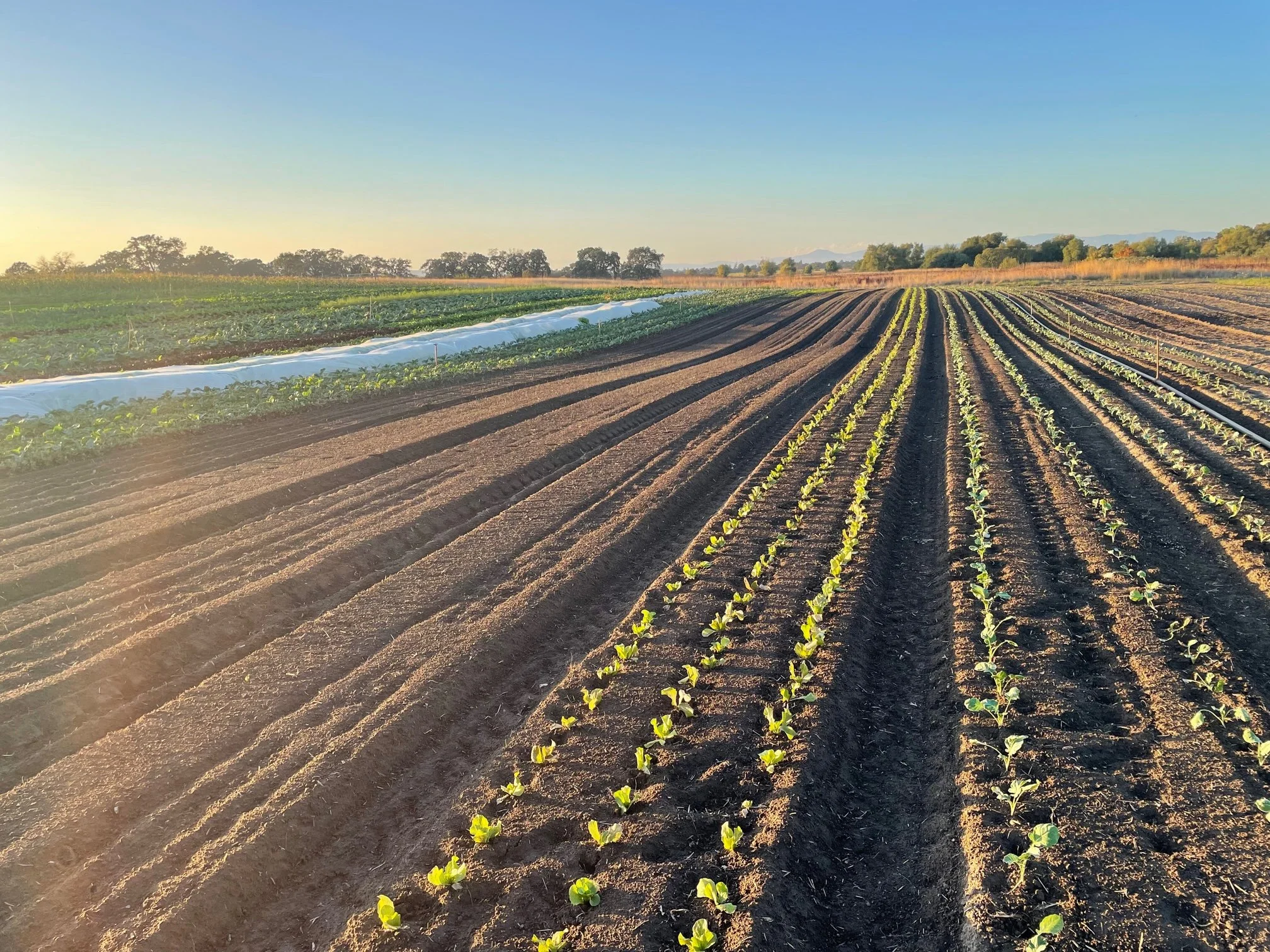
6/26/18 - Week 3 - The Magic of Garlic


"Under the earth the miracle happened..." - Pablo Neruda


Of all the magical crops we grow here at Green Valley Community Farm, perhaps no others enchant us more than the alliums.

And of the 11 allium varieties we grow (from tender scallions to sweet Walla Walla onions) no other enchants us more than garlic.

IMG_4709-2.JPG


We remember the cool November day this year's garlic crop was planted. We remember the low light, the sun just trimming the doug firs on the Western hills, the long fall shadows, and the brisk air. A sweet crew of members joined us that day. Our cat Bilbo who was just a kitten.

Together we popped the cloves from their mother bulbs and held them in our hands; vulnerable, alone, like pale half moons; with trepidation we placed them into the autumn soil, thinking of the cold wet winter ahead. It felt like a prayer.. and an improbable one. We mulched those beds extra thick. And then we left.

We closed the gates. The Sun went south. The Winter constellations turned overhead.

IMG_4732.JPG

And out there, on the East facing slope of High Garden, the cloves slumbered. They slumbered through the longest nights of the year, and through the battering early storms of Winter.


And then one day, deep down under the straw and soil, unbeknownst to anyone, they awoke.

In mid January, "clumsy green stems appeared," and we watched in awe as, day after day, week after week, "leaves were born like swords in the garden."

But we never dared to ask what lay below, and certainly never looked -- out of modesty, out of superstition, out of longing, not wanting to break the spell or to disturb the magic occurring there. We'd walk by the garlic patch whistling a tune, looking at the horizon, as if nothing was growing there, only once in a while stealing a furtive, hopeful glance at the unfurling greenery, and swelling stems.

"... and the earth heaped up her power."

In the mounting heat and elongated days of late Spring, scapes uncurled out of the hardnecks like giddy harbingers. And further along, as if on cue to some mysterious power, the green arching leaves begin to brown. Stalks swelled, and finally, leaves begin to brown and die.

That is when we begin to actually look at our garlic plants, but still standing helplessly in our world, above, with furrowed brows earnestly, attentively, counting leaves, like counting rosaries. And finally, one day, with held breath and a prayer in our hearts, we trust a spade into earth, heaved up, heard the crackling of roots breaking from earth, and we lifted up from "the secrecy of the dark earth"... garlic!

IMG_4966.jpg

See you in the fields,

David & Kayta

*Italicized quotes from the poem Ode to the Onion by Pablo Neruda
6/15/18 - Week 2 - Seed Saving as a Community

IMG_3640.JPG

A simple, beautiful thing happened on the farm this past week.

Members brought corn seeds that they had saved in their homes over the winter back to the farm to be planted.

In doing so, they performed perhaps the most vital agricultural act, saving seed. This act, in ways that are as practical as they are divine, connected us to each other; connected our kitchens and homes to the Earth; and connected us to time and to ancient ancestors and distant descendants.

“Whoa, dude, get a grip… We just saved some of those corn cobs on our dresser.”

Precisely!

So the story goes...

There once was a man in Montana looking for a flour corn suited to the short, tumultuous summers. He reached out to friends, who reached out to their friends, and he gathered as many heirloom corn varieties as he could. He was given seeds from the Intermountain West and the Dakotas; seeds from the Desert South and the Deep South; seeds from the East, and the West; seeds from Native Americans, from European homesteaders, and from African American farmers. Then, one Spring he planted them out in the same field together and let them cross, and that Fall, he harvested. He chose the ears that he liked best — the ones that were beautiful; the ones that produced a lot of seed; the ones that had a hard, protective shell; and the ones that gave sweet flour -- and he saved them. He planted those out the next Spring and so on and so forth.

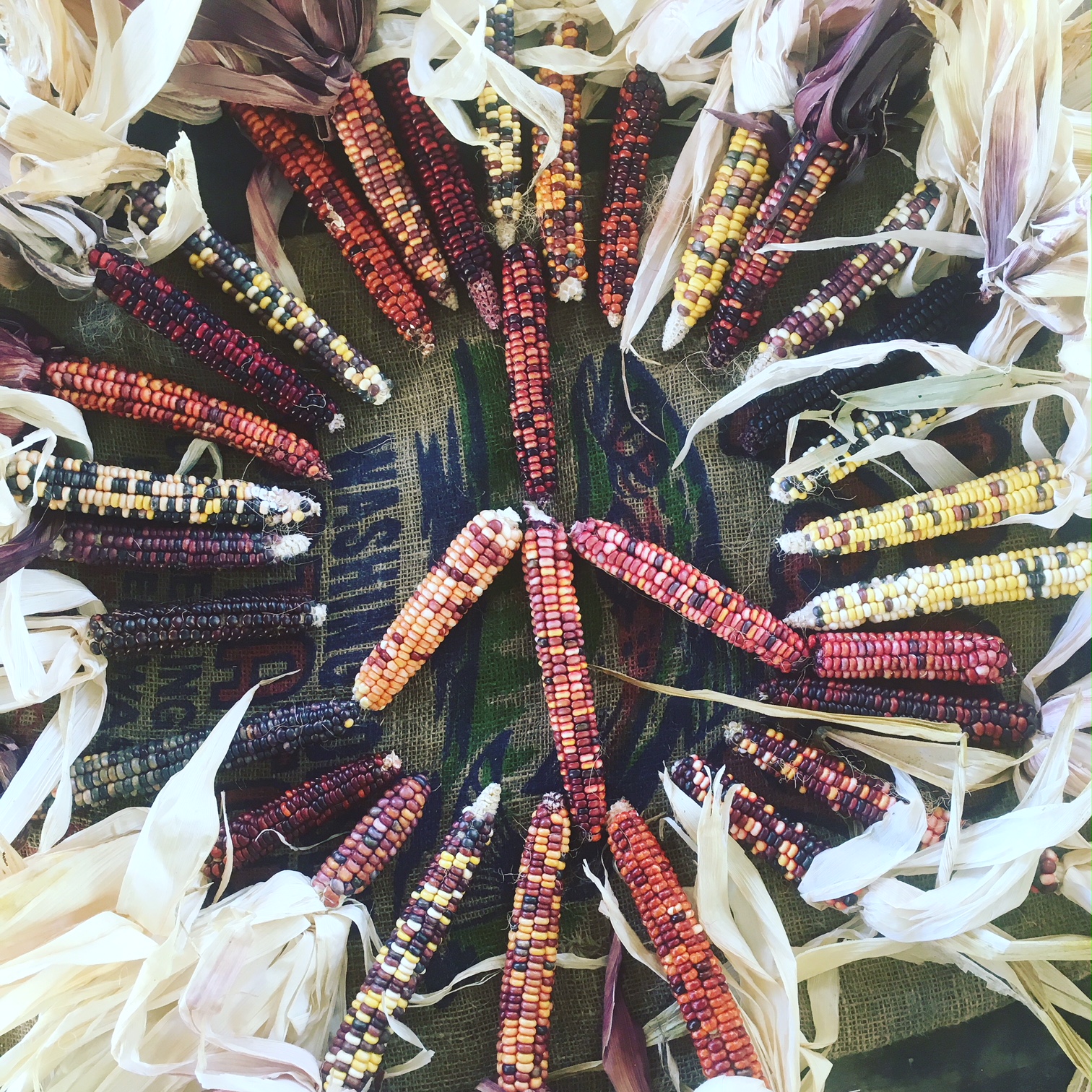
After many years, this corn became known as Painted Mountain: A gorgeous, multi-colored, hearty, early flint heirloom that contains within each kernel, in a very real way, an immense genetic diversity and history; genes baring the mark of numerous peoples and cultures selecting for their needs, their desires, their histories, their stories, and their lands. These genes bare the history of people who lived and died by their corn, who were reared on it and fed their children the same corn their great-great grandmothers saved.

Kayta and I planted some Painted Mountain seeds in our East Field last spring next to the Jack-O-Lanterns. They didn’t all do well. Some didn’t thrive. Some were cut down by wire worms. But some grew strong.

Some of you may remember the hot September day we harvested that patch, eating bagels and cream cheese under the willow, and marveling at the explosions of color behind each husk.

Image-1-2.jpg

We brought the harvested ears into our greenhouses to dry, and a few weeks later we threshed them and milled the kernels into flour at Tierra Vegetables. Then came the best part… We made pancakes and breads and cakes. And for a brief moment, our bodies and our thoughts were made of Painted Mountain Corn.

But some ears we didn’t thresh or mill. Some were so beautiful that they took our breath away. The wine-dark red ones, the impossibly orange, the muted pastel mosaics of greens, purples, and blues. These, we kept, and took home and to adorn our kitchens, our mantles, and our dusty dresser drawers.

When we chose ones we liked, that simple act of affection and appreciation for beauty, we did it without even knowing it… we performed the most ancient, important agricultural act. We selected for plants that did well that summer, in this soil, in this climate, on this farm.

Over the winter, those seeds we protected in our homes. They listened to the winter rains patter on our roofs and to the laughter, the tears, and songs in the house. And then we brought them back to the farm to plant.

It strikes us that in this simple moment of seed saving, perhaps we became what our name aspires to: We became a community farm.

A bold statement -- but nothing could be truer. In taking a small step toward adapting this powerful, sacred staple food crop to this land, we simultaneously honored all that went into those seeds before they came here... and a settled future. We chose interdependence to this place, to this seed, and to each other.

Thanks for being a part of this farm community!

Well how’s that for a sappy Farmer’s Log? Next week, we’ll have to write about tractor maintenance or something!

See you in the fields,

David and Kayta

6/7/2018 - Week 1 - Farming is a strange game

Well, hello there, nice to see you!

It feels surreal to be writing in these annals again! It seems like just yesterday Kayta and I were sitting by the woodstove, sippin' tea, listening to the rain, and dreaming of the season ahead, far off in the distance...

Then Old Sun came back around and BAM! Time to sharpen those harvest knives again.

Well, I guess there were a few months of prep, perspiration, and planting in between; a plot twist or two; new protagonists, new antagonists. Aye, it's been an entertaining (and educational!) second Act, this second Spring for us here at Green Valley Community Farm.

Farming is a strange game. Steph Curry probably attempts 100 three-pointers every day at practice (and makes 101). Farmers only get one chance per year to try many things. The most experienced potato farmer may have planted potatoes only 40 times in his or her lifetime.

Last year was a blur of firsts for us here at Green Valley. Our first time working this soil. Our first time planting potatoes and well, everything else here! And doing something just the one time, you don't really know if the results are from something you did, from nature, from nurture, or from just plain old beginners luck. Now, nearing the end of our second Spring and seeing the results of some second attempts, we feel we've officially begun the learning curve of this place... the long arcing road of asking, learning, and, if we're lucky, understanding what the heck is going on in the flora, soil, and ecological systems we tend here.

For example, we now know that as CSA farmers aiming for a June 1st start date, one of the hardest shots for us to make will be our first big Spring transplanting. The soils here are clay-heavy and water sheathes down from the surrounding hillsides long after the last heavy rains (April 6th Atmospheric River, anyone?). Cold and wet soils tend to have less active aerobic biology and the negative charge of clay particles tends to cling greedily to whatever native nutrients a soil contains, making them unavailable to plants. In a nutshell: Cold + wet + clay soils = SAD PLANTS!

Our last two attempts at these early transplantings have bounced around the rim, and given us heart attacks, before finally falling in. The plants go into the soil looking vigorous and vibrant, and then a week or two later they go limp, shrink (if that were possible), and turn every color possible besides the one you want... green!

Last year, we watched this drama play out rather helplessly before the warmth of June helped our first brassicas rebound and mature into upstanding vegetable citizens in spite of their rough upbringing. This year, we were going to do it right from the get-go. And thanks to our amazing new farmer Anna Dozor (who we can't wait for you to meet), we were able to plant even healthier looking starts into more deftly prepared soil. But lo and behold... the same withering symptoms began to occur. Heart attacks commenced.

Enter: August York.

August (a CSA member and soil biologist and consultant who has been graciously helping us get to know our soil) swooped in with his knowledge, a compost tea brewer, and rich organic concoctions. With the compost tea breathing a breath of microbiological life into the sleeping soil and spoonfuls of concoction, we nursed our babes through their time of need.

IMG_4758.JPG

Yup, then that Old Sun came back around, the soil warmed up, the native soil life woke up, and the plants exploded. The harvest knives will be singing on Friday.

We hope this story of the year's first crops prevailing over a wet, wet April adds a touch of sweetness to your first bites from the farm.

And can’t wait to share many more stories and sweet bites with you in the months ahead.

Thanks for joining us on the journey!

See you in the fields,


Your 2018 farm crew, Kayta, Anna​, and David