
Harvest Week 17 - 7th Annual Potato Harvest Party

JOIN US FOR OUR 7th ANNUAL
POTATO HARVEST PARTY!

THIS Saturday, October 14th, 8:30 am - 11:30 am

Join us for our 7th annual potato harvest party! There’s nothing like watching potatoes shower up out of the ground behind the wake of the tractor and then getting dirty and bagging them with friends. It’s an unforgettable experience, especially for the kiddos.

All abilities and interests welcome. Feel free to bring non-members. We recommend a sunhat, water bottle, and clothes you don’t mind getting dirty. Some people prefer using gloves. We’ll have some light refreshments, music from the boombox, and agrarianly awesome time. (For new folks: This potato harvest is not required in any way for members to enjoy potatoes, we will be distributing the tuberous bounty all year whether or not you come to harvest!)

THIS WEEK’S HARVEST

In a nutshell:

Fancy Fall Braising/Salad Mix, Spinach, Newham Little Gem Lettuce, Panisse Oakleaf Lettuce, Brussel Sprout Tops, White Russian Kale, Fennel, Multicolored Beets, Poblano Peppers, Sweet Peppers, Romance Carrots, Murdoc Cabbage, Summer Squash & Zucchini, Elsye Yellow Onions, Harvest Moon Potatoes, Heirloom & Red Slicing Tomatoes

U-PICK

  • Jack-O-Lantern Pumpkins: Season limit 1 per person

  • Albion Strawberries: 2 pints per share

  • Cherry Tomatoes: 3 pint per share

  • Jalapeños: 5 peppers per share | If you like your jalapeños hot, look for peppers with checking (little cracks) on them

  • Buena Mulata Peppers: 1 peppers per share | Usable at any color, but with more fruity flavor when ripe red or orange

  • Habanero Peppers: 4 pepper per share | Ripe when orange

  • Aji Limo Peppers: 4 pepper per share | Ripe when yellow. This citrusy Peruvian pepper is traditionally used in ceviche. Sometimes called Lemon Drop in the US.

  • Goldilocks Beans: 4 pints per share

  • Herbs: Italian Basil, Thai Basil, Tulsi Basil, Dill, Chamomile, Parsley, Onion Chives, Garlic Chives, Tarragon, Oregano, Marjoram, Culinary Sage, Lemon Balm, Lemon Verbena, Vietnamese Coriander, Shiso (Perilla), Culinary Lavender, French Sorrel, Borage, Violas, Thyme and Mints.

  • Flowers!

There are still lots of gorgeous pumpkins! You’ll have the greatest selection if you venture a little further out into the field.

HARVEST NOTES

  • Jack-O-Lanterns for Pumpkin Pie? Lots of folks have asked us if the Jack-O-Lantern pumpkins are edible. While they are technically edible, they’ve been bred for their charming appearance rather than flavor, so we don’t recommend eating them. Don’t worry, we’ll be rolling out 9 different types of truly delicious winter squashes over the coming weeks.

  • Tomatoes: Our tomatoes are winding down! We’ll likely have one or two more weeks of a modest harvest.

  • Brussels Sprout Tops: Each year around this time we trim the tops off of the Brussel sprouts plants to encourage the sprouts to size up evenly. This annual necessity has the delicious benefit of giving us delicate bunches of cooking greens with that lovely Brussel Sprout flavor. Use as you would any of your favorite cooking greens like Kale or Collards.

  • Kimchi Week Next Week! Every year, we design our crop plan so that scallions, daikon, and Napa cabbage all line up so that members can make kimchi! We wanted to give you a heads up in case you want to stock up on the other ingredients or make room in your schedule for a delicious project.

Pickle Party!

We’ve recently fallen in love with a sandwich called The Scuttlebutt (think thick-sliced feta, aioli, hard-boiled eggs, and an herby, pickled-vegetable-filled salad with olives and capers on homemade focaccia!), and one delightful byproduct of this development is having a fridge full of these bright and beautiful pickles. Even if you’re not thinking of making a Scuttlebutt, we think you’ll love using these pickles to dress up other sandwiches or as a vibrant side to pretty up any plate.

If you’re on the fence, check out CSA member Kate Seely’s Scuttlebutt testimonial:

“This is the perfect sandwich! A little savory, a little sweet, with lots of herb and a perfect juiciness to it. It can look intimidating, but just do a little over two days: Prep your focaccia one day, your pickles the next, then bake your focaccia the morning of your first feast. Then, with your extra ingredients already prepped, you're set for sandwiches for the next few days!  DELISH! And so beautiful, too. “

You can find the entire recipe here!

pickled Beets & Onions

  • 1 bunch beets (about 5 or 6)

  • 1/4 cup olive oil

  • 2 large red onions, thinly sliced

  • 1 1/2 tablespoons kosher salt, divided

  • 2 cups red wine vinegar

  • 2 cups water

  • 1 cup sugar

  • 1 tablespoon whole black peppercorns

  • 1 tablespoon coriander seeds

  • 1 tablespoon mustard seeds

  • 2 whole star anise pods, broken up

  • 8 whole allspice berries

Roast the beets: Preheat the oven to 400° F. Put the beets in a roasting pan, add just enough water to the pan to evenly cover the bottom. Salt the beets with 1 tablespoon of salt and drizzle them with olive oil. Cover with foil and roast for about an hour, until they're tender when pierced with a knife. Let them cool, then peel the beets. Cut them into 1/4-inch slices and pack loosely in 2-3 heatproof quart jars with the onions.

In a saucepan, combine the red wine vinegar, water, sugar, and 1/2 tablespoon kosher salt, plus the peppercorns, coriander seeds, mustard, anise, and allspice. Bring to a boil over medium-high heat, stirring to dissolve the sugar and salt. Pour the brine over the beets and onions, then let them cool at room temperature. Transfer them to a plastic or glass container, cover them, and refrigerate for at least a day. They'll last up to 2 months.

Pickled Carrots

  • 8 medium carrots, peeled and very thinly sliced into rounds or on a bias

  • 2 cups apple cider vinegar

  • 2 cups water

  • 1 cup sugar

  • 1/2 cup kosher salt

  • 1 tablespoon coriander seeds

  • 1 tablespoon fennel seeds

  • 2 árbol chiles (or any of our hot peppers)

Place the sliced carrots in a heatproof quart jar. In a saucepan, combine the apple cider vinegar, water, sugar, kosher salt, coriander, fennel, and the chiles. Boil, stir, and pour over the carrots. Cool them, then store in the fridge for at least a day, and up to 2 months.

FARMERS LOG

7TH ANNUAL POTATO HARVEST

Tomorrow morning, we'll come together as a community to perform a quintessential agricultural ritual: The potato harvest. As we kneel down, on the Earth, bagging the cool, bulbous tubers, we will join in concert thousands of people around the world performing the same act. We will also join untold millions of ancestors who, in the late summer and fall, knelt together and harvested potatoes. We will be joined, by a real, living, breathing chain of seed potatoes to hundreds of historic potato harvests in Europe and Asia and to the thousands of harvests in the Andes and Northeastern Bolivia — the birthplace of this amazing plant.

There is nothing quite like an abundant potato harvest and the feeling, afterwards, of storing them away — in a pit, a cooler, a cave; the potatoes themselves alive, breathing slowly, promising food, promising life, throughout the winter months.

Potatoes are the highest caloric food crop per-acre of any crop (over maize, wheat, and rice). And they are the only one of these “staff-of-life” crops that grows (the food part, at least) deep in the Earth — shrouded in the dark and in mystery until they are harvested and lifted up into the light.

While we check the potatoes as they grow every so often, every potato harvest is a mystery until it happens: How will the crop turn out this year? Will it be an abundant?

If our first few small harvests are any indicator, it looks like we’ve been blessed with a healthy, abundant potato crop. The potato field in purple and white flower in June and July was a vision to behold. They scented the foggy mornings. The shimmering green foliage reached above your waist and covered every inch of ground so it was hard to walk. All that energy, all that delight, all that sunlight, was sent down below to the tubers, which are waiting for us now. They’ve been coming out of the ground “sound as stone” and will nourish us all through this fall and winter.

And that is cause for celebration.

Join us tomorrow for our 7th annual potato harvest as we "shower" up the living roots and scatter libations in remembrance and thanks.

See you in the fields,
David & Kayta

Harvest Week 16 - Pumpkin Patch Open!

JOIN US FOR OUR 7th ANNUAL
POTATO HARVEST PARTY!

NEXT Saturday, October 14th, 8:30 am - 11:30 am

Join us for our 7th annual potato harvest party! There’s nothing like watching potatoes shower up out of the ground behind the wake of the tractor and then getting dirty and bagging them with friends. It’s an unforgettable experience, especially for the kiddos.

All abilities and interests welcome. Feel free to bring non-members. We recommend a sunhat, water bottle, and clothes you don’t mind getting dirty. Some people prefer using gloves. We’ll have some light refreshments, music from the boombox, and agrarianly awesome time. (For new folks: This potato harvest is not required in any way for members to enjoy potatoes, we will be distributing the tuberous bounty all year whether or not you come to harvest!)

THIS WEEK’S HARVEST

In a nutshell: Pumpkins! Need we say more?

Fancy Fall Braising/Salad Mix, Assorted Lettuce, Rainbow Chard, Sugarloaf Chicories, Hakurei Salad Turnips, Celery, Purple Daikon, Bishop Cauliflower, Sweet Peppers, Romance Carrots, Delicata Winter Squash, Summer Squash & Zucchini, Elsye Yellow Onions, Harvest Moon Potatoes, Heirloom & Red Slicing Tomatoes.

U-PICK

  • 🌟 Jack-O-Lantern Pumpkins: Season limit 1 per person | See below for more details on the pumpkin patch!

  • Albion Strawberries: 2 pints per share

  • Cherry Tomatoes: 4 pint per share

  • Shishito & Padrón Frying Peppers: Gleanings — meaning the plants have mostly stopped producing but you’re welcome to forage for a few

  • Jalapeños: 5 peppers per share | If you like your jalapeños hot, look for peppers with checking (little cracks) on them

  • Buena Mulata Peppers: 1 peppers per share | Usable at any color, but with more fruity flavor when ripe red or orange

  • Habanero Peppers: 2 pepper per share | Ripe when orange

  • Aji Limo Peppers: 2 pepper per share | Ripe when yellow. This citrusy Peruvian pepper is traditionally used in ceviche. Sometimes called Lemon Drop in the US.

  • Goldilocks Beans: 4 pints per share

  • Herbs: Italian Basil, Thai Basil, Tulsi Basil, Dill, Chamomile, Parsley, Onion Chives, Garlic Chives, Tarragon, Oregano, Marjoram, Culinary Sage, Lemon Balm, Lemon Verbena, Vietnamese Coriander, Shiso (Perilla), Culinary Lavender, French Sorrel, Borage, Violas, Thyme and Mints.

  • Flowers!

Better get your pumpkins before Alice takes them all!

HARVEST NOTES

  • Delicata Winter Squash: Debuting as the first of 9 Winter Squash varieties we will enjoy this year, Delicata are a perennial favorite. Versatile, and sweet, they even have edible skins. For the easiest preparation, cut in half, scoop out the seeds and roast, face down, until soft enough that you can easily stick a fork in. They are also delicious cut into rings or half circles, tossed with an oil of your choice (coconut is particularly scrumptious) and then roasted until caramelized. Enjoy!

  • Harvest Moon Potatoes: Numerous crew and CSA members agree, Harvest Moons might be the best potato there is. The Burpee’s catalogue says it well: “Potatoes as objects of beauty? Let your eyes linger on ‘Harvest Moon’, with her velvety dark-purple skin and dense, sumptuous golden-yellow flesh. A seductively gorgeous purple potato princess, she’s as gorgeous to behold as she is tasty. Infused with creamy, nutty flavor, ‘Harvest Moon’ is a culinary triumph on her own, no butter or salt required.” Enjoy every which way: mashed, baked, boiled, fried—or adding color and flavor to a potato salad.

  • Canning Tomatoes: Our tomatoes are winding down — this is the last week that canning tomatoes will be available in limited quantities.

PUMPKIN PATCH!

Spooky season is here and so is our 7th annual WCCF pumpkin patch! The pumpkins did really well this year so there is a pumpkin out there for every kid and adult participating in the CSA. Even if you are alternating weeks with another share, you can all take a pumpkin!

To find the pumpkin patch, just look below the oak trees. You can’t miss it!

Season limit on Jack-O-Lanterns: 1 per person

FARMERS LOG

SPRING AND SUMMER IN REVIEW

While our harvest season is far from over, this time of year — the time of bulk harvests and the end of planting — is a great time of year to look back on the year. How did our crops do and how did we farmers do? What did the Farm Gods deal us and how did we play our hand? Who won and who lost in our fields this year?

A big question, yes — and an evolving question still — but let’s look back on the last three quarters of this football game.

Winter and Spring

The winter and spring were defined by one of the wettest rain years in recent history. The 2022 - 2023 rain year simultaneously blessed the land and the farmers of this drought-stricken state and caused untold farmer headaches, outright destruction, and crop loss.

We were spared the outright destruction.  

As far as the blessings go, just ask the frogs. The population of frogs on the farm this year has been astounding. There seems to be a Western Tree Frog in every harvest bin, under every seed tray, and hiding in every Sugarloaf Chicory we cut. And they are not alone — every plant from the oak trees to the year’s voracious weeds seem to have drunk from a deep well. There are wild grasses along the creek taller that my head. It is beautiful. 

The wet winter also caused perhaps the biggest crop loss in our farm’s history — the garlic. I remember planting our garlic during the year’s first Fall rain storm and it… did… not… stop. The ground was so saturated for so long into the Spring that our little garlic plants were never able to develop robust roots. While not a complete loss, I estimate we got about 1/6th of volume of garlic we usually do, the majority of which we need to save for seed for next year.

Finally, the wet winter-spring delayed our season by about 2 weeks as it was so wet we couldn’t get the tractors into the fields!

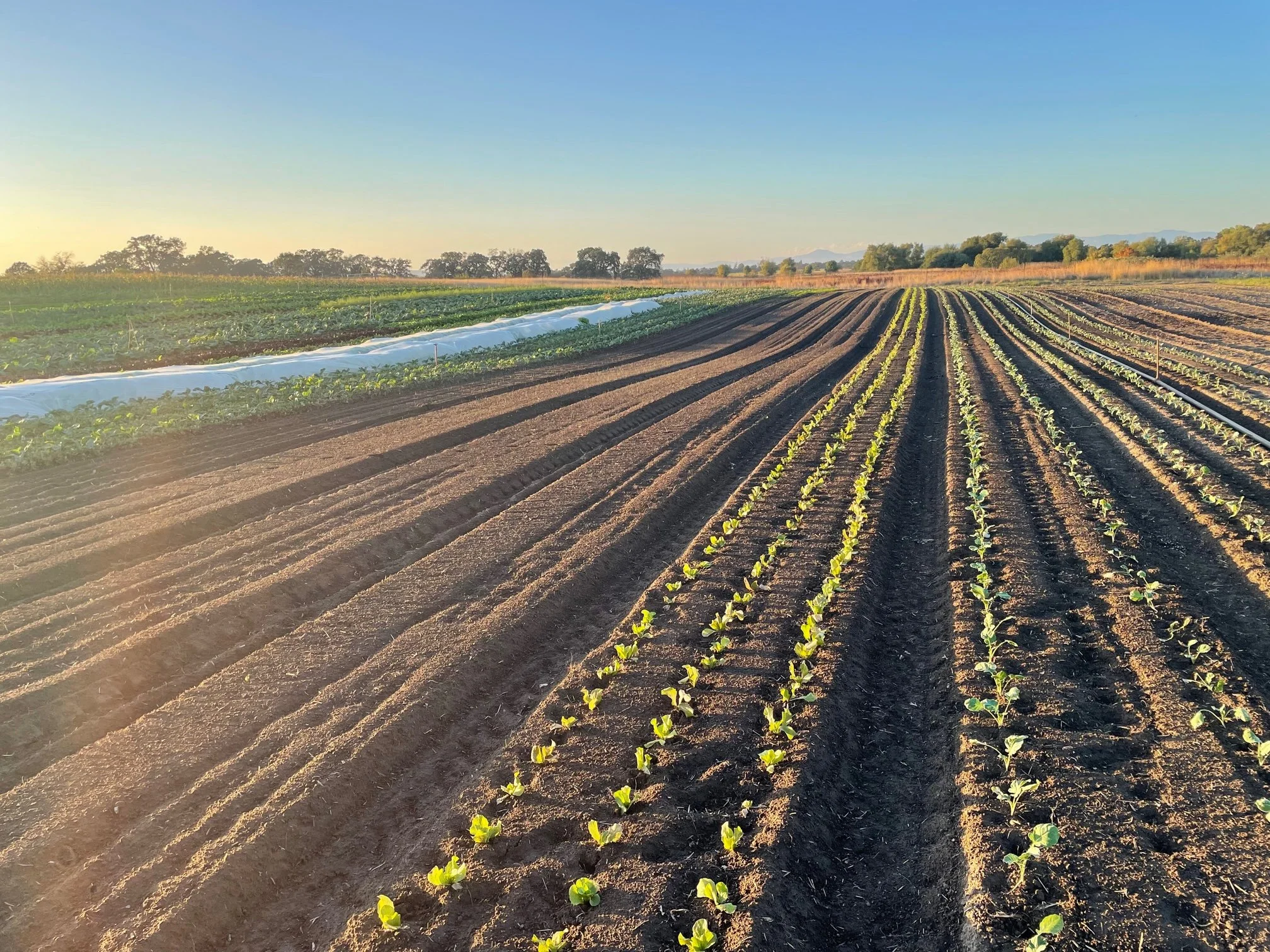
Fall veg is stacking up nicely out in Farfield.

Summer

Almost like a spiritual extension of the wet winter, this summer was unusually cool, which caused numerous more subtle winners and losers in the fields.

First and foremost, the strawberries loved it. There is a reason why 2 billion dollars worth of strawberries are grown in the foggy summers of Salinas and Watsonville. This summer here often resembled those foggy coastal towns and the strawberries felt right at home. It brought us immense joy to see all the strawberry-smeared toddler faces as the plants pumped out hundreds of pints a week. 

Also in the winner camp were all our summer greens, brassicas, and onions. Things like lettuce and celery usually struggle a bit in August and September as the dial on the thermometer creeps up, but they were happy as a clam all summer long. Our onion crop also had their hot-girl-summer and we are rich in softball sized onions to carry us through the end of the year.

The cooler summer shortened our tomato and pepper season a bit — those nightshades need heat to ripen fruit, so the fruiting season was delayed into a slightly shorter, more condensed avalanche. Last week and the week before it was the tomatoes. This week it’s the sweet peppers that are all coming on at once.

On the other hand, the cooler days preserved what fruits did ripen on the vine for longer, and caused less sunburn and loss, and may have contributed to a better, bulkier tomato year overall. These are the things we farmer ponder.

Aye, watching plants respond — in sometimes unexpected ways — to what nature throws at them is one of the coolest things about farming. 

Fall

Now we head out to the last quarter of this football game. What hand will be dealt? Will the rains come hard and early, or will it be a dry and hot fall? No one but the Farm Gods know.

But our fall field of greens and fresh vegetables looks stacked out there in Farfield; our potatoes are coming in round and sound; Kayta and I had the best Delicata of our lives last night; and this crew is top-notch. 

So I’d wager we’ll have a victoriously tasty Autumn. 

See you in the fields,
David

Harvest Week 15 - Rain Kissed

JOIN US FOR OUR 7th ANNUAL
POTATO HARVEST PARTY!

Saturday, October 14th, 8:30 am - 11:30 am

There’s nothing like watching potatoes shower up out of the ground behind the wake of the tractor and then getting dirty and bagging them with friends. It’s an unforgettable experience, especially for the kiddos, and we hope you’ll join us!

All abilities and interests welcome. Feel free to bring non-members. We recommend a sunhat, water bottle, and clothes you don’t mind getting dirty. Some people prefer using gloves. We’ll have some light refreshments, music from the boombox, and agrarianly awesome time.

THIS WEEK’S HARVEST

In a nutshell: Summer and fall collide on the harvest table.

Mustard Mix, Little Gem Lettuce, Assorted Lettuce, Dazzling Blue Dino Kale, Bel Fiore Chicory & Radicchio, Bishop Cauliflower, Sweet Peppers, Poblano Peppers, Fennel, Multicolored Beets, Summer Squash & Zucchini, Cabernet Onions, Bintje Potatoes, Green Cabbage, Heirloom & Red Slicing Tomatoes.

U-PICK

  • Albion Strawberries: 2 pints per share

  • Cherry Tomatoes: 6 pint per share

  • Shishito & Padrón Frying Peppers: 1 pints total per share | Likely the last week

  • Jalapeños: 6 peppers per share | If you like your jalapeños hot, look for peppers with checking (little cracks) on them

  • Buena Mulata Peppers: 5 peppers per share | Usable at any color, but with more fruity flavor when ripe red or orange

  • Habanero Peppers: 1 pepper per share | Ripe when orange

  • 🌟 Aji Limo Peppers: 1 pepper per share | Ripe when yellow. This citrusy Peruvian pepper is traditionally used in ceviche. Sometimes called Lemon Drop in the US.

  • 🌟 Goldilocks Beans: 3 pints per share | These gorgeous golden green beans seem to glow. Perfectly suited to any of your favorite cooked bean dishes or for making dilly beans!

  • Amethyst Beans: Gleanings | Surprisingly, the plants from our earliest succession have started to make more beans. Feel free to pick some if you feel like foraging.

  • Tomatillos: 1 pint per share

  • Herbs: Italian Basil, Thai Basil, Tulsi Basil, Dill, Chamomile, Parsley, Onion Chives, Garlic Chives, Tarragon, Oregano, Marjoram, Culinary Sage, Lemon Balm, Lemon Verbena, Vietnamese Coriander, Shiso (Perilla), Culinary Lavender, French Sorrel, Borage, Violas, Thyme and Mints.

  • Flowers!

Our final patch of u-pick green beans, Goldilocks, on the far right.

Preserving the Harvest

Canning Tomatoes

Tomato production is still going strong, but we recommend taking home your share’s 25 lb season limit (this week or next!) before the the plants start to tap out. Check out Week 12’s newsletter for a super simple fresh tomato sauce recipe that freezes beautifully.

lemon dill Sauerkraut

We have some beautiful (and giant!) heads of cabbage in the share this week, perfect for making sauerkraut! Here is our favorite garlicky, dill kraut recipe from the book Fermented Vegetables by Kristen and Christopher Shockey 

(Yields about 1 gallon of kraut)

  • about 6 pounds cabbage (2 small heads or one large one)

  • 1 1/2-2 tablespoons unrefined sea salt

  • 4 tablespoons lemon juice

  • 1-2 tablespoons dried dill 

  • 4-5 cloves of garlic, finely grated

  1. To prepare the cabbage, remove the coarse outer leaves. Rinse a few unblemished ones and set them aside. Quarter and core the cabbage, thinly slice, and transfer to a large bowl. 

  2. Add the dill, lemon juice, and 1 tablespoon of the salt and, with your hands, massage it into the leaves, then taste. You should be able to taste the salt without it being overwhelming. Add more salt if necessary. The cabbage will soon look wet and limp, and liquid will begin to pool.  At this point, add the garlic. If you've put in a good effort and don't see much brine in the bowl, let it stand, covered, for 45 minutes, then massage again. 

  3. Transfer the cabbage to a crock or 2-quart jar, a few handfuls at a time, pressing down on the cabbage with your fist or a tamper to work out air pockets. You should see some brine on top of the cabbage when you press. Leave 4 inches of headspace for a crock, or 2 to 3 inches for a jar. Top the cabbage with one or two of the reserved outer leaves. Then, for a crock, top the leaves with a plate that fits the opening of the container and covers as much of the vegetables as possible; weigh down with a sealed, water-filled jar. For a jar, use a sealed, water-filled jar or ziplock bag as a follower-weight combination. 

  4. Set aside the jar or crock on a baking sheet to ferment, somewhere nearby, out of direct sunlight and cool, for 4 to 14 days. Check daily to make sure the cabbage is submerged, pressing down as needed. 

  5. You can start to test the kraut on day 4. You'll know it's ready when it's pleasingly sour and pickle-y tasting, without the strong acidity of vinegar; the cabbage has softened a bit but retains some crunch; and the cabbage is more yellow than green and slightly translucent. 

  6. Ladle the kraut into smaller jars and tamp down. Pour in any brine that's left. Tighten the lids, then store in the refrigerator. This kraut will keep, refrigerated, for 1 year.

Tossing some beautiful Cauliflower heads during harvest this morning.

FARMERS LOG

We started in on some truly autumnal tasks this week like mowing and spading big blocks in the fields to prep for cover cropping and walking the winter squash and Jack-O-Lanterns to decide when to clip them!

And lucky for us, this autumn began with a little kiss of rain. We were so grateful for that kiss, adding a little softness, and a little green into what’s usually the driest time of the year. It’s brought to mind one of our favorite poems, by Ursula K. Le Guin, a daughter of California.

* * * * *

TO THE RAIN

BY URSULA K. LE GUIN

Mother rain, manifold, measureless,
falling on fallow, on field and forest,
on house-roof, low hovel, high tower,
downwelling waters all-washing, wider
than cities, softer than sisterhood, vaster
than countrysides, calming, recalling:
return to us, teaching our troubled
souls in your ceaseless descent
to fall, to be fellow, to feel to the root,
to sink in, to heal, to sweeten the sea.

* * * * *

Many of you asked how the rain affected the farm. Aside from a few squishy strawberries and tomatoes, it was a manifold blessing and sweet relief to the soul and to the senses of all the creatures of the farm. The calls of the songbirds seemed to be tinged with joy that wet morning. And now everything seems to have became softer — from the blades of dry grass to the very earth under our feet which seemed to change from baked brick to a bouncy sponge.

Fall Carrots, being rarified by the cooler nights. We will have a brief break from carrots this week to let these size up a little more and we’ll start distributing them next week.

You can see and taste the rain’s blessing in the crops too. Our friend Ryan Power at New Family Farm once said, "Vegetables become more refined in the Fall."  Truer words were never spoken. Perhaps it’s from those occasional fall rains. Or perhaps it’s from the slower growth caused by the reducing sunlight that makes the vegetables grow sturdier, like hardwood trees; rarified and essentialized. Or maybe it’s because they stare more often at the moon and stars these days than the belligerent sun. Or perhaps it's the cooler days and cooler nights that slow down the insect and root worm armies and allow our veggies to let their defenses down and grow in peace. Whatever the cause, it is true: Many in our vegetable society are looking more dapper than they have all year — especially the greens.

We hope you enjoy the share this week: That unique time of year when autumn and summer collide on the harvest table and you can chase some fruity tomatoes with rain-kissed cauliflower.

See you in the fields,
David