Harvest Week 14 - Equinox on the Farm

THIS WEEK’S HARVEST

In a nutshell: With the equinox comes the first of our fall-inflected shares.

Arugula, Mustard Mix, Little Gem Lettuce, Green Romaine Lettuce, Rainbow Chard, Indigo Radicchio, Green Bok Choi, Green Magic Broccoli, Celery, Assorted Sweet Peppers, Summer Squash & Zucchini, Assorted Cucumbers, Romance Carrots, Walla Walla Onions, Various Heirloom & Red Slicing Tomatoes.

U-PICK

  • Albion Strawberries: 4 pints per share

  • Cherry Tomatoes: 6 pint per share

  • Shishito & Padrón Frying Peppers: 1 pints total per share | Likely the last week for frying peppers

  • Jalapeños: 5 peppers per share | if you like your jalapeños hot, look for peppers with checking (little cracks) on them

  • Buena Mulata Peppers: 4 peppers per share | usable at any color, but with more fruity flavor when ripe red or orange

  • Habanero Peppers: 1 pepper per share | ripe when orange

  • Tomatillos: 1 pint per share

  • Herbs: Italian Basil, Thai Basil, Tulsi Basil, Dill, Chamomile, Parsley, Onion Chives, Garlic Chives, Tarragon, Oregano, Marjoram, Culinary Sage, Lemon Balm, Lemon Verbena, Vietnamese Coriander, Shiso (Perilla), Culinary Lavender, French Sorrel, Borage, Violas, Thyme and Mints.

  • Flowers!

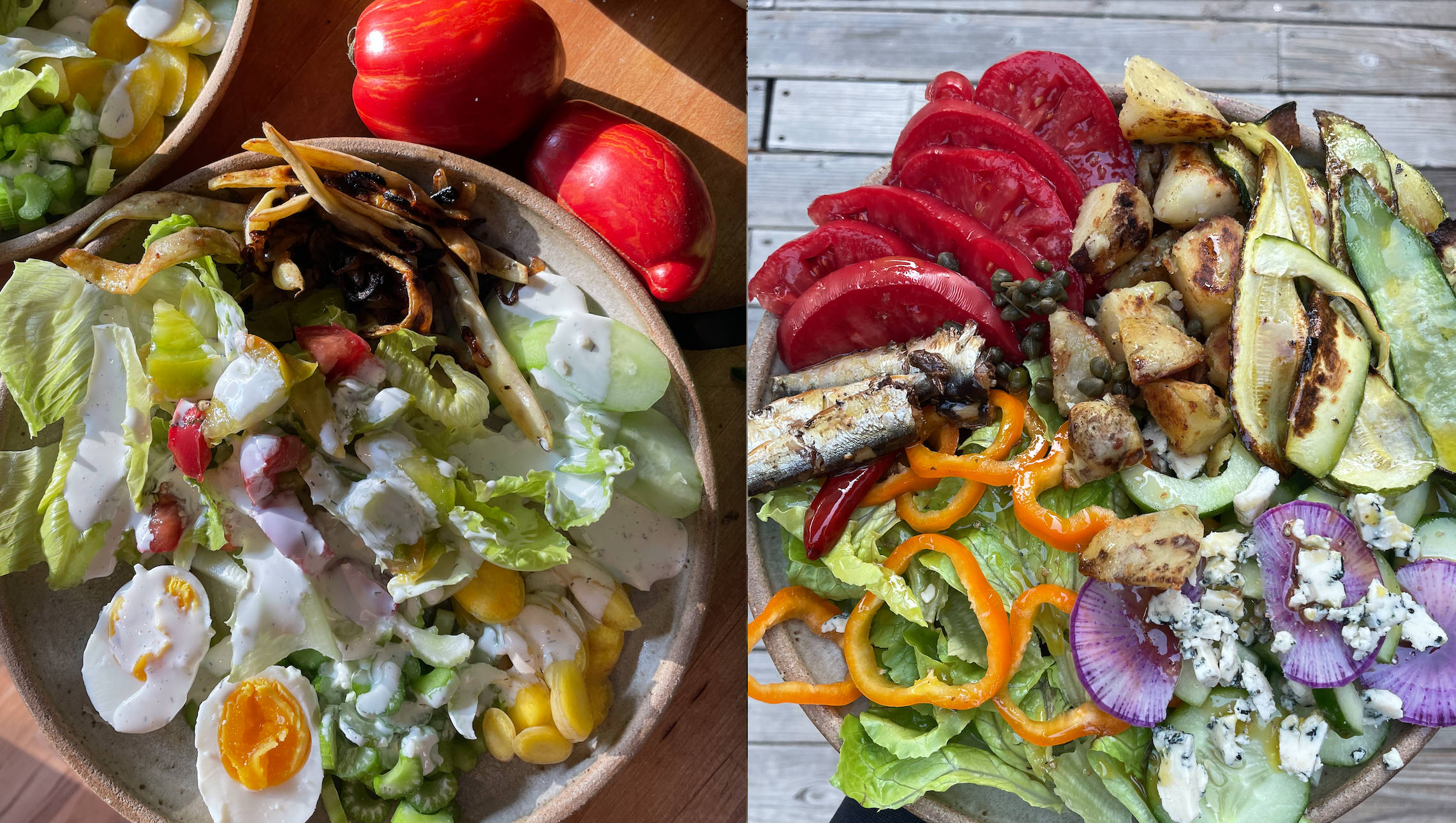
A couple of recent Nicoise Salad-inspired dinners. On the left: Dragon Tongue beans with caramelized onions, cucumber, carrot, celery, lettuce, tomato and hard boiled egg with herby Ranch dressing. On the right: heirloom tomato, pan-fried potatoes, roasted zucchini, cucumbers and purple daikon with blue cheese, lettuce and sweet pepper, capers and sardines with the classic Nicoise dressing from the Week 6 newsletter.

CANNING TOMATOES

The tomatoes are exploding — now is the time to preserve! We have upped our season limit for bulk tomatoes. Each share is now allotted a 25 lb season limit — meaning your share can home 25 lbs of tomatoes from the 2nds canning bins in the barn either all at once, or on separate occasions (i.e. 7.5 lbs twice). While we hope tomatoes will be around for a while longer, this is definitely the peak of production and the best time to take home quality bulk tomatoes for preserving.

Our favorite way to preserve tomatoes is just to freeze fresh tomato sauce. It’s easier than canning and tastes better (we think)! See Week 12’s newsletter for Kayta’s go-to fresh tomato sauce recipe.

Meals from a week in Tomato Town. Pics by Adam.

tomato town

by home chef ambassador adam

We had a lot of memorable firsts in August 2020. First home purchase. Followed immediately by our first wildfire evacuation. The other August 2020 first that I’ll always remember is my very first vine-ripened Sungold grown by David and Kayta. THAT is how much I cherish tomatoes. I always have, but since that moment I am absolutely obsessed with WCCF’s tomatoes. I was traveling recently, and was terrified I was going to miss peak season. Peak tomato season is my superbowl. I was so excited to get home just in time to walk the red carpet of Tomato Town.

Tomato Town Tips and Tricks:

  1. When I u-pick, I snip them at the stem, to leave it attached to the fruit (yes, botanically speaking, tomatoes are fruit, but so are cukes and zukes and they never catch any gruff). This requires that you be more careful when picking, and makes for a touch more prep work to twist them off before serving, but it’s worth it. Cherry tomatoes with their stem last longer, and it prevents them from splitting.

  2. When I bring all my tomatoes home, I make one decision immediately - which tomatoes will be eaten raw and which will be cooked. This ensures I don’t waste a single ounce of sweet seeded magic. Prime specimens are reserved for raw consumption in salads, sandwiches, fresh salsas, etc. These are tomatoes that are soft but tight-skinned, with no bruises. I store them on the counter to stay room temp and be used every day throughout the week. The others I store in the fridge, without making any sacrifices to flavor or texture because they will be cooked. These days, I eat tomatoes at every single meal and I plan to preserve enough to ration in the depths of winter.  

This Week In Tomato Town 

  • Last night’s dinner was a TBLTs (double tomato, single everything-else) with a caprese salad on the side. Honorable mentions to the lacto-fermented pickles which I preserved a few weeks ago and the smear of spicy arugula mayo. 

  • Tonight we enjoyed a summer style pasta with barely-cooked tomatoes and shrimp. When I cook these tomatoes, I barely cook them because they are so summer-fresh. I sauteed them with butter, garlic, onion, and shrimp, finished with pasta water and herbs. Ladled onto pasta and topped with more herbs and grated parmesan. Perfection. 

  • For our Rosh Hashanah dinner I paired roast chicken with zucchini latkes topped with tomato relish (also the more traditional sour cream and homemade applesauce)  

  • Whole and by the handful.  Simple. Indulgent. Is there anything better? 

Adam’s upick haul.

FARMERS LOG

TUrn! Turn! Turn!

At 11:50 PM tonight, the Earth will wobble its midline straight in line with the sun on its way south — the Autumnal Equinox.

If you listen closely at that moment, you might big “yipeee!” from thousands of Northern hemisphere farmers.

It’s not that we begrudge the summer. No. We just love the changes.

It struck me today how the tasks of pulling off the growing season harmonizes with the seasons in such a way that it always seems like there is just enough time to do what needs to be done by the skin on our chinny-chin-chins.

The Byrds were right: To everything, there is a season. 

In the spring, we aren’t harvesting yet, so we have all the time in the day to prep the canvas; to tune-up our equipment and build irrigation systems; to seed 200 trays a week in the greenhouse; to pot up, stake, and trellis tomatoes; and to mow cover crop, turn soil, shape beds and plant, plant, plant!

Then harvest seasons starts and two, three, then four days a week are consumed with harvest. You put down the shovel and the hammer and take up the harvest knife. All other projects cease. Planting and harvesting are your life (and maybe some weeding if you’re lucky). The days are at their longest. If there is ever a time to be harvesting hundreds of pounds of cucumbers, tomatoes and squash in the morning and then planting out a mile of carrots in the afternoon, it is the summer.

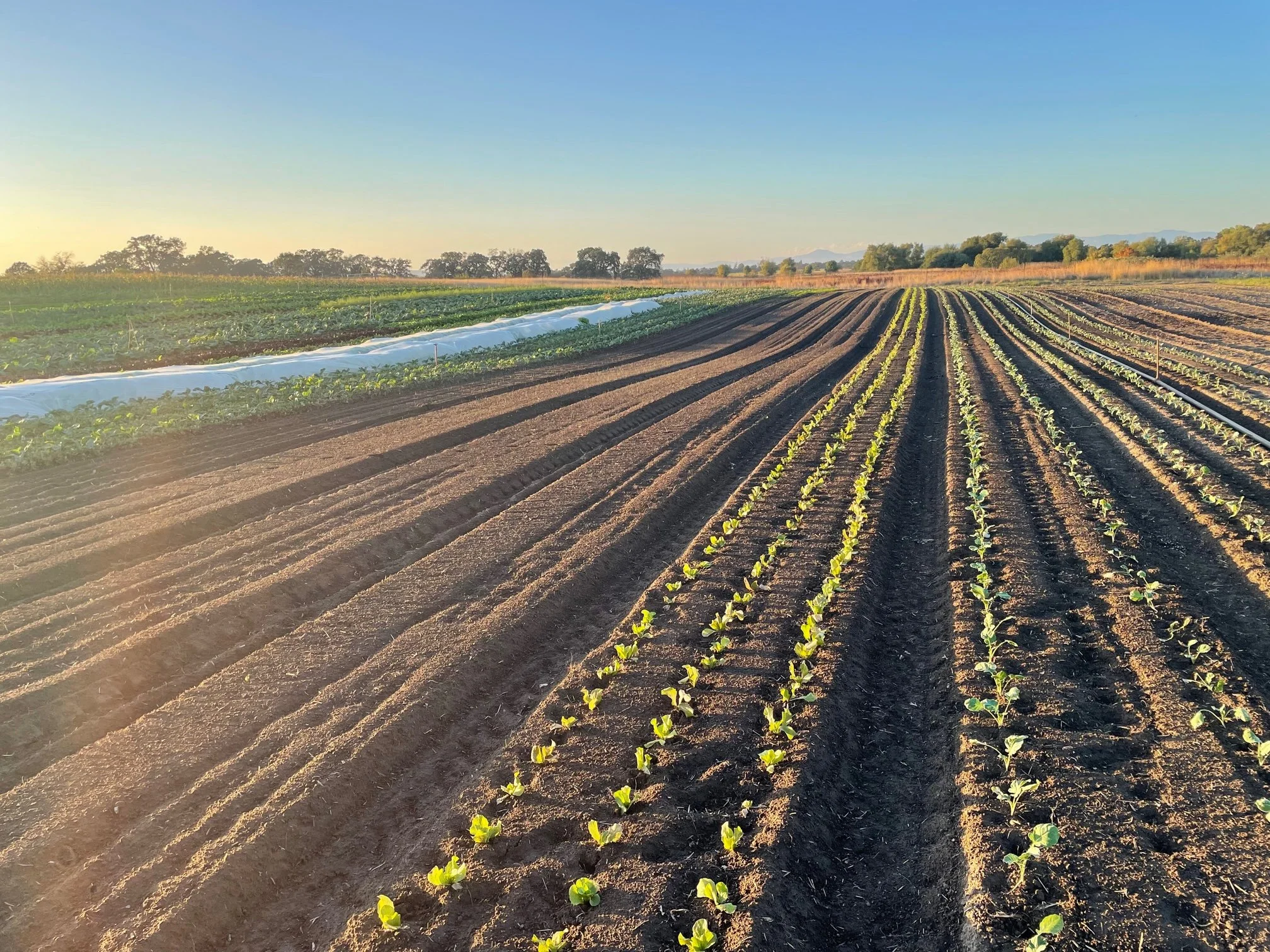
Paige and Aisling putting some of the last lettuce of year is in the ground.

Before you know it, it’s late-Summer. The tomatoes start exploding, the cucumbers already are, you’re still planting like crazy and then the melons come in — and just when you think you’ll break, that there isn’t enough time in the long days, you scroll through your crop plan and see that plantings are nearly done. No more bed shaping. The greenhouse seedings stop. You plant the last Fall brassicas in the field, the tractor sits quiet for a minute, and you can spend all day amongst the vines and in the cooler playing Tetris with boxes of Summer fruit. 

Then comes the Autumnal Equinox.

The tomatoes are still pumping and the potatoes and winter squash are calling to be harvested; the corn is filling out and crisping up. The big harvests are here. Space needs to be cleared to store the bounty. Winter is just around the corner so you also need to establish new garlic and strawberries beds and to lime new fields, and get ready for cover cropping — and just when you think you’ll break, that there isn’t enough time in the shortening days the heat starts to ebb, the tomatoes show signs of slowing down. Soon, a light frost will roll through the farm and nip the summer fruits. Smiling friends will come to help you harvest the potatoes. The chill morning air goes down like a draught of ambrosia. You transplant the last lettuce of the season. You have a moment sit down to order cover crop and calculate how much garlic to save for seed.

All this is why you won’t ever hear a farmer say, “Shucks! Summer is over.” We are greedy for the turnings.

We love nothing more than a first harvest. But the glory of the first tomato fades under the weight of hundreds of tomato crates and then we crave cold hands and cozy coats and the crisp snap of the stem of a plump winter radicchio. Lucky for us, when scolding kiddos for running through the corn becomes sad and hackneyed, Autumn comes, and we can yell, “Come! Knock it down! Gather armfuls of cobs!” 

Change is our tonic — and one of the great sustaining elixirs of farm life.

Soon, winter will come. The rains will come and we will turn in — to rest, rejuvenation, and internality. We’ll clean up the farm and we’ll look back on the year and plan the next. We’ll look at spreadsheets, sit, think, fix things, and sleep. 

But ample sleep turns into insomnia; too much internality into angst. Our harvest muscles will atrophy, we will get pudgy, and we will forget why we are puttering out in the wet and the cold. And just when we think we’ll break, that there is too much open-endedness in the too short days, the sun will return and we will hear the Swainson’s Thrush calling us back out to the fields, beckoning us, “Build it up again! Plant! Turn! Turn! Turn!”

See you in the fields,
David


CSA BASICS

ATTENTION MEMBERS: Please make sure to drive slow (15 - 20 mph) on Cooper Rd. out of respect for our human and pet neighbors! Thank you!

What time is harvest pick-up?

  • Saturday harvest pick-ups run from 9:00 am - 2:00 pm

  • Tuesday harvest pick-ups will run from 1:00 pm - 6:00 pm

When can I u-pick? Oriented members can come to the farm any time, 7 days a week, sunrise to sunset, to u-pick and enjoy the farm, minding weekly u-pick limits.

2023 CSA program dates: Our harvest season will run this year from June 24th - December 19th

Where is the farm? The member parking lot is located at 1720 Cooper Rd., Sebastopol, CA 95472.

Where should I park? Follow our sign on Cooper Rd. down a short gravel driveway. Please find a parking spot next to the solar panels or along the road further down. Please don’t park behind the solar panels.

Where’s the bathroom!: Under the big solar panels in the parking lot.

What should I bring?

  • Your WCCF tote bag & reusable produce bags

  • Pint baskets or small containers for measuring your allotment of u-pick crops like strawberries

  • A vase, bucket, or water bottle to keep your flowers and herbs happy

  • Clippers or secateurs to cut flowers (if you have some), we also have some in the barn

  • Water / sun hat / picnic supplies if you plan to stay awhile!

  • Friends and family!

Newsletters & email communication: All our important CSA communications are through this email address, which seems to be getting spam blocked a lot. Please make sure this email address is in your address book so you get important CSA communications. All newsletters and important updates are also posted on the Newsletters page of our website weekly.

Harvest Week 13 - Late-Summer’s Rhythm

THIS WEEK’S HARVEST

In a nutshell: Tomatoes to snack-on; tomatoes to slice; tomatoes to preserve. Peak tomato!

Salanova Salad Mix, Cegolaine Little Gem Lettuces, Assorted Head Lettuce, White Russian Kale, Bel Fiore Chicories, Purple Daikon Radishes, Fennel, Poblano Peppers, Assorted Sweet Peppers, Bintje Potatoes, Summer Squash & Zucchini, Assorted Cucumbers, Romance Carrots, Walla Walla Onions, Assorted Melons, Various Heirloom & Red Slicing Tomatoes, Farao Cabbage

Upick abundance! Featuring Pink Princess and Purple Bumblebee cherry tomatoes in the top row, Sun Gold and Supersweet 100 in the middle row, and Indigo Cherry Drop in the bottom. The peppers in the bottom right are red jalapeños, which, when dried and smoked, become Chipotle.

U-PICK

  • Albion Strawberries: 4 pints per share

  • Cherry Tomatoes: 6 pint per share

  • Shishito & Padrón Frying Peppers: 2 pints total per share | There continue to be more Shishitos than Padróns. See Week 6’s Newsletter for harvest and preparation tips.

  • Jalapeños: 4 peppers per share | if you like your jalapeños hot, look for peppers with checking (little cracks) on them

  • Buena Mulata Peppers: 4 peppers per share | see Harvest Notes for details!

  • Tomatillos: 1 pint per share

  • Herbs: Italian Basil, Thai Basil, Tulsi Basil, Dill, Chamomile, Parsley, Onion Chives, Garlic Chives, Tarragon, Oregano, Marjoram, Culinary Sage, Lemon Balm, Lemon Verbena, Vietnamese Coriander, Shiso (Perilla), Culinary Lavender, French Sorrel, Borage, Violas, Thyme and Mints.

  • Flowers!

CANNING TOMATOES

The tomatoes are exploding — now is the time to preserve! We have started our distribution of bulk tomatoes for canning / freezing. Each share is allotted a 15 lb season limit — meaning your share can home 15 lbs of tomatoes from the 2nds canning bins in the barn either all at once, or on separate occasions (i.e. 7.5 lbs twice).

Our favorite way to preserve tomatoes is just to freeze fresh tomato sauce. It’s easier than canning and tastes better (we think)! See Week 12’s newsletter for Kayta’s go-to fresh tomato sauce recipe.

Cherry Tomato Introductions!

By now we hope you’ve explored and sampled a few of all of them, but we wanted to properly introduce you to this year’s cherry tomato line-up so you can enjoy a proper taste testing . Check out the picture above to see what they look like!

  • Pink Princess: Developed by an oxen-driving, seed-saving wizard in Massachusetts, this gem is such a favorite of ours that when the seed was temporarily unavailable a couple years ago, we saved our own! Mellow and sweet, with a hint of grapefruit, these cherry tomatoes are on the smaller size and ripen to a beautiful matte pink.

  • Purple Bumblebee: Dusky purple with metallic striping, these have a sweet flavor and meaty texture. They’re on the large side for cherry tomatoes, and make a beautiful salad component.

  • Sungold: The sun... captured. An unbeatable classic. Ripe when deep orange. Candy sweet, super productive. Is it even summer until you have a handful of Sungolds?

  • Supersweet 100: A classic red cherry tomato for a shock of red sweet tang. Ripest when deep scarlet red. The secret to Supersweets is to leave them out on the counter for a day or two after you pick them — they sweeten up off the vine.

  • Indigo Cherry Drops: These striking purple orbs are chock-full of healthy anthocyanins (antioxidants) and deliciousness! They are ripe when the green side darkens to red -- keep a close eye out when picking as even the unripe tomatoes of this variety are purple!

2023 Cherry Tomato Crew! Top row L to R: Purple Bumblebee, Sungold | Bottom row L to R: Pink Princess, Indigo Cherry Drop, Supersweet 100

Samin Nosrat’s Panzanella salad

At the height of tomato season, Panzanella is one of our go-to favorite meals. Light, refreshing, and incredibly delicious, it really shines when it’s made of the best ingredients.

Ingredients

CROUTONS

  • 1 (1-pound) day-old rustic or sourdough bread loaf

  • 1/3 cup olive oil

  • 1/4 teaspoon kosher salt, or to taste

TOMATO VINAIGRETTE

  • 1/4 cup finely chopped shallots

  • 1/4 cup red wine vinegar

  • 2 tablespoons aged balsamic vinegar (such as Monari Federzoni)

  • 4 very ripe small tomatoes (about 1 pound)

  • 8 fresh basil leaves, torn into large pieces

  • 1/2 cup extra-virgin olive oil

  • 2 garlic cloves, smashed

  • 1/2 teaspoon plus a pinch of kosher salt

SALAD

  • 3/4 cup thinly sliced red onion

  • 1 tablespoon red wine vinegar

  • 1 pint cherry tomatoes

  • 1 1/2 pounds Early Girl or other flavorful ripe tomatoes, cored and cut into bite-size pieces (about 3 1/2 cups)

  • 1 1/4 teaspoons kosher salt, or to taste, divided

  • 4 Persian cucumbers, peeled and cut into 1/2-inch-thick slices (about 2 1/4 cups)

  • 16 fresh basil leaves, torn into large pieces

  • Flaky sea salt (such as Maldon)

directions

Make the croutons

  1. Preheat oven to 400°F. Remove crust from bread, and discard or reserve for another use. Cut loaf into 1-inch-thick slices; cut slices into 1-inch-wide strips. Tear strips into 1-inch pieces, and toss with oil until evenly coated. Spread in an even layer on 2 rimmed baking sheets. Bake croutons on separate oven racks in preheated oven 8 minutes. Continue to bake until golden brown and crisp, 18 to 22 minutes, flipping croutons and rotating pans (top to bottom) often to ensure even browning. Remove croutons from baking sheets as they finish browning. Sprinkle croutons with kosher salt, and let cool in a single layer.

Make the tomato vinaigrette

  1. Stir together shallots, red wine vinegar, and balsamic vinegar in a medium bowl; let stand 15 minutes. Cut tomatoes in half, and grate cut sides on large holes of a box grater until only skin remains. Discard skins. Set aside 1 cup tomato pulp. (Reserve remaining tomato pulp for another use.) Stir tomato pulp, oil, basil leaves, garlic, and kosher salt into vinegar mixture; let stand at least 10 minutes or up to 30 minutes. Remove and discard garlic. (Taste vinaigrette with a crouton or tomato slice, and adjust salt and acid as needed.) Set aside 1 1/4 cups vinaigrette; reserve remaining vinaigrette for another use.

Make the salad

  1. Toss together onion and vinegar in a small bowl; let stand 20 minutes. Set aside. Place half of croutons in a large salad bowl, and toss with 1/2 cup reserved vinaigrette. Place tomatoes on top of croutons, and season with 1/2 teaspoon kosher salt (to encourage them to release some of their juices); let stand 10 minutes.

  2. Remove onions from vinegar, reserving vinegar. Add onions, cucumbers, basil, and remaining croutons to bowl with tomatoes. Toss with reserved onion vinegar, remaining 3/4 cup reserved vinaigrette, and remaining 3/4 teaspoon kosher salt, adjusting amounts as desired. Divide salad evenly among 4 to 6 plates. Sprinkle with sea salt.

WINTER SISTER FARM CSA SIGN-UPS NOW OPEN!

The hottest tickets in town are now on sale — Winter Sister Farm’s 2024 Winter CSA program is now open for registration! Winter Sister Farm, right next door to us, was started by our dear friends Anna and Sarah Dozor. Their CSA runs runs from December through May and includes 24 weeks of specialty winter veggies, flowers, herbs, and more — all picked up by CSA members, free-choice market style, on their beautiful farm here on Cooper Rd! Sign-up today!

FARMERS LOG

WEEK 13

This week was another in the unmistakable rhythm of late-Summer.

Monday kicked off with Tuesday’s zucchini, summer squash and melon harvest, followed by our biggest tomato harvest of the year yet, followed by odds and ends in the afternoon. “Tuesday is as Tuesday does" — which for us now is a big early morning fresh harvest and vegetable wash session for the afternoon pick-up. Tristan spent both afternoons mowing weeds in our harvested fields and expertly mechanically cultivating our new transplants with the electric tractor.

On Wednesday (aka field work day!) Tristan shaped a fresh bed for Paige to direct sew our last round of Hakurei turnips. Tristan built another irrigation line for the new seedlings and Asa, Aisling, and Paige tackled the weeds in the newer transplants out in Farfield.

Freshly cultivated and hoed vegetables sizing up for Fall.

In late Summer mode, Thursday looks a lot like Monday: Another monster harvest: Summer squash, zucchini, and cucumbers first thing followed by Saturday’s melons, tomatoes, a fresh round of carrots out from Farfield, and a small order of Escarole for FEED Sonoma. At the end of the day we washed the days spoils and trimmed Walla Walla Onions to prep for the weekend.

Today we ventured out in the misty morning for our fresh harvest haul for Saturday — lettuce mix, lettuce heads, Bel Fiore chicory, sweet peppers, etc., etc. With some time to spare in the morning coolness, we seized the moment and tucked away a half a macro-bin of Integro purple cabbage for a later shares like squirrels packing away for winter. In the afternoon it was all washing and cleaning the barn for pick-up; Paige and Asa worked in the garden and clearing the pathways of the cherry tomatoes; Tristan continued weed mowing patrol out in Farfield and then he and I swapped out a loaned part (a hydraulic bed roller) for a newly arrived pan shaper on the back of our bed-former (the red tractor attachment). We’re excited to see how it works next week!

Enjoy this week’s tomato full share!

See you in the fields,
David


CSA BASICS

ATTENTION MEMBERS: Please make sure to drive slow (15 - 20 mph) on Cooper Rd. out of respect for our human and pet neighbors! Thank you!

What time is harvest pick-up?:

  • Saturday harvest pick-ups run from 9:00 am - 2:00 pm

  • Tuesday harvest pick-ups will run from 1:00 pm - 6:00 pm

When can I u-pick?: Oriented members can come to the farm any time, 7 days a week, sunrise to sunset, to u-pick and enjoy the farm, minding weekly u-pick limits.

2023 CSA program dates: Our harvest season will run this year from June 24th - December 19th

Where is the farm? The member parking lot is located at 1720 Cooper Rd., Sebastopol, CA 95472.

Where should I park?: Follow our sign on Cooper Rd. down a short gravel driveway. Please find a parking spot next to the solar panels or along the road further down. Please don’t park behind the solar panels.

Where’s the bathroom!: Under the big solar panels in the parking lot.

What should I bring?:

  • Your WCCF tote bag

  • Pint baskets or small containers for measuring your allotment of u-pick crops like strawberries

  • A vase, bucket, or water bottle to keep your flowers and herbs happy

  • Clippers or secateurs to cut flowers (if you have some), we also have some in the barn

  • Water / sun hat / picnic supplies if you plan to stay awhile!

  • Friends and family!

Newsletters & email communication: All our important CSA communications are through this email address, which seems to be getting spam blocked a lot. Please make sure this email address is in your address book so you get important CSA communications. All newsletters and important updates are also posted on the Newsletters page of our website weekly.

Harvest Week 12 - Farming in the Aftermath

THIS WEEK’S HARVEST

In a nutshell: Late summer abundance.

Assorted Sweet Peppers, Bintje Potatoes, Chioggia & Gold Beets, Bicolor Sweet Corn (last week!), Summer Squash & Zucchini, Assorted Cucumbers, Romance Carrots, Cabernet Onions, Assorted Melons, Early Girl & Heirloom Tomatoes, Salad Mix of Salanova Lettuce & Bel Fiore Chicory, Rosaine Little Gem Lettuces, Assorted Head Lettuce, Escarole, Pink Ladyslipper Radishes, Hakurei Salad Turnips

U-PICK

  • Albion Strawberries: 4 pints per share

  • Cherry Tomatoes: 4 pint per share

  • Shishito & Padrón Frying Peppers: 2 pints total per share | There continue to be more Shishitos than Padróns. See Week 6’s Newsletter for harvest and preparation tips.

  • Dragon Tongue Beans: 2 pints per share

  • Jalapeños: 4 peppers per share | if you like your jalapeños hot, look for peppers with checking (little cracks) on them

  • Buena Mulata Peppers: 2 peppers per share | see Harvest Notes for details!

  • Pickling Cucumbers: gleanings | Pretty much done producing but there may still be a few left if you feel like foraging.

  • Tomatillos: 1 pint per share

  • Herbs: Italian Basil, Thai Basil, Tulsi Basil, Dill, Chamomile, Parsley, Onion Chives, Garlic Chives, Tarragon, Oregano, Marjoram, Culinary Sage, Lemon Balm, Lemon Verbena, Vietnamese Coriander, Shiso (Perilla), Culinary Lavender, French Sorrel, Borage, Violas, Thyme and Mints.

  • Flowers!

Introducing our 2023 tomato team! From left to right, top row: Speckled Roman, Black Prince, Early Girl, Valencia | Middle row: German Johnson, Striped German, Big Beef | Bottom row: Black Krim, Aunt Ruby’s German Green, Goldie

HARVEST NOTES

  • Escarole: One of our favorite members of the chicory family, escarole looks like hearty lettuce. While it can be eaten raw in salad for those who aren’t afraid of a little bitterness, escarole really shines when sautéed, braised or in soup, as cooking highlights its velvety texture and savory depth. For the most simple preparation, try sautéing it in olive oil with plenty of garlic, Parmesan and lemon. It’s also delicious in Italian Wedding Soup, beans with sausage and escarole and Utica Greens (recipe below!).

PRESERVING THE HARVEST

Bulk Tomatoes are here! From now until the end of tomato season, bulk quantities of Speckled Roman Sauce Tomatoes and all 2nds (tomatoes that are blemished or quite ripe but still tasty) will be available! Bulk tomatoes will have a season limit, meaning the total tomatoes available per share over the course of the season. You’re welcome to take them all at once or a little bit here and there, whichever you like!

The easiest way to put up tomatoes is freezing. While you can freeze tomatoes without processing first, we particularly love halving them, drizzling with olive oil and roasting in a low-temp oven to concentrate the flavors. Or, if you have the time now and want to make a sauce that truly bottles the taste of summer, consider making fresh tomato sauce!

Fresh Tomato Sauce

There are a million ways to make tomato sauce, but luckily enough, the simplest really is the best. Here are rough guidelines for a foolproof and astonishingly delicious sauce that freezes well:

  • Sauté onions and garlic in more olive oil than you might think you need

  • Add tomatoes and salt to taste and cook down for 45 minutes to an hour until your sauce has reached the desired consistency and flavor — Depending on your preferred consistency, tomatoes can be peeled and de-seeded before cooking, or, for a more rustic sauce, just chop and them throw them in the pot seeds and all.

For more detailed instructions, and some good ideas for variations on tomato sauces, check out this Smitten Kitchen post on Fresh Tomato Sauce.

Paige, Aisling and Tristan rocking the transplanter and planting late season chicories.


Utica Greens recipe

— from Upstate Ramblings

This Italian-American dish from upstate New York makes beautiful use of this week’s escarole and comes highly recommended by a long-time CSA member.

Ingredients

  • 1 head escarole

  • 3 Tablespoon olive oil

  • 1/2 cup prosciutto, diced

  • 1/2 cup onion, chopped

  • 3 cloves garlic, minced

  • 5 hot pickled cherry peppers, chopped

  • 1/2 cup water

  • salt and pepper to taste

  • 1/3 cup bread crumbs

  • 1/4 cup Romano cheese, grated

Instructions

  1. Rinse the escarole and chop into small pieces.

  2. Bring salted water to a boil and blanch the escarole for 2 minutes. Drain in a colander and run under cold water.

  3. Heat the olive oil in a frying pan. Add the proscuitto and onion and cook for about 5 minutes.

  4. Add the garlic and cook for another minute.

  5. Add the drained escarole, cherry peppers and water. Stir it all together and add a little salt and pepper if desired.

  6. Cook until the escarole is wilted, about 7-8 minutes.

  7. Sprinkle the top with bread crumbs and cheese, and stick under the broiler for 2 minutes to brown the top.

WINTER SISTER FARM CSA SIGN-UPS NOW OPEN!

The hottest tickets in town are now on sale — Winter Sister Farm’s 2024 Winter CSA program is now open for registration! Winter Sister Farm, right next door to us, was started by our dear friends Anna and Sarah Dozor. Their CSA runs runs from December through May and includes 24 weeks of specialty winter veggies, flowers, herbs, and more — all picked up by CSA members, free-choice market style, on their beautiful farm here on Cooper Rd! Sign-up today!

FARMERS LOG

FARMING IN THE AFTERMATH REDUX

We had another big-time September week in the fields: Nestled in between some monster harvests the crew smashed out the last big transplanting of the year out in Farfield — a huge milestone. Now, pretty much all of the plants we will consume through mid-December are out in the field dangling their root toes in the ground.

Turns out, it’s hard to find the time to write new full-length Farmer’s Log with such a cute little 4-month old dumpling in the house, so this week we wanted to revisit another newsletter from a previous season, this one from August 2020 after the Lightning Complex Fires, on what our farm might look like, and how it would have to change, in an “apocalyptic” scenario.

* * * * *

Whether evoked by current events or not, apocalyptic reveries are, it seems, a recurring obsession of human imagination across cultures. Why? Because they tell us about ourselves in the present. Imagining an extreme future holds up a mirror. What dangers are we afraid of? What is important to us? What is essential? And what luxuries do we take for granted? 

Assuming we were all still here and had to eat, how would our farm have to change and adapt after the breakdown of most or all of the supply chains that sustain it now? 

We tossed this fantastical subject around and the conversation was illuminating — not as exercise in science fiction or doomsday thinking, but because it taught us about the farm now.

The subjects we honed in on were seeds, manure, labor and motive power. 

SEEDS

Seed saving is a beautiful task. You lovingly grow something until it matures. You select the most beautiful and store it with care. You give some to friends. The seed ties you to past seasons — to past generations — to time itself. You repeat the cycle — a cycle of love and discipline — each year.

We save some seed at Green Valley Community Farm. We’ve been saving the Hopi Blue Corn seed we plant for several years now. We’ve been saving our big Lorz Garlic seed for 5 season now — and generally they look better and better every harvest. We’ve occasionally saved seed potato. Kayta has been saving many flower seeds from the garden: Nigella, hollyhock, agrostemma, to name a few — last year, Sora, Ahn, and Tuli helped gather the celosia you see blooming today. 

But we do not save most of the vegetable seed we grow. Why?

First, time management. Seed saving is a meticulous, labor intensive craft. We pay other farmers for seeds because then we can devote more of our limited space and time to the food part of farming.

Secondly, saving our own seed would mean we couldn’t offer quite the same diversity we do because of cross pollination. The cross pollination of two different varieties of the same species creates a hybrid that is often not yummy to eat. The carefully isolated genetics in open-pollinated food crops is why a lot of heirloom varieties have place names. Marina di Chioggia winter squash, for example, comes from a certain region of Italy. People from that region started to fall in love with a certain sweet pumpkin. Farmers grew fields of them in isolated patches, and slowly the region developed a fairly consistent strain of squash that became a local staple. If we saved seed from our Marina di Chioggia squash, which is currently being grown next to 8 other varieties of winter squash originating from other other regions, what we would get would end up next year would possibly be bitter, hard-skinned, and ugly!  

So the vast, and relatively affordable modern seed exchange we have access to allows us to grow tremendous variety in the same field without worrying about crossing. We take advantage of our access to a world library of seeds at our fingertips to grow an extreme amount of diversity in our fields. In this way we are deeply connected to myriad regions, farms, and farm workers devoted to growing vegetable seeds for market farmers like us. 

After the apocalypse we’d have to focus what we grow and spend a lot more time saving seed. We’d might have to drop sweet corn in favor of massive field of hardy Hopi Blue to feed us through the winter.

If you could only pick one squash to save in your family for generations, which seed would you start with?

The fresh veg field we’re currently harvesting from out across the creek — made with a little help from modern seed markets, easy access to fertility, and diesel.

MANURE

But before we even thought about planting seeds we’d be thinking about poop. 

Similar to seeds, a functional modern supply chain gives modern farmers like us cheap and easy access to fertility. For a very reasonable price, you call up Leballister’s in Roseland and Cold Creek Compost in Mendocino, and get 24 tons of organic compost and 2000 lbs Petaluma chicken manure, dried, processed, and pelletized, delivered to your doorstep.

This is all because of cheap energy, which we will get to next.  

In the olden times, or the end times as it were, the amount of energy involved in mixing that compost (Caterpillar D9’s) or processing and shipping that chicken manure, would be far from possible. Indeed, a post apocalyptic Green Valley Community Farmers would need to devote much more time and energy to manure.

In order to sustain anywhere close to the level of vegetable production we do, we would need many more human hands managing many more animals, their manures, and their rotations through our fields. In the post apocalyptic world we would have to keep the animals that fuel our plants much closer to home.

We would all miss our clothes washing machines greatly.

LABOR AND MOTIVE POWER

We never think apoco-thoughts more viscerally than during power outages. For a farm reliant on electric power to irrigate — if feels a little bit like having a knife to your throat. 100 degree heat, no electricity, and a field of baby brassicas = not comfortable.

This is where things get really interesting. Indeed, our farm — and our society — without fossil fuels would be hard to recognize.

For starters, all of our irrigation would be done with gravity, wind power, or weaker powered solar pumps if we were lucky. Without access to plastic and aluminum irrigation supplies we would likely have to flood irrigate, as so many ancestral cultures did, releasing water down careful canals shaped in the fields. Because this method of irrigation would limit the crops amenable to this arid climate, gone would be the lettuce and arugula of August, relegated now, perhaps, to a short fling of succulent greens in the early Spring. In the dry months we would forage for our greens and herbs in the creek beds and wetlands or get our vitamin C from carefully stored cabbages. Our fields would focus on the hardy, deep rooted staples amendable to flood irrigation, dry farming, and dry summers: Potatoes, corn, winter squash… some hardy roots. We would plant fruit and nut trees and look to the indigenous people and the indigenous foodways of California. We would tend oaks religiously. 

When we did prep a valley field for food, we would all do it together. Gone would be the luxury of a Kubota doing a week’s worth of work in one hour. Green Valley Community Farm members would become Green Valley Community Farm farmers. The horse and mule and donkey would rule again. 

The reason why 95% of humans were, before the industrial revolution, involved in agriculture is because that is how many human bodies and human hands it takes to tend landscapes without fossil power.  

IN CONCLUSION

It struck us, in the carrots, tossing around this imagined future, both how close and how far we are from it.

Our modern luxuries can feel like a thick, insurmountable wall between us and both the pain, and possibly the deliverance, of a world without them.

In reality, these luxuries are only a thin veil. Perhaps, by recognizing the tenuousness of this veil, we can glean its lessons and make the choice to guide our technologies and actions toward simplicity, grace, and balance, rather than short lived extravagance.

See you in the fields.
David for Kayta

CSA BASICS

ATTENTION MEMBERS: Please make sure to drive slow (15 - 20 mph) on Cooper Rd. out of respect for our human and pet neighbors! Thank you!

What time is harvest pick-up?:

  • Saturday harvest pick-ups run from 9:00 am - 2:00 pm

  • Tuesday harvest pick-ups will run from 1:00 pm - 6:00 pm

When can I u-pick?: Oriented members can come to the farm any time, 7 days a week, sunrise to sunset, to u-pick and enjoy the farm, minding weekly u-pick limits.

2023 CSA program dates: Our harvest season will run this year from June 24th - December 19th

Where is the farm? The member parking lot is located at 1720 Cooper Rd., Sebastopol, CA 95472.

Where should I park?: Follow our sign on Cooper Rd. down a short gravel driveway. Please find a parking spot next to the solar panels or along the road further down. Please don’t park behind the solar panels.

Where’s the bathroom!: Under the big solar panels in the parking lot.

What should I bring?:

  • Your WCCF tote bag

  • Pint baskets or small containers for measuring your allotment of u-pick crops like strawberries

  • A vase, bucket, or water bottle to keep your flowers and herbs happy

  • Clippers or secateurs to cut flowers (if you have some), we also have some in the barn

  • Water / sun hat / picnic supplies if you plan to stay awhile!

  • Friends and family!

Newsletters & email communication: All our important CSA communications are through this email address, which seems to be getting spam blocked a lot. Please make sure this email address is in your address book so you get important CSA communications. All newsletters and important updates are also posted on the Newsletters page of our website weekly.