
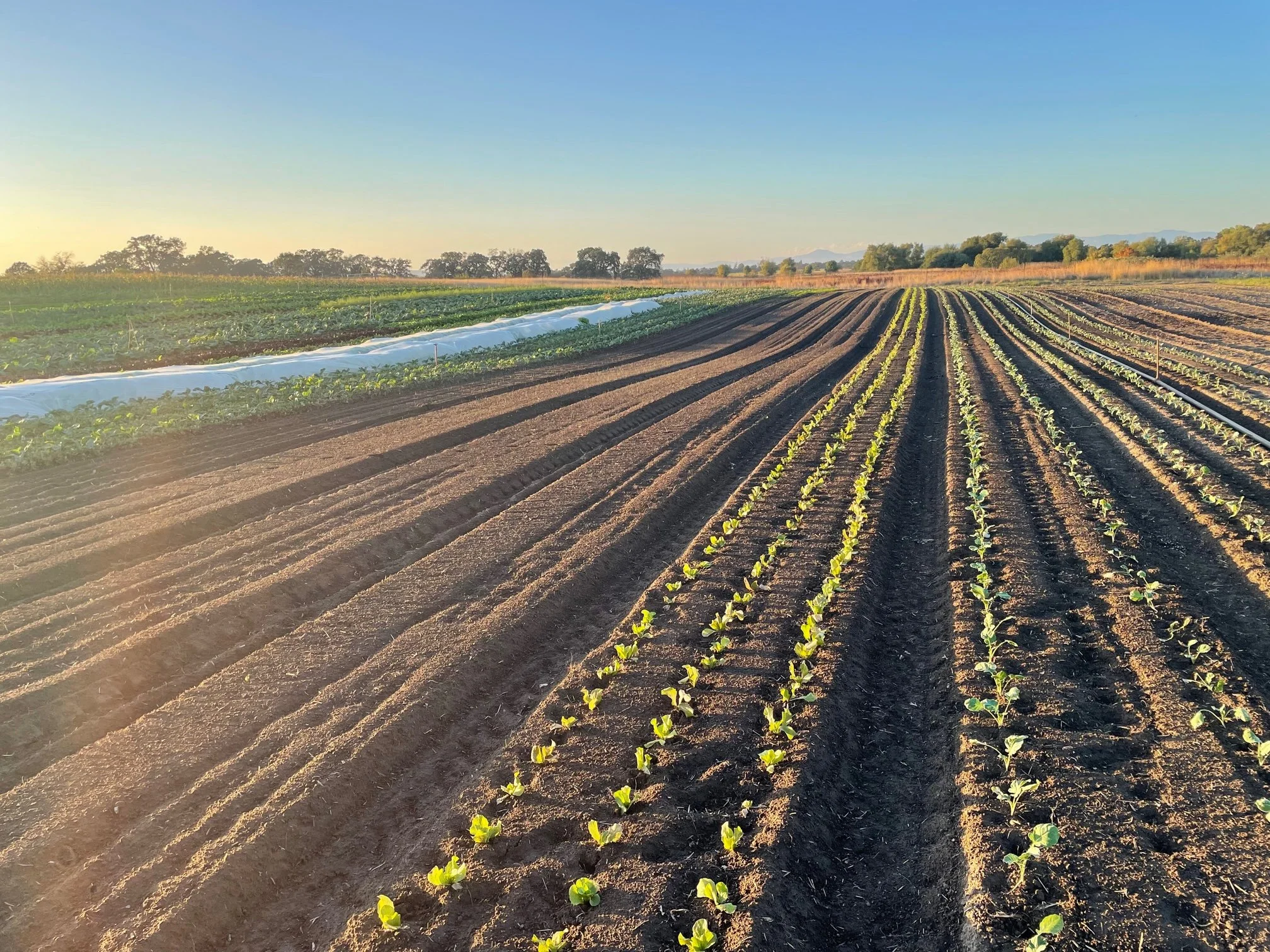
Harvest Week 11 - The Space Between

THIS WEEK’S HARVEST

In a nutshell: Tomatoes are ripening higher on the vine and curing onions burst out of the sides of the greenhouse.

Bicolor Sweet Corn, Summer Squash & Zucchini, Lemon & Persian Cucumbers, Rainbow Carrots, Walla Walla Sweet Onions, Galia & Sarah’s Choice Melons, Early Girl & Heirloom Tomatoes, Salad Mix, Little Gem Lettuces, Red Butter Lettuce, Rainbow Chard, Fennel, Celery, Hakurei Salad Turnips, Sweet and Tender Cabbage.

U-PICK

  • Albion Strawberries: 3 pints per share

  • Cherry Tomatoes: 3 pint per share

  • Shishito & Padrón Frying Peppers: 2 pints total per share | There continue to be more Shishitos than Padrons. See Week 6’s Newsletter for harvest and preparation tips.

  • Dragon Tongue Beans: 4 pints per share | These gorgeous, purple-speckled beans have a sweet flavor.

  • Jalapeños: 4 peppers per share | if you like your jalapeños hot, look for peppers with checking (little cracks) on them

  • Buena Mulata Peppers: 2 peppers per share | see Harvest Notes for details!

  • Pickling Cucumbers: 1 gallon season limit | Winding down, so pick soon if you still haven’t! See Week 6’s Newsletter for harvests and pickling instructions.

  • Tomatillos: 1 pint per share

  • Herbs: Italian Basil, Thai Basil, Tulsi Basil, Dill, Chamomile, Parsley, Onion Chives, Garlic Chives, Tarragon, Oregano, Marjoram, Culinary Sage, Lemon Balm, Lemon Verbena, Vietnamese Coriander, Shiso (Perilla), Culinary Lavender, French Sorrel, Borage, Violas, Thyme and Mints.

  • Flowers!

HARVEST NOTES

  • Rainbow Carrots: For the next week or two we’ll have our custom mix of rainbow carrots. We often think that the vast variations in carrot flavor due to variety, terroir, and season warrant them having their own tasting flights. We hope you enjoy Purple Haze, Romance and Gold Nugget as much as we do!

CELERY AND FENNEL WITH WALNUTS AND BLUE CHEESE

Recipe by Alison Roman

This week is the perfect time to make this sophisticated (and easy) salad! We’ve been enjoying it as a side dish, or made more substantial eaten atop a grain like farro.

Serves 4 to 6

  • 1⁄2 cup toasted walnuts, coarsely chopped

  • Kosher salt and freshly ground black pepper

  • 4 celery stalks, with leaves, thinly sliced on the bias

  • 1 large fennel bulb, trimmed and thinly sliced lengthwise

  • 1⁄2 small shallot, thinly sliced (torpedo onions would be good here too)

  • 2 tablespoons fresh lemon juice, plus more as needed (also delicious with champagne vinegar!)

  • 1⁄4 cup olive oil, plus more as needed and for drizzling

  • 1 1⁄2 ounces firm blue cheese, such as Bayley Hazen or Valdeon, or a mild Stilton, thinly sliced or crumbled

  1. Toss the walnuts with a bit of olive oil so they are nicely coated, then season with salt and pepper and set aside.

  2. Toss the celery stalks (reserve the leaves for garnish), fennel, shallot, and lemon juice in a large bowl; season with salt and pepper. Drizzle with the olive oil and season with enough lemon juice to make it very tangy.

  3. Transfer to a large serving platter or large shallow bowl and top with the walnuts, cheese, celery leaves, and another drizzle of olive oil and plenty of pepper.

WINTER SISTER FARM CSA SIGN-UPS NOW OPEN!

The hottest tickets in town are now on sale — Winter Sister Farm’s 2024 Winter CSA program is now open for registration! Winter Sister Farm, right next door to us, was started by our dear friends Anna and Sarah Dozor. Their CSA runs runs from December through May and includes 24 weeks of specialty winter veggies, flowers, herbs, and more — all picked up by CSA members, free-choice market style, on their beautiful farm here on Cooper Rd! Sign-up today!

FLOWER POWER: THe Space Between

Tips and inspiration to unlock the flower garden from our Flower Ambassador, Cassidy Blackwell

The subtle tilt of light. The scratch of seed pods against my arm as I walk through the flower rows. The bright pinks of summer Snapdragons have faded into the bronzed hues of Hot Biscuit Amaranth and the the deep velvety wine colored Scabiosa. Even though it’s 90 degrees at 6pm, you can feel the change of seasons in the flower garden.  

Nature is marching towards the equinox and this straddling of seasons is showing in my bouquets! The bold face Rudbeckias and Sunflowers (literally) nod to the summer sun while golden seed pods and grasses give artful and earthy flourishes to finish. While the big white Nicotiana’s have faded, I’m absolutely loving their smaller dusty coral hued Peach Screamer Nicotiana cousins in the far Western garden bed.

Bright palettes have been replaced by more muted tones. While the joys of peak summer may have been found in bright bold array of hues, I’m enjoying this subtlety of this shift because in this space between there remains beauty and growth. 

See you in the garden,
Cassidy

CSA BASICS

ATTENTION MEMBERS: Please make sure to drive slow (15 - 20 mph) on Cooper Rd. out of respect for our human and pet neighbors! Thank you!

What time is harvest pick-up?:

  • Saturday harvest pick-ups run from 9:00 am - 2:00 pm

  • Tuesday harvest pick-ups will run from 1:00 pm - 6:00 pm

When can I u-pick?: Oriented members can come to the farm any time, 7 days a week, sunrise to sunset, to u-pick and enjoy the farm, minding weekly u-pick limits.

2023 CSA program dates: Our harvest season will run this year from June 24th - December 19th

Where is the farm? The member parking lot is located at 1720 Cooper Rd., Sebastopol, CA 95472.

Where should I park?: Follow our sign on Cooper Rd. down a short gravel driveway. Please find a parking spot next to the solar panels or along the road further down. Please don’t park behind the solar panels.

Where’s the bathroom!: Under the big solar panels in the parking lot.

What should I bring?:

  • Your WCCF tote bag

  • Pint baskets or small containers for measuring your allotment of u-pick crops like strawberries

  • A vase, bucket, or water bottle to keep your flowers and herbs happy

  • Clippers or secateurs to cut flowers (if you have some), we also have some in the barn

  • Water / sun hat / picnic supplies if you plan to stay awhile!

  • Friends and family!

Newsletters & email communication: All our important CSA communications are through this email address, which seems to be getting spam blocked a lot. Please make sure this email address is in your address book so you get important CSA communications. All newsletters and important updates are also posted on the Newsletters page of our website weekly.

Harvest Week 10 - On a Speck in Space

THIS WEEK’S HARVEST

In a nutshell: Summer settles in.

Bicolor Sweet Corn, Summer Squash & Zucchini, Lemon & Persian Cucumbers, Striped Armenian Cucumbers, Loose Romance Carrots, Fresh Torpedo Onions, Galia & Sarah’s Choice Melons, Early Girl Tomatoes, Poblano Peppers, Salad Mix, Cegolaine Little Gem Lettuces, Assorted Head Lettuce, Red Russian Kale, Purple Daikon, Loose Beets

A school of Poblanos caught in our fishing net.

U-PICK

  • Albion Strawberries: 3 pints per share

  • Cherry Tomatoes: 2 pint per share

  • Shishito & Padrón Frying Peppers: 3 pints total per share | There are lots of Shishitos in the back of the beds at the moment. See Week 6’s Newsletter for harvest and preparation tips.

  • 🌟 Dragon Tongue Beans: 3 pints per share | These gorgeous, purple-speckled beans have a sweet flavor.

  • 🌟 Jalapeños: 2 peppers per share | if you like your jalapeños hot, look for peppers with checking (little cracks) on them

  • 🌟 Buena Mulata Peppers: 2 peppers per share | see Harvest Notes for details!

  • Pickling Cucumbers: 1 gallon season limit | Winding down, so pick soon if you still haven’t! See Week 6’s Newsletter for harvests and pickling instructions.

  • Herbs: Italian Basil, Thai Basil, Tulsi Basil, Dill, Chamomile, Parsley, Onion Chives, Garlic Chives, Tarragon, Oregano, Marjoram, Culinary Sage, Lemon Balm, Lemon Verbena, Vietnamese Coriander, Shiso (Perilla), Culinary Lavender, French Sorrel, Borage, Violas, Thyme and Mints.

  • Flowers!

From left to right: a very checked Jalapeño pepper, 3 Buena Mulata Peppers in various stages of ripeness, Dragon Tongue beans.

HARVEST NOTES

  • Dragon Tongue Beans: The coolest looking green bean you’ve ever seen. A delicious, aptly named purple striped fresh bean ready to take over right where the Purple Amethyst Beans left off. Located in the two beds just to the right of the Amethyst Beans.

  • Poblano Peppers: The poblano chili pepper is the beloved mild chili, originating in the state of Puebla, México that when dried it is called “ancho” or chili ancho and when roasted and stuffed with cheese becomes the magnificent chili relleno. This week will be offering the first taste of these wonderful peppers. For an easy, incredibly satisfying combo, try sautéing chopped poblanos with sweet corn kernels, torpedo onions, smoked paprika, lime and salt! Or just throw them in every dish you make like Aisling!

  • Buena Mulata Peppers: We're excited to introduce these gorgeous heirloom peppers. The seeds came from Truelove Seeds, a farm-based seed company specializing in culturally important seeds. Here's how they describe this pepper and its story:

    "Beautiful, spicy, and flavorful cayenne pepper that starts purple and then passes through salmon and orange on the way to turning a gorgeous red. The tall striking plants are laden with 4-5 inch fruits, which are tasty at all stages, but we prefer the added sweetness of the fully red fruit.

    Buena Mulata Pepper was the name on the baby food jar next to the name "Pippin" in the bottom of the deep freezer in William Woys Weaver's grandmother's basement, a decade after his plant-loving grandfather's untimely death. If you've heard of the Fish Pepper, this story probably sounds familiar. There were many other seeds besides those of the beautiful, delicious, and now widely-available Fish Pepper in that frozen trove, and many that passed through Horace Pippin's hands, including this Buena Mulata. Horace Pippin is now a well-known artist who beautifully depicted everyday life, landscapes, religion, WWI, and themes of the injustices of slavery and segregation. In the 1940s, he traded seeds from his friends in the Black catering communities of Philly and Baltimore in exchange for bee sting therapy for WWI arm injury from William Woys Weaver's grandfather H. Ralph Weaver's hives. Seeds stay viable longer in the freezer; our heirlooms only survive if someone removes them from storage and places them in soil; and stories only live when they are told."

    As they ripen to red, Buena Mulata develop a sweetness in addition to their spice. They're particularly great for making beautiful pickles or drying to crush into pepper flakes or powder.

WINTER SISTER FARM CSA SIGN-UPS NOW OPEN!

The hottest tickets in town are now on sale — Winter Sister Farm’s 2024 Winter CSA program is now open for registration! Winter Sister Farm, right next door to us, was started by our dear friends Anna and Sarah Dozor. Their CSA runs runs from December through May and includes 24 weeks of specialty winter veggies, flowers, herbs, and more — all picked up by CSA members, free-choice market style, on their beautiful farm here on Cooper Rd! Sign-up today!

FARMER’S LOG

ON A SPECK IN SPACE

I went for an epic Farmer’s Log this week, on farming as a “discipline” from the trenches of August, but I bit off more than I could chew! I’ll post that essay soon, but tonight we’ll leave you in the helpful hands of the beat poet, Lew Welch.


* * * * *

NOTES FROM A PIONEER ON A SPECK IN SPACE

by Lew Welch


Few things that grow here poison us.
Most of the animals are small.
Those big enough to kill us do it in a way
Easy to understand, easy to defend against.
The air, here, is just what the blood needs.
We don’t use helmets or special suits.

The Star, here, doesn’t burn you if you
Stay outside as much as you should.
The worst of our winters is bearable.
Water, both salt and sweet, is everywhere.
The things that live in it are easily gathered.
Mostly, you eat them raw with safety and pleasure.

Yesterday my wife and I brought back
Shells, driftwood, stones, and other curiosities
Found on the beach of the immense
Fresh-water Sea we live by.
She was all excited by a slender white stone which:
“Exactly fits the hand!”

I couldn’t share her wonder;
Here, almost everything does.


* * * * *

See you in the fields,
David & Kayta

CSA BASICS

ATTENTION MEMBERS: Please make sure to drive slow (15 - 20 mph) on Cooper Rd. out of respect for our human and pet neighbors! Thank you!

What time is harvest pick-up?:

  • Saturday harvest pick-ups run from 9:00 am - 2:00 pm

  • Tuesday harvest pick-ups will run from 1:00 pm - 6:00 pm

When can I u-pick?: Oriented members can come to the farm any time, 7 days a week, sunrise to sunset, to u-pick and enjoy the farm, minding weekly u-pick limits.

2023 CSA program dates: Our harvest season will run this year from June 24th - December 19th

Where is the farm? The member parking lot is located at 1720 Cooper Rd., Sebastopol, CA 95472.

Where should I park?: Follow our sign on Cooper Rd. down a short gravel driveway. Please find a parking spot next to the solar panels or along the road further down. Please don’t park behind the solar panels.

Where’s the bathroom!: Under the big solar panels in the parking lot.

What should I bring?:

  • Your WCCF tote bag

  • Pint baskets or small containers for measuring your allotment of u-pick crops like strawberries

  • A vase, bucket, or water bottle to keep your flowers and herbs happy

  • Clippers or secateurs to cut flowers (if you have some), we also have some in the barn

  • Water / sun hat / picnic supplies if you plan to stay awhile!

  • Friends and family!

Newsletters & email communication: All our important CSA communications are through this email address, which seems to be getting spam blocked a lot. Please make sure this email address is in your address book so you get important CSA communications. All newsletters and important updates are also posted on the Newsletters page of our website weekly.

Harvest Week 9 - The Dog Days of Summer

THIS WEEK’S HARVEST

In a nutshell: Summer arrives on the harvest table! Sweet corn, melons and eggplant , oh my!

Bicolor Sweet Corn, Summer Squash & Zucchini, Lemon & Persian Cucumbers, Striped Armenian Cucumbers, Loose Romance Carrots, Fresh Cabernet Onions, Galia & Sarah’s Choice Melons, Early Girl Tomatoes, Eggplant (from Longer Table Farm), Arugula, Mustard Mix, Cegolaine Little Gem Lettuces, Romaine Lettuce, Dino Kale, Lady Murasaki Purple Bok Choi, Fennel

U-PICK

  • Albion Strawberries: 4 pints per share

  • Cherry Tomatoes: 1 pint per share | This limit will (greatly) increase as the plants come into production.

  • Shishito & Padrón Frying Peppers: 5 pints total per share | There are lots of Shishitos in the back of the beds at the moment. See Week 6’s Newsletter for harvest and preparation tips.

  • Amethyst Green Beans: 3 pints per share | Won’t be around much longer — take advantage while they’re still here!

  • Pickling Cucumbers: 1 gallon season limit | See Week 6’s Newsletter for harvests and pickling instructions.

  • Herbs: Italian Basil, Thai Basil, Tulsi Basil, Dill, Chamomile, Parsley, Onion Chives, Garlic Chives, Tarragon, Oregano, Marjoram, Culinary Sage, Lemon Balm, Lemon Verbena, Vietnamese Coriander, Shiso (Perilla), Culinary Lavender, French Sorrel, Borage, Violas, Thyme and Mints.

  • Flowers!

Kayta’s “black and white” bouquet from this evening with night blooming Nicotiana, unopened Agrostemma, Cilantro flowers, Centauria, Bishop’s Children Dahlia foliage, and Black Scabiosa

HARVEST NOTES

  • Bicolor Sweet Corn: Sweet corn is a nutrient and space hungry crop, so it’s kind of a delicacy for us (limit will be 3 ears per share this week). But if you haven’t had this sweet corn from us before, it might be the best your’ve ever had. NOTE* You are likely to find a living corn borer caterpillar in at least one of your sweet corn ears! This is a totally normal (and unavoidable) part of organic sweet corn. Just toss the little guy outside and enjoy your corn!

  • Melons! This cool, cool summer has caused our first two successions of melons to converge. This week we’ll have mostly Galia melons, with a few Sarah’s Choice mixed in, and then in a week or two they’ll switch…

    • Galia Melons: Originally developed by growers in Israel, Galia melons were the first hybrid of intensely perfumed Middle Eastern melons. The Galia melon looks like a cantaloupe on the outside and a honeydew on the inside. Its light green, smooth-textured flesh, and honey sweet.

    • Sarah’s Choice Cantaloupe: The best cantaloupe variety there is… period.

  • Striped Armenian Cucumbers: Sometimes called serpentine for their inventive, twisting shapes, these cucumbers are technically more closely related to melons! Their skins are very slightly fuzzy and so thin that they never need to be peeled, allowing you to highlight their beautiful stripes. 

  • Eggplant from Longer Table Farm: After our beautiful eggplant plants hardly produced a single ripe fruit for us last year (too cool here?), we decided to outsource this crop to our friends at Longer Table Farm. Enjoy!

WINTER SISTER FARM CSA SIGN-UPS NOW OPEN!

The hottest tickets in town are now on sale — Winter Sister Farm’s 2023 Winter CSA program is now open for registration! Winter Sister Farm, right next door to us, was started by our dear friends Anna and Sarah Dozor. Their CSA runs runs from December through May and includes 24 weeks of specialty winter veggies, flowers, herbs, and more — all picked up by CSA members, free-choice market style, on their beautiful farm here on Cooper Rd! Sign-up today!

Fall carrots, chicories, and brassicas growing out in Farfield.

FARMER’S LOG

THE DOG DAYS OF SUMMER

The sun beats down, the hills are bleached gold, and the fruits of summer rain down… the dog days of summer are here.

The term “dog days”, for the late summer, traces back to the ancient Mediterranean, where people connected the night sky return of the brightest star, Canis Majoris (aka Sirius, aka “Orion’s Dog”), to the sultry days of late July-August when, as Virgil said, “the Dog-star cleaves the thirsty ground.” These ancient people associated the dog days with fever, bad luck, and heat.

As Marin naturalist and tracker Richard Vacha brilliantly observes of our own Mediterranean climate in his book The Heart of Tracking, the dog days can be a raucous, frolicking time for wild canines as they feast on the fattened prey and fruit of summer and as canine pups leave the den and come into their own. (Perhaps this is the wild origin of the naming of the star?)

But, in Mediterranean climates like ours, the dog days are also a scarce time, a spent time. They are the beginning of a great dry down and the great dormant period of our year.

“For a wild animal,” Vacha writes, the late summer and early fall “can be as tough to endure as an East Coast winter. Food is scarce, water is scarce, and green vegetation is crowded into riparian corridors, drawing the animals that depend on these resources closer together. The animals who prey upon them have shifted correspondingly. Territorial patterns are all in great flux as the expansive cycle of the summer season slowly winds down.”

On the farm, this shift into the dog days — their abundance and scarcity — has been clear.

Our harvests are more and more heavy with fruit: Melons, tomatoes, cucumbers; soon we will be enjoying our first poblanos and sweet peppers; the wild blackberries are laden. In the garden, our first rounds of flowers and herbs are following the wild grasses, tapping out and throwing seed.

And in our staple field crops, if July was an outward explosion of verdant vegetation, the dog days are the beginning of a hunkering down, a drawing nigh, a focused inward stare toward the serious work of setting fruit, forming bulbs and tubers, and setting seed. The jubilant field of winter squash flowers is now metamorphosizing as green and gold orbs swell in the shade of their sun battered leaves. Similarly, in the potatoes, a perfect waist-high sea of leaves and flowers is now shrinking down, as the plants throw all their energy into swelling their secret tubers in the black earth below. Our Hopi Blue corn and Dutch Butter Popcorn are in silks, with ears swelling.

And as the wildland plants dry out and are scorched to gold, her wild inhabitants turn more and more to the farm — an irrigated green oasis — for moisture and succulent meals. The wild turkeys and their fluffy younglings visit the fields every morning and evening, snipping off hydrating bits of lettuce (they seem to love romaine!). Gophers take bites out of our drip irrigation lines nightly, seeking the cool water flowing within. 

But the sweet relief of the first Fall rains will come soon enough.

Until then, keep cool, move slow, and enjoy the fruitful abundance of the dog days of summer!

See you in the fields,
David & Kayta

“Fox in a Coyote Bush” illustration by Kayta from The Heart of Tracking by Richard Vacha from Mount Vision Press

CSA BASICS

ATTENTION MEMBERS: Please make sure to drive slow (15 - 20 mph) on Cooper Rd. out of respect for our human and pet neighbors! Thank you!

What time is harvest pick-up?:

  • Saturday harvest pick-ups run from 9:00 am - 2:00 pm

  • Tuesday harvest pick-ups will run from 1:00 pm - 6:00 pm

When can I u-pick?: Oriented members can come to the farm any time, 7 days a week, sunrise to sunset, to u-pick and enjoy the farm.

2023 CSA program dates: Our harvest season will run this year from June 24th - December 19th

Where is the farm? The member parking lot is located at 1720 Cooper Rd., Sebastopol, CA 95472.

Where should I park?: Follow our sign on Cooper Rd. down a short gravel driveway. Please find a parking spot next to the solar panels or along the road further down. Please don’t park behind the solar panels.

Where’s the bathroom!: Under the big solar panels in the parking lot.

What should I bring?:

  • Your WCCF tote bag

  • Pint baskets or small containers for measuring your allotment of u-pick crops like strawberries

  • A vase, bucket, or water bottle to keep your flowers and herbs happy

  • Clippers or secateurs to cut flowers (if you have some), we also have some in the barn

  • Water / sun hat / picnic supplies if you plan to stay awhile!

  • Friends and family!

Newsletters & email communication: All our important CSA communications are through this email address, which seems to be getting spam blocked a lot. Please make sure this email address is in your address book so you get important CSA communications. All newsletters and important updates are also posted on the Newsletters page of our website weekly.