
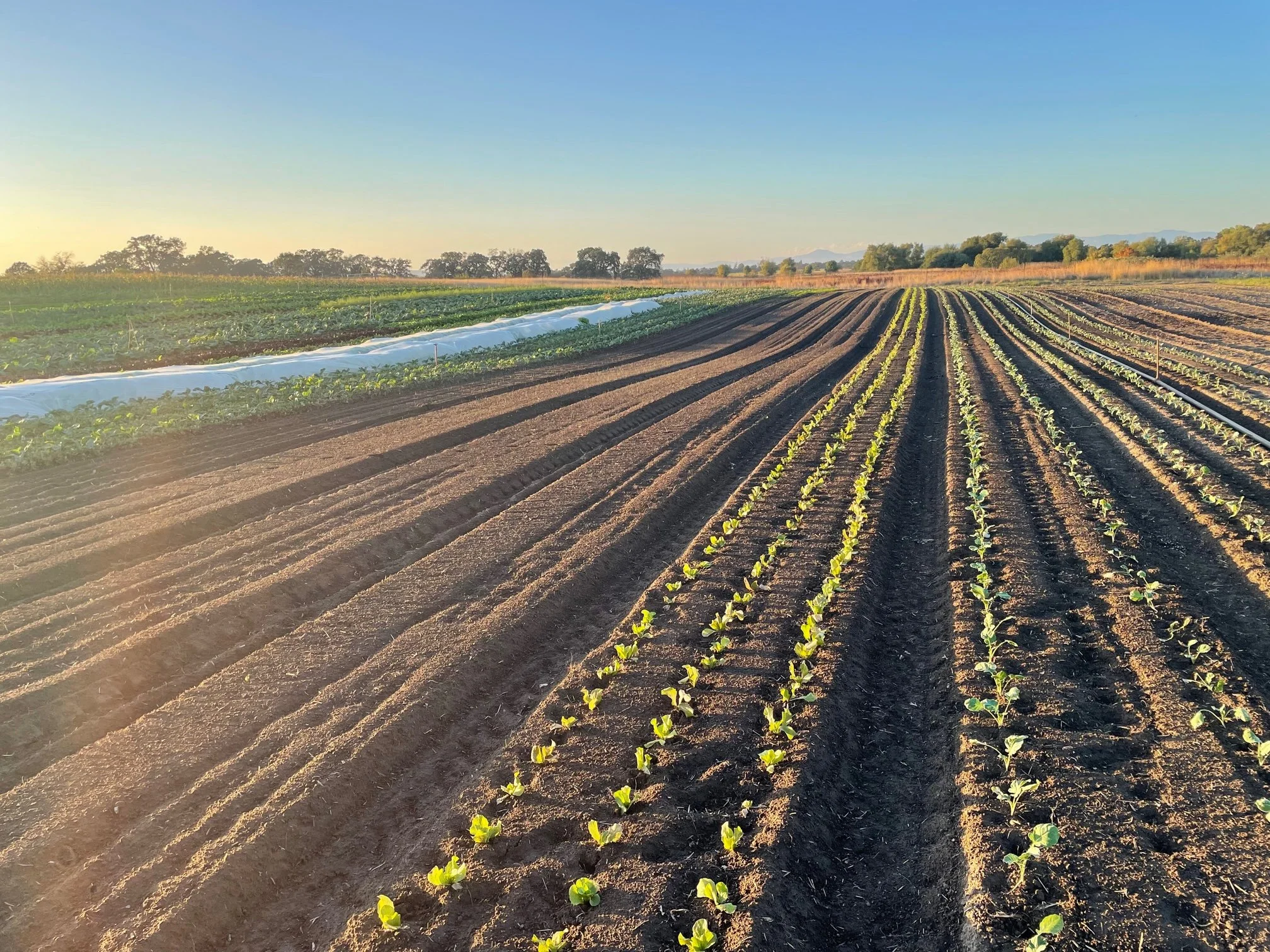
Harvest Week 5 - Work Song

THIS WEEK’S HARVEST

The first taste of shishito peppers heralds the approach of the fruity bounty of summer

Arugula, Mustard Mix, Bel Fiore Chicories, Red Butter Lettuce, Cegolaine Little Gem Lettuce, Collards, Green Magic Broccoli, Kohlrabi, Celery, Fennel, Bunched Chioggia Beets, Patty Pan, Costata & Dunja Summer Squash, Lemon & Persian Cucumbers, Corinto Cucumbers, Fresh Torpedo Onions, Loose Mokum Carrots

U-PICK

  • Albion Strawberries | 3 pints per share

  • Sugar Snap Peas | Gleanings (1 pint per share max)

  • Shishito Frying Peppers | 1/2 pint per share (A first taste: This limit will increase as the plants mature)

  • Herbs: Cilantro, Dill, Italian Basil, Thai Basil, Tulsi Basil, Chamomile, Parsley, Onion Chives, Garlic Chives, Tarragon, Oregano, Marjoram, Culinary Sage, Lemon Balm, Lemon Verbena, Vietnamese Coriander, Shiso (Perilla), Culinary Lavender, French Sorrel, Borage, Violas, Calendula, Nasturtium (Thyme and Mints are taking a break to regrow a bit.)

  • Flowers!

HARVEST NOTES

  • Shishito Frying Peppers: These Japanese frying peppers are long and wrinkled with delicate, thin walls. Best picked between 3-4” long, they are almost never spicy, and will eventually ripen to a sweet red. They are incredibly delicious fried in hot olive oil until browned, sometimes with a dash of lemon or smoked paprika, and always with a liberal sprinkle of salt. A plate of just-off-the-stove frying peppers is an irresistible appetizer or snack. Shishitos also make incredible tempura.

  • Bel Fiore & Sugarloaf Chicories: This is our first (and not last) harvest of chicories as whole heads. Chicories (which include Frisee, various Radicchios, Dandelions and Escarole) are like the cooler, edgier, tattooed cousin of lettuce. People are sometimes intimidated by their bitterness — but fear not, properly prepared, chicories contain a world of deliciousness. Chicories pair beautifully with rich fats. One simple way to prepare them is to roast them in the oven. Try cutting a Bel Fiore or Sugarloaf head into quarters, coat the quarters completely with olive oil, rub on some garlic, and then broil them until the outer leaves are slightly crisped and blackened the leaves are melted and soft. Then top with salt and grated parmesan and eat as a side. For a raw chicory salad, check out CSA member Sarah Kate Benjamin’s simple and masterful recipe below.

  • Fresh Torpedo Onions: A favorite in Italy and France, these beautiful, pink, elongated onions are similar to Cipollinis — mild, delicate, and delicious raw. We recommend incorporating them into whatever fresh salads you’re making this week or topping a pizza or sandwich.

  • Herb Inspiration: This is probably the last week to pick from our abundant cilantro succession before it begins sending up its white flowers (later coriander seeds!). To take advantage of it before it goes, we highly recommend making a green sauce that’s a play on chimichurri, chermoula, or pesto. While you can use any combinations of herbs from the garden, we’ve been enjoying equal parts parsley and cilantro, with a little bit of mint, chopped or blended with raw garlic, lemon and lemon zest, olive oil and salt. Use as a zingy topping on any hearty food — roasted Cipollini onions or grilled summer squash for instance. This sauce will keep one week in the fridge, so if you make a big batch it’s best to freeze some for later use.

SARAH KATE’S RADICCHIO SUMMER SALAD

On days when it’s just too hot to cook, a big salad usually does the trick for dinner. While crisp lettuce is a mainstay for all of your salad needs, its bitter cousin chicory is worth giving a try. Yes, chicories tend to be on the bitter side, but that bitter is actually good for you. Bitter greens are cooling to the body and help you digest and assimilate your foods better. So, if you’ve been wondering what to do with the Bel Fiore or Sugarloaf Chicory, you’ll want to make this quick and easy salad. And don’t be shy with the fresh herbs either. Grab your favorites to toss into the dressing or sprinkle on top just before serving. 

Ingredients 

For the dressing 
1 cup yogurt 
½ cup crumbled feta cheese
1 clove garlic, grated 
¼ cup freshly chopped dill 
1 tablespoon freshly chopped fennel fronds 
1 tablespoon apple cider vinegar
2 teaspoons honey 
½ cup olive oil 
Salt and pepper, to taste 

For the salad 
1 head Bel Fiore or Sugarloaf Chicory (Little Gems work too) 
½ cup breadcrumbs 
2 radishes, thinly sliced 

  1. Add all of the dressing ingredients to a blender or food processor and combine until smooth. Taste and adjust for more honey or vinegar. 

  2. Gently tear the salad greens into large pieces and add to a mixing bowl. 

  3. Toss the greens and radishes with a few tablespoons of the dressing, depending on how dressed you like them.

  4. To serve, add half of the dressed salad to a serving bowl and top with half of the breadcrumbs. Repeat and finish with a drizzle of dressing and a sprinkle of fresh herbs if you’d like.  


For more recipe inspiration, check out Sarah’s weekly recipe newsletter here and get access to over 45 seasonal recipes.

FARMER’S LOG

WORK SONG

This Friday harvest was a triumphant one — both trucks overflowing with the bulk of longer growing vegetables like celery, beets, and broccoli. Indeed, some Friday harvests are so full we resort to a poem in the Farmer’s Log.

* * * * *

Work Song Part II - A Vision (Epilogue)
by Wendell Berry

If we will have the wisdom to survive,
to stand like slow growing trees
on a ruined place, renewing, enriching it…
then a long time after we are dead
the lives our lives prepare will live
there, their houses strongly placed
upon the valley sides…

The river will run
clear, as we will never know it…
On the steeps where greed and ignorance cut down
the old forest, an old forest will stand,
its rich leaf-fall drifting on its roots.

The veins of forgotten springs will have opened.
Families will be singing in the fields…
Memory,
native to this valley, will spread over it
like a grove, and memory will grow
into legend, legend into song, song
into sacrament. The abundance of this place,
the songs of its people and its birds,
will be health and wisdom

and indwelling light.

This is no paradisal dream.
Its hardship is its reality.

* * * * *

See you in the fields,
David & Kayta

CSA BASICS

What time is harvest pick-up?:

  • Saturday harvest pick-ups run from 9:00 am - 2:00 pm

  • Tuesday harvest pick-ups will run from 1:00 pm - 6:00 pm

When can I u-pick?: Oriented members can come to the farm any time, 7 days a week, sunrise to sunset, to u-pick and enjoy the farm.

2023 CSA program dates: Our harvest season will run this year from June 24th - December 19th

Where is the farm? The member parking lot is located at 1720 Cooper Rd., Sebastopol, CA 95472.

Where should I park?: Follow our sign on Cooper Rd. down a short gravel driveway. Please find a parking spot under the solar panels to your left, or up against the straw bales further down. Please do not park behind the solar panels.

Where’s the bathroom!: Under the big solar panels in the parking lot.

What should I bring?:

  • Your WCCF tote bag

  • Pint baskets or small containers for measuring your allotment of u-pick crops like strawberries

  • A vase, bucket, or water bottle to keep your flowers and herbs happy

  • Clippers or secateurs to cut flowers (if you have some), we also have some in the barn

  • Water / sun hat / picnic supplies if you plan to stay awhile!

  • Friends and family!

Newsletters & email communication: All our important CSA communications are through this email address, which seems to be getting spam blocked a lot. Please make sure this email address is in your address book so you get important CSA communications. All newsletters and important updates are also posted on the Newsletters page of our website weekly.

Harvest Week 4 - Flower Power: Color Palettes

THIS WEEK’S HARVEST

In a nutshell: Another springy harvest with choice salad greens and crunchy snacks crowned in the full display of peak summer flowers

Oak Leaf Lettuce Mix, Chicory & Mustard Salad Mix (Red Cloud Komatsuna, Radicchio and Frisee), Cegolaine Little Gems, Cherokee Summer Crisp Lettuce, Rainbow Chard, Mei Qing Choi Bok Choi, French Breakfast Radishes, Baby Fennel, Corinto Cucumbers, Green Zucchini and Yellow Crookneck Squash, Fresh Cipollini Onions, Loose Mokum Carrots, Fresh Lorz Garlic

U-PICK

  • Albion Strawberries | 2 pints per share: Looks like the second year strawberries (closer to the flower garden) are more prolific this week

  • Sugar Snap Peas | 4 pints per share: Last week of super abundant sugar snaps

  • Herbs: Cilantro, Dill, Italian Basil, Thai Basil, Tulsi Basil, Chamomile, Parsley, Onion Chives, Garlic Chives, Tarragon, Oregano, Marjoram, Culinary Sage, Lemon Balm, Lemon Verbena, Vietnamese Coriander, Shiso (Perilla), Culinary Lavender, French Sorrel, Borage, Violas, Calendula, Nasturtium / Thyme and Mints are taking a break to regrow a bit.

  • Flowers! Too many to list…

Choose your own adventure

HARVEST NOTES

  • Cipollini Onions: Originating in Boretto, Italy, cipollini onions are an extremely sweet, mild onion. They are so mild that they can be cut thin and eaten on pizza, salad, or straight up! They are also commonly grilled until translucent and slightly charred. Check out Home Chef Ambassador Adam Kahn’s scallion sauce recipe from last week’s newsletter.

  • Chicory & Mustad Salad or Braising Mix: This R-rated salad mix is concocted from two chicories (frisee and Bel Fiore ('“beautiful flower”) radicchio) and red cloud komatsuna. The chicories add a pleasant bitterness while the red cloud komatsuna adds a subtle spice. We recommend paring with a rich dish or dressing or mixing with your lettuce mix to add beauty and sophistication. This mix can also be braised.

  • Sugar Snap Peas: The last week of peak sugar snaps. Pick the fattest pods to find the sweetest peas and avoid thin pods as those will be sweetest next week. Go to the areas less travelled to find the jackpots. If the plants are leaning into the pathway, just gently push them aside to walk past them.

  • Cilantro and Dill: Look for the colored stakes on the west side of the garden to find these lush happy herbs.

FLOWER POWER: COLOR PALETTES

Tips and tricks to unlock the flower garden from our Flower Ambassador, Cassidy Blackwell

Using a color palette can create a more cohesive look and an artful vibe. To do this, select a single color or a combo range you like and stick to it. This can be especially helpful if you need to pick quick!

Here are three arrangements I recently created using color palettes.

1) A Warm Palette (Left): I cannot get enough of the aptly named Sunset Snapdragons. I'm also loving the peach sherbet-hued Calendula and the Yarrow blooms, which range from soft blush to a jammy red. Together all of these flowers created a beautiful tonal palette in a range of warm hues. 

 2) A Cool Palette (Center): I created this arrangement a couple weeks ago when it was really hot outside and I wanted to lean into cooler color temps. In the garden I love how the slender-stemmed, purple blossoms of the Agrostemma sway in the wind and the ethereal, almost neon blue glow of the Chinese Forget-Me-Nots. The Amaranth, Strawflowers and a single Dahlia anchor the arrangement with a beautiful burgundy bass line. Looks like I will be channeling these cooling vibrations again this weekend!

3) Color Combo (Right): I took inspiration from the honorable, humble and healing Chamomile in creating this classic palette of yellow, white and green. Then I set out in finding other blooms that fit the bill. I hunted in the Marigold bed to find blooms in the perfect lemony yellow. The Rudbeckia with their big sunny faces were a perfect addition. The abundant white trumpets of the Nicotiana rounded out the bloom crew. While assembling this arrangement I realized that in order to see the white blooms I needed more contrast. The carrots in the CSA share offered the perfect solution: I used the carrot tops to add a backdrop of greenery! Finally, golden grasses and wild radish seedpods complete the arrangement with texture and movement. (For the Color Theory nerds in the house, this is called an “analogous palette”. If you want a deep dive on other palettes check this link out) 

Of course, this is just one tool of many in your floral tool kit! See the Week 1 Newsletter for the opposite approach which used nearly every color in the garden and stay tuned for more!

FARMER’S LOG

ODE TO THE ONION

We were in the flow this pleasantly warming July week. Paige, Aisling and Asa took care of a big greenhouse seeding and planted out the last remaining garden beds. Tristan and Anna shaped our fall carrot beds and set up irrigation on that field so we can germinate (and then kill) some of the impressive number of weed seeds before seeding carrots (aka “stale bedding”). We transplanted a nice fleet of lettuce trays into the sweet sandy loam of Farfield West. We did a bunch of watering in advance of the weekend heat. And we weeded!

The weeds are still coming on strong, at this phase of the year, many are stretching out and trying to throw seed. For the next few weeks the name of the game for us is keeping as many of them at bay as possible. When you zoom out from the work the weeds create, their growth is a humbling and impressive (almost inspiring) display of the vigor and the power of growth of the plant kingdom at this time of year. We salute you, formidable weed frenemies.

Our reward for our battles today was the first, fresh bulbing onion harvest. It is always a happy day the day we harvest the first fresh onions of the year, usually Cipolllinis, their bellies “grown round with dew”. As is our tradition, in honor of this week’s Cipollinis, we'll leave you with the one-and-only, Pablo…

This year’s onion crop swelling in the foreground with this year’s potatoes taking a drink in the background

* * * * *

Ode to the Onion
by Pablo Neruda

Onion,
luminous flask,
your beauty formed
petal by petal,
crystal scales expanded you
and in the secrecy of the dark earth
your belly grew round with dew.
Under the earth
the miracle
happened
and when your clumsy
green stem appeared,
and your leaves were born
like swords
in the garden,
the earth heaped up her power
showing your naked transparency,
and as the remote sea
in lifting the breasts of Aphrodite
duplicating the magnolia,
so did the earth
make you,
onion
clear as a planet
and destined
to shine,
constant constellation,
round rose of water,
upon
the table
of the poor.

You make us cry without hurting us.
I have praised everything that exists,
but to me, onion, you are
more beautiful than a bird
of dazzling feathers,
heavenly globe, platinum goblet,
unmoving dance
of the snowy anemone

and the fragrance of the earth lives
in your crystalline nature.

* * * * *

See you in the fields,
David & Kayta

CSA BASICS

What time is harvest pick-up?:

  • Saturday harvest pick-ups run from 9:00 am - 2:00 pm

  • Tuesday harvest pick-ups will run from 1:00 pm - 6:00 pm

Oriented members can come to the farm any time, 7 days a week, sunrise to sunset, to u-pick and enjoy the farm.

2023 CSA program dates: Our harvest season will run this year from June 24th - December 19th

Where is the farm? The member parking lot is located at 1720 Cooper Rd., Sebastopol, CA 95472.

Where should I park?: Follow our sign on Cooper Rd. down a short gravel driveway. Please find a parking spot under the solar panels to your left, or up against the straw bales further down.

Where is the food?: The produce pick-up barn is just to the right of the solar panels and above our big greenhouse. You can’t miss it!

What should I bring?:

  • Former members, please bring your WCCF tote bag! (New members will be given a new one.)

  • Pint baskets or small containers for strawberries and herbs (if you have some, we can provision you with 3 pint baskets)

  • A vase, bucket, or water bottle to keep your flowers and herbs happy

  • Clippers or secateurs to cut flowers (if you have some)

  • Water / sun hat / picnic supplies if you plan to stay awhile!

Newsletters & email communication: All our important CSA communications are through this email address, which seems to be getting spam blocked a lot. Please make sure this email address is in your address book so you get important CSA communications. All newsletters and important updates are also posted on the Newsletters page of our website weekly.

Harvest Week 3 - Veggie Choreography

THIS WEEK’S HARVEST

In a nutshell: Peak sugar snap peas are exploding while the flowers keep on rolling along with the first taste of cool summer cucumbers, dill and cilantro.

Lettuce Mix, Mustard Mix, Cegolaine Little Gems, Red Butter Lettuce, Baby Romaine Lettuce, Dino Kale, Komatsuna, French Breakfast Radishes, Kohlrabi, Corinto Cucumbers, Green Zucchini and Yellow Crookneck Squash, Scallions, Mokum Carrots

U-PICK

  • Albion Strawberries | 2 pints per share: There are two strawberry patches open for picking this year. Looks like the second year strawberries (closer to the flower garden) are a little more prolific this week, but new patch is worth a visit.

  • Sugar Snap Peas | 3 pint per share: Read below for important tip

  • Herbs: Cilantro, Dill, Italian Basil, Thai Basil, Tulsi Basil, Chamomile, Parsley, Onion Chives, Garlic Chives, Tarragon, Oregano, Marjoram, Culinary Sage, Lemon Balm, Lemon Verbena, Vietnamese Coriander, Shiso (Perilla), Culinary Lavender, French Sorrel, Borage, Violas, Calendula, Nasturtium / Thyme and Mints are taking a break to regrow a bit.

  • Flowers! Too many to list…

HARVEST NOTES

  • Sugar Snap Peas: The sugar snap peas are exploding this week. Pro-tip: Go to the areas less travelled to find the jackpots. If the plants are leaning into the pathway, just gently push them aside to walk past them. Also, pick the fattest pods to find the sweetest peas.

  • Cilantro and Dill: Look for the colored stakes on the west side of the garden to find these lush happy herbs. The plants are still a bit small so harvest, but take it easy on them this week.

His Royal Highness, the Prince of West County Community Farm, Froggy McFroggertons VIII | Photo by CSA member Erin Wong.

FARM ORIENTATION TOURS FOR NEW MEMBERS

All new members are asked to attend a brief orientation tour their first time picking up their harvest share. We’ll give you your farm tote bags, show you ropes in the flower and herb garden and the strawberry patch, and go over farm safety and common questions.

WEEK 3 TOUR TIMES: Saturday, 9 am, 11am, 1pm and Tuesday, 1 pm, 3 pm, and 5:30 pm

CSA BASICS

What time is harvest pick-up?:

  • Saturday harvest pick-ups run from 9:00 am - 2:00 pm

  • Tuesday harvest pick-ups will run from 1:00 pm - 6:00 pm

Oriented members can come to the farm any time, 7 days a week, sunrise to sunset, to u-pick and enjoy the farm.

2023 CSA program dates: Our harvest season will run this year from June 24th - December 19th

Where is the farm? The member parking lot is located at 1720 Cooper Rd., Sebastopol, CA 95472.

Where should I park?: Follow our sign on Cooper Rd. down a short gravel driveway. Please find a parking spot under the solar panels to your left, or up against the straw bales further down.

Where is the food?: The produce pick-up barn is just to the right of the solar panels and above our big greenhouse. You can’t miss it!

What should I bring?:

  • Former members, please bring your WCCF tote bag! (New members will be given a new one.)

  • Pint baskets or small containers for strawberries and herbs (if you have some, we can provision you with 3 pint baskets)

  • A vase, bucket, or water bottle to keep your flowers and herbs happy

  • Clippers or secateurs to cut flowers (if you have some)

  • Water / sun hat / picnic supplies if you plan to stay awhile!

Newsletters & email communication: All our important CSA communications are through this email address, which seems to be getting spam blocked a lot. Please make sure this email address is in your address book so you get important CSA communications. All newsletters and important updates are also posted on the Newsletters page of our website weekly.

SUMMER Squash & SCALLIONS SAUCE GOODNESS

If you thought we only had a Flower Ambassador this year, think again. We also have a Home Chef Ambassador, CSA member extraordinaire Adam Kahn, who we’ll introduce you to later — because he’s is currently rescuing a vehicle stuck in a ditch. In between all the heroic stuff he does, Adam consistently whips up heroically delicious meals from CSA produce. He’s kindly agreed to share his stoke with us this year to rescue us from being stuck (metaphorically) in the kitchen. This is how he’ll be using this week’s zucchini and scallions.

THOMAS KELLER’S SQUASH

Despite the provenance, this is also super simple, and is more about technique than flavor.

  1. Slice the squash lengthwise

  2. Place the squash cut-side up, and ensure it’s stable.  If it’s rolling around on you, you can nestle the squash in a clean, bunched up kitchen towel.

  3. With a small (paring) knife, make diagonal crosshatch slits into the flesh of the squash. (I’ve found it's best not to cut into the skin if you can avoid it, as it makes it easier to handle later on)

  4. Sprinkle the cut side liberally with salt

  5. Let sit for ~20 mins. Wait time is the key to this technique.  The salt will draw out the moisture, which will dissolve the salt, then the salty liquid will go back into the squash.

  6. Once most of the moisture has been reabsorbed, dry the surface with a clean towel, brush with oil, and sear or grill over high heat (close the grill or cover the pan as much as possible to also cook through while you’re searing.  This will avoid the need to finish in the oven as the original recipe calls for).  Once seared, flip and repeat on the other side.

  7. Top with your favorite sauce.  I like the charred scallion listed below, or a spiced yogurt.

This process leverages osmosis, and is equally applicable on any protein (add salt, let it sit for long enough that the moisture has been reabsorbed, pat dry right before cooking).

Charred Scallion Condiment Sauce

Toss the scallions in oil and salt, and throw them on high heat.  I’ll usually use at least an entire bunch, sometimes two or three. To keep it simple, I’ll just use whatever I’m using to cook the rest of the meal (the grill, fry pan, oven, etc.)  Turn the scallions once, and don’t be afraid to burn them.  Some char is good here.  Now you have a couple options.  

  • First, choose the rest of your flavors for the sauce.  I will always include something sweet, something sour, and an herb. I’ve found these make a great balance, but you can omit anything to fit your needs.  Here are some combinations I like: 

    • mustard, sweet pickles, and thyme

    • chiles, lime, brown sugar, and cilantro

    • Strawberries, balsamic, mint

  • Second, texture:

    • For chunky and rustic, just chop the scallions into big (1-2”) pieces.  You’ll probably still want the other ingredients to be smaller, especially if they are strongly-flavored like the pickles.

    • For a smoother sauce, just throw everything into a blender.

That’s it. Add more oil and salt to your liking, and mix it all together.  A very quick way to turn a simple protein into a composed dish!

FARMER’S LOG

VEGGIE CHOREOGRAPHY

We had a great, productive week out here in the fields! We hilled out potatoes and hand weeded our second succession of carrots. We spaded a big block for our 3rd and final Fall storage carrot and Fall veg field. And on Thursday we transplanted our 3rd and final Fall cabbage patch and seeded our 2nd of 6 arugula and mustard greens beds.

Sometimes people are curious, "How do you know what to plant and when?"

Crop planning, as we call it, looks different on every farm, here’s a little rundown of how it works at WCCF…

Working Backwards

Every Winter, since 2016, Kayta and I work backwards from examples of the harvest shares we want to have for people in the Spring, Summer, and Fall. That goes something like…

“Well, we gotta have alliums every week. What’s life without alliums?”
“And snack crops! The kiddos gotta have snacks!”
“Lettuce and carrots = always.”
“And fancy salad greens too”
“Yeah, and some sort of hearty green for braising and sides.”
“And novelties to keep it fun: Corn, scapes, fennel, kohlrabi…”
“What flowers are possible in early June?”
“What are the most epic 9 Winter Squash varieties to dole out in the Fall?” Etc, etc….

From these envisioned harvests, we start mapping it out. Using harvest and planting logs (and memories) from seasons past regarding yields and how much people took, and taking into account each crop’s growth cycle, heat and frost sensitivities, yield expectations, and things like that, we can deduce how many seeds to sow in the greenhouse and fields and when.

Freshly planted winter squash on June 18th with 2023’s onion crop in the background.

A Dance of Time Scales

When we plant seeds depends on each individual crop’s life span, or “days to maturity” in farmer lingo. For example, we like to have primo arugula and mustard greens at least twice a month every week from June-December. Arugula and mustards are a super fast maturing little plants (~25 days from germination to primo harvest) so this year we’ll sow about 1,600 ft of arugula every month from May 8th until September 25th. Carrots, on the other hand, take 75-90 days to mature. They also have a much larger harvest window (meaning we can harvest off the same planting for over a month after they size up). So for carrots we sow 3 larger blocks, the first on April 24th, and the last in mid-July, and that will give us fresh bunched and loose carrots all the way until mid-December. On the long end of the spectrum are crops like Hopi Blue Corn, Pumpkins and Winter Squash. These crops we plant once, as they take all season to mature, and we‘ll enjoy them in the Fall.

And so it goes that each Spring we embark with a neat greenhouse sowing and field planting schedule — a musical score to a carefully choreographed dance with the time-scales of plants. These schedules become the drum-beat of our weeks and eventually become the harvest shares you see each week!

Rubber Hits the Road

Harvest is when the real work of crop planning — namely the note taking and record keeping — begins. What actually happened? How many bed-feet of cabbage were transplanted? How much cabbage did we harvest and how much did people take home? Was it enough? Was it too much? How did that variety hold up to the heat of July? Some things we don’t need to take notes on, like Sarah’s Choice cantaloupe being the best melon of all time. We remember that one.

Record keeping is key. Every Wednesday, we take a walk through the fields looking to see what we can offer in the harvest that next week. We look at how much people took home of various crops in the previous week (and previous years) to estimate how many bins to harvest. Every year, for example, it seems we are uber rich in lettuce right around the summer solstice because of how quickly it grows. So we will adjust our future plantings down a notch around then and increase back to normal as the light fades.

Indeed, the most sacred objects on the farm are the famous, scrumpled “Harvest Log” composition notebook and a dirty old binder that lives in the truck labeled “Planting Log”. These are outward symbols of a slowly amassing memory of successes and failures that will help us, each winter, to create a planting plan ever more refined and custom tailored to this soil, this microclimate, and this CSA.

Painting with Seeds

But the “art” of crop planning for us is in taking all of this business and planting for harvests in a way that harmonizes with the seasons, surpises, delights, and helps our CSA members fall in love with food and flowers every week.

If everything goes to plan this year, for example, you should experience a seasonal arc of alliums. The fresh garlic, scallions, and cipollini onions of Spring will give way to the full sized, rich Cabernet Red, Walla Walla Sweet, and Torpedo bulbs of Summer which will in turn give way to the solid, crispy-paper-cured orbs of late Summer and Fall. In this way we hope our allium crop plan, and our whole crop plan, is a love song to seasons and the soil.

They say, "If you want to make God laugh, make a plan." But, with some elbow grease and a little bit of luck, I think we are we're well on our way to pulling off our 400 row, 60 column “2023 Crop Plan.xlsx”!

Thanks to a little help from our friends...

See you in the fields,
David