
7/30/2021 - Pond Love

Cherry Caramel and Sugar Stars Phlox in the garden.

Cherry Caramel and Sugar Stars Phlox in the garden.

IN THE FLOWERS THIS WEEK

Featured Flower: As you walk through the garden this week, see if you can pick out the sweet scent emanating from our newly blooming phlox. Floret Flower Farm describes it as resembling “lilac combined with melon”, but Kayta thinks it smells more like My Little Ponies. We have two varieties — the sophisticated antique Cherry Caramel and it’s glittering and variable counterpart Sugar Stars. Both are endlessly useful in arrangements and have delightfully long vase life.

Pro-tip: Your flowers will appreciate being in as clean an environment as you can provide for them. This means keeping your vase scrubbed, replacing (or at least topping off) the water as often as possible, and removing any leaves that would be submerged in the water and go bad. You’ll be rewarded for your efforts by much longer lasting blooms.

This Week’s Flower Challenge: This week, try utilizing flower seed heads in your arrangements. Seed heads come in an incredible variety of textures and shapes, and can make you look at the garden in a whole new way. The bouquet below features seed heads from Scabiosa, Poppies and Transformer Nigella, as well as Dill flowers and Centaurea buds for all the wild textures.

IMG_2594.jpg

IN THE HERBS

  • Oregano, Marjoram, Thyme, Chives & Garlic Chives, Lemon Balm, Lemon Verbena, Chamomile, Tulsi Basil, Purple & Green & Bi-color Shiso (aka Perilla), Mints, Italian Basil, Purple Basil, Thai Basil, Cilantro Flowers, Dill Flowers, Anise Hyssop, Sage, Tarragon, and Vietnamese Cilantro, Culinary Sage, Sorrel

Pro-tip: Our beautiful bed of dill is in full bloom! Now is the time to indulge in this brief and delightful form of a beloved herb. We love putting dill flowers in our bouquets, as above, or popping them whole — stem, flowers, seeds and all— into jars of homemade pickles. For a quick take, try making fridge pickles that don’t require water bath canning.

Garlic for sale

We are excited to share that our farm-grown garlic is ready for sale! This beautiful softneck variety is one that we originally purchased from local garlic superstar Bernier Farms in 2017. Ever since then, we’ve saved the best of each season’s harvest to be used as seed stock in the coming year, thus selecting the most vigorous plants best adapted to our unique growing conditions. It’s available for sale on the front table of the barn, right next to the basket of clippers. Please bring cash — $10 / lb, available anytime.

IMG_2600-2.jpg

Pint Baskets

We are currently out of pint baskets in the barn. Please remember to reuse your baskets, and, if you’ve developed a stockpile, please bring them back to the barn so that some are available for members who’ve forgotten theirs.

CONSTRUCTION ZONE FOR SOLAR ARRAY

For the next 6 weeks or so, the area in front of our barn will be a construction zone — for the best possible reason: A giant solar array!

Please pardon the inconvenience and make sure your little ones are extra careful around the construction site.

NOTES & REMINDERS

  • Confused? Ask us! If you’re ever confused about anything in the garden, don’t hesitate to ask us in person or via email. We love helping you use the garden!

  • How do I find the herbs? All herbs that are ready to pick are marked with a colored stake with the name of the herb on it.

FARMER’S LOG

POND LOVE

This farm — all the flowers and the strawberries and the bumble bees sleeping on zinnias — is all possible because of pond water. That’s right… pond water.

In the 1960’s, seeing that there wasn’t much ground water out here, the old-timers jumped through the hoops and shelled out the dough to install a two-acre catchment pond up in the hills above the fields. 

It was a good idea.

That pond is a beautiful place. Besides the straight line hill of the dam, it looks prehistoric up there, like it has been there forever. Mr. Blue Heron has lived there ever since we got here, probably since the beginning of time, croaking his dinosaur croak and feasting on fat bull frog tadpoles. On the inner wall of the dam there is a huge wall of cat-tails where red wing blackbirds nest. Our neighbor once saw river otters dashing up the spillway.

It is a summer oasis in our parched ecosystem. All our wild neighbors drink from there in the summer, but most of all us — in the form of food begot from its water.

IMG_4164.jpg

Aye, if it were not for the pond, Green Valley Community Farm would not be here. The ground water on this land could only support a couple large kitchen gardens and some landscaping.

We’ve been feeling extra grateful for the pond this week. Even after two years of pretty intensive farming under two years of historic drought, it’s still up there; still holding quite a lot of water, a football field 6 ft high by my count today.

We’ve got pond on the mind because it was a momentous week on the pond. This new raft that you see in the picture above was installed. This here raft holds and winches up the floating intakes that provide our irrigation water. They are the main arteries of the farm, where it all begins.

The raft is the finishing touch on a project the Gold Ridge Resource Conservation District sponsored in 2019 to re-build the old intakes to better facilitate farm irrigation and yearly dry-season water releases to support salmon and other species in the creek. It’s a beautiful win-win. We would never have been able to afford this necessary improvement to the farm’s irrigation infrastructure and it will make for easy dry season water releases into the creek for years — hopefully decades — to come.

So here is to John Green & Erica Mikesh at the Gold Ridge RCD and Jerry and Don’s Yager Pump and Well for doing such a great job on this project. And here is to the old timers for the foresight to build this pond. It supports so many lives — human, plant, animal, and bumble bee alike.

See you in the fields,
David & Kayta
Click here for an archive of past newsletters

7/23/2021 - A New Crop

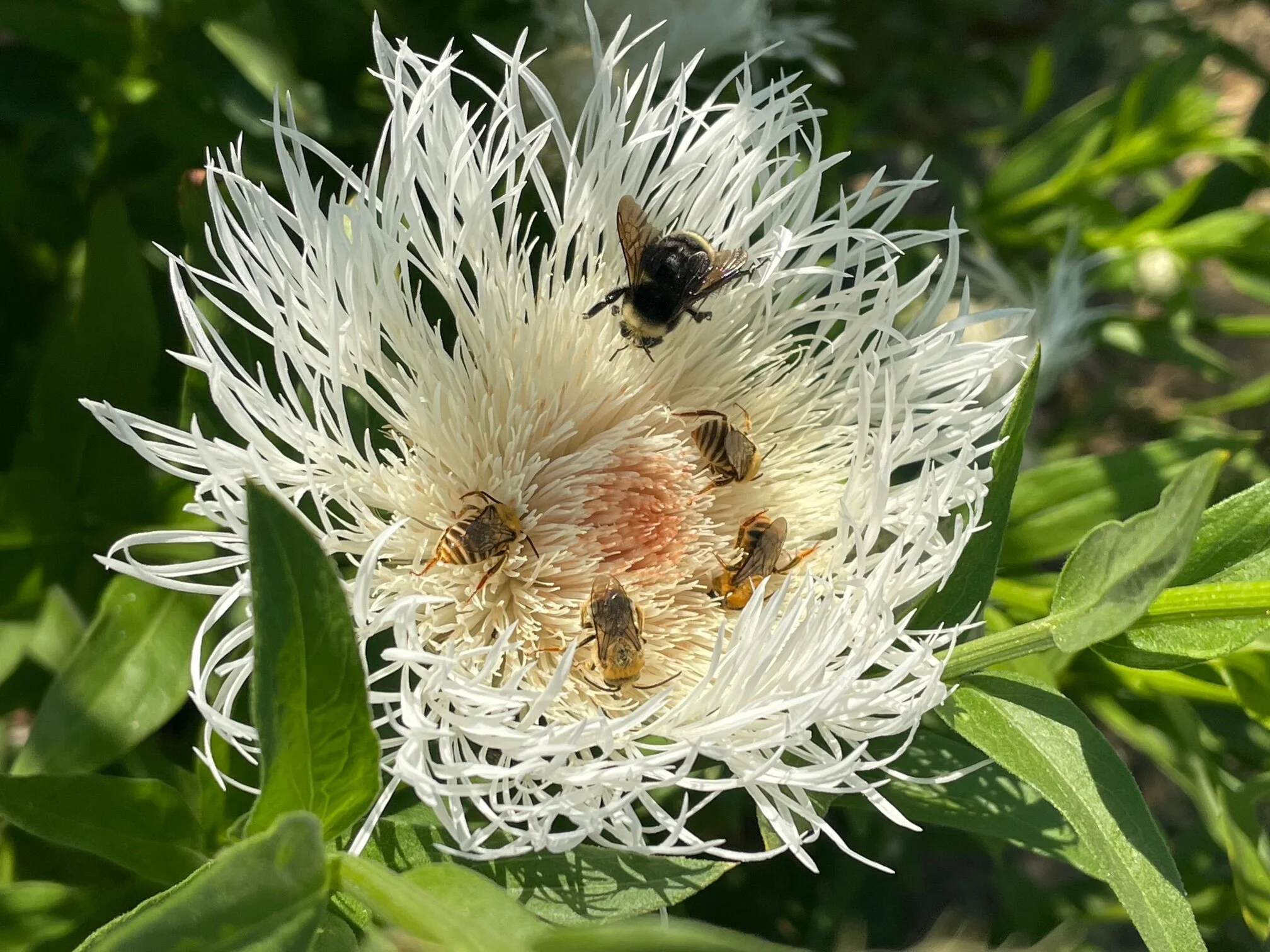
Four native “flower flies” and one bumble enjoy a recently opened Centaurea above the Gnome Homes

Four native “flower flies” and one bumble enjoy a recently opened Centaurea above the Gnome Homes

CONSTRUCTION ZONE FOR SOLAR ARRAY

For the next 6 weeks or so, the area in front of our barn will be a construction zone — for the best possible reason: A giant solar array!

The solar array will be enough to provide for electricity needs for the whole property (and then some) and provide more shade and rain protection around the barn! Please pardon the inconvenience and make sure your little ones are extra careful around the construction site. Shout out to Green Valley Farm + Mill our landmate Jeremy Fisher for taking on this project!

IN THE FLOWERS THIS WEEK

Featured Flower: Keep an eye out this week for the very first of our new drying flower — Xeranthemum. It’s down on the end of one of the long beds above the gnome homes. Try picking a few and adding them to a mixed bouquet of drying flowers. If kept in a dark, dry space they should keep their color for years!

This Week’s Flower Challenge: This week, try making your bouquet in a vessel that you’ve never used before. See what new shapes emerge!

Xeranthemum

Xeranthemum

IN THE HERBS

  • Oregano, Marjoram, Thyme, Chives & Garlic Chives, Lemon Balm, Lemon Verbena, Chamomile, Tulsi Basil, Purple & Green & Bi-color Shiso (aka Perilla), Mints, Italian Basil, Purple Basil, Thai Basil, Cilantro, Dill, Anise Hyssop, Sage, Tarragon, and Vietnamese Cilantro, Culinary Sage, Sorrel

Strawberry Torte

This easy and delicious recipe is an adaptation of the New York Times’ beloved plum torte recipe first published in 1983. We found out about it from our friend and colleague Anna Dozor. It’s adaptable and can really be made to fit any fruit — think fresh summer blackberries, plums, or strawberries and rhubarb.

  • 3/4 to 1 cup sugar

  • 1/2 cup unsalted butter, softened

  • 1 cup unbleached flour, sifted

  • 1 teaspoon baking powder

  • pinch of salt

  • 2 eggs

  • 2 pints of strawberries, each cut in half

  • optional: lemon zest, vanilla, or other flavorings of your choice

Heat oven to 350 degrees.

Cream the sugar and butter in a bowl. Add lemon zest or vanilla if using. Add the flour, baking powder, salt and eggs beat well.

Spoon the batter into a springform pan of 8,9, or 10 inches. Place the cut strawberries cut side up on top of the batter.

Bake approximately one hour until a knife almost comes out clean from the center of the cake. Delicious with barely sweetened whipped cream (consider making lemon verbena infused whipped cream!).

NOTES & REMINDERS

  • Confused? Ask us! If you’re ever confused about anything in the garden, don’t hesitate to ask us in person or via email. We love helping you use the garden!

  • How do I find the herbs? All herbs that are ready to pick are marked with a colored stake with the name of the herb on it.

FARMER’S LOG

CANNABIS IN THE FIELDS

A couple of weeks ago, after months of paperwork, Kayta and I received approval from the Sonoma County Department of Agriculture to grow a half-acre of medical cannabis in our fields this year. Their leaves are now wiggling in the wind in our lower fields.

As many of you know, we are vegetable farmers and this farm is about neighbors coming together over fresh local produce, flowers and herbs. Introducing cannabis into our fields was not an easy decision for us because of its loaded history in our society and our County.

Like most small farms in Sonoma County, Kayta and I have long struggled with how to make growing food the way we do make sense financially. The reasons why a small vegetable farm in a place like Sebastopol is such an economically precarious enterprise is a subject for another Newsletter — but, needless to say, after this drought forced us to cancel the year's vegetable production we were looking at a pretty grim economic outlook for the farm.

Concurrently, since Sonoma County approved zoning permits for cannabis cultivation on some agriculturally zoned parcels in 2016, we have watched a few vegetable growing peers incorporate cannabis into their fields in a safe, legal, organic way that helped them keep their farms running. So we started looking into it and indeed found a landscape much different than the one we grew up with: Cannabis — like prunes and hops and apples and wine grapes before — is now an emerging legal cash crop in Sonoma County, already shaping the agricultural landscape. 

The sun sets on Grapes & Cream and Sun Bisc cannabis cultivars in field 2.

But regardless of the societal shifts occurring around cannabis, our biggest concern when we were considering trialing some cannabis in our own fields was how you, our members, would feel about it. After all, this farm is for you. But in conversations with so many of you we heard nothing but support. We came away feeling that if we could grow this plant in alignment with our soil and land stewardship values, and if it could help Green Valley Community Farm survive and thrive, then we owed it to ourselves and to the community that has grown up around the farm to give it a try.

So here goes!

Our immediate hope for this crop is that it helps us survive this drought year with just 10% of the water we normally use. We also hope to trial whether or not some cannabis mixed into our crop rotation might help bring financial stability and resiliency to the farm so that Kayta and I can keep doing the work that we love, in the community that we love, for the rest of our careers.

Fun facts & answers to some frequently asked questions:

  • This crop is 100% legal, permitted, licensed, inspected, tagged, tracked and taxed by a combination of the California Dept of Food and Agriculture; the Sonoma County Dept of Agriculture/Weights and Measures; and the Cal Dept of Fish and Wildlife.

  • No, the weed flowers will not be u-pick. Good try though. ;-)

  • Cannabis is a very water light crop and uses only 30% of the water vegetables use per half acre.

  • Why didn't you just do a smaller produce CSA this year? We only had enough water to run a 30 share CSA this year. A CSA of that size would have not paid the bills. Cannabis packs an economic punch big enough to get us through with such few plants in the ground.

  • You might sometimes see us spraying the plants in the evenings. These sprays are organic micronutrients, like kelp meal, and pro-biotic beneficial bacteria meant to help the plants to ward off pests.

  • No, we are not going to abandon the food farm to become cannabis growers! We love farming food for this community way to much. This CSA is our baby and we both hope it is our life long work.

  • Yes, we are hoping to grow some amount of cannabis in future years on the side in tandem with the vegetables in the hopes that it helps us keep up with the cost of living and farming in West Sonoma County.

  • The two of us have never grown a cannabis plant in our lives (!) so we are growing this crop under the tutelage and in partnership with our friends at New Family Farm, fellow Sebastopol vegetable farmers who've been experimenting and innovating with cannabis in the field for a few years now.

  • What you see is a half acre of more than 10 varieties of cannabis plants with rows spaced very widely to encourage airflow. There is an insectary bed planted every 4th bed to attract natural pest predators. These insectary rows are planted with Sweet Alyssum, Cosmos, Crimson Clover, Phacelia, and other goodies

  • We will be growing it with similar practices to how we grow long term crops like tomatoes and winter squash — except if each tomato plant were the Prince of France and required the fluffiest beds, the finest delicacies, and weekly compost teas.

As always, we are an open book and are happy to answer any questions you have about this new crop in the fields.

We hope you all are enjoying the exploding July garden and the sweet strawberry breeze!

See you in the fields,
David & Kayta

Click here for an archive of past newsletters

7/16/2021 - Catnip & Queen Anne's Lace

IN THE FLOWERS THIS WEEK

Of the new faces in the garden this week, we wanted to highlight two in particular.

  • Chocolate Queen Anne’s Lace: These beauties have been selected to enhance the delicate pinks and purples that are sometimes found in the wild strain. While beautiful at every stage, it’s best to harvest once the flowers are fully open and laying flat. If picked earlier they have a tendency to wilt. Find them just above the cilantro.

  • Breadseed Poppies: We are trialing a few very dramatic breadseed poppies this year. You’ll find them above the agrostemma on the side closest to the stairs. While glamorous, breadseed poppies have an incredibly short vase life as a cut flower, unless their cut stem is dipped in boiling water for 7-10 seconds. That said, they look stunning in the garden, the bees love them, and best of all, the seed heads, green and dried are a beautiful addition to bouquets.

On the left, Dara Queen Anne’s Lace and on the right Danish Flag Poppy.

On the left, Dara Queen Anne’s Lace and on the right Danish Flag Poppy.

Pro-tip: The vase life of flowers is affected in part by how far along they are in the process of blooming. While we love the exuberance and ephemerality of a flower in full-blown glory, it’s also fun to also experiment with picking them at earlier stages: a bud, a half opened flower, and then watching them come into bloom in your vase, changing before your eyes.

This Week’s Flower Challenge: A practice in simplicity. First of all, please pick an abundance of flowers. Make a giant bouquet. But, in addition, keep an eye out for individual stems that call to you. Place each one in a vessel of its own — a bud vase, a glass, a shapely kombucha bottle — and sprinkle through your house. For maximum enjoyment, consider the tip above.

IMG_2398.JPG

IN THE HERBS

  • Oregano, Marjoram, Thyme, Chives & Garlic Chives, Lemon Balm, Lemon Verbena, Chamomile, Tulsi Basil, Purple & Green & Bi-color Shiso (aka Perilla), Mints, Italian Basil, Purple Basil, Thai Basil, Cilantro, Dill, Anise Hyssop, Sage, Tarragon, and Vietnamese Cilantro, Culinary Sage

This Week’s Featured Herb: Catnip! As one of our favorite seed catalogs Wild Garden Seed put it: “Now really, who doesn't enjoy having a bit of a nip in the evening with the cat? Or watching the neighborhood felines sneak over to have a private party in the catnip patch? That's why we have it around. But catnip turns out to be as attractive to bumble bees and butterflies as to cats, and I enjoy their enjoyment as immensely as los gatos. I also find the smell refreshing, and the flowers are beautiful in their own right. Flower folks will find it useful as greenery and filler, and of course it makes a calming tea.” You’ll find our catnip freshly labeled and growing in a wine barrel near the lemon verbena.

NOTES & REMINDERS

  • Confused? Ask us! If you’re ever confused about anything in the garden, don’t hesitate to ask us in person or via email. We love helping you use the garden!

  • How do I find the herbs? All herbs that are ready to pick are marked with a colored stake with the name of the herb on it.

FARMER’S LOG

The Farm Gods and/or the Gnomes have been slightly angered with us this week (irrigation risers blowing up; tractors not starting; tools mysteriously walking away) so this week we must leave in you the soft yet weathered hands of an old Farmer’s Log:

EQUINOX TURNINGS - 9/15/2020

At 6:30 AM this Tuesday morning, the sun will cross the plane of the equator — the autumnal equinox.

It struck me today how the tasks of pulling off the farm year harmonize with the seasons in such a way that it always seems like there is just enough time to accomplish what needs to be accomplished by the skin on our chinny-chin-chins.

The Byrds were right: To everything, there is a season. 

In the Spring, you aren’t harvesting yet so you have all the time in all the medium-length days to prep the canvas and plant out the farm; to expand the propagation zone and build new irrigation systems; to fix gates; to seed 60 trays a week in the greenhouse; to pot up tomatoes, to stake tomatoes, to trellis tomatoes; to mow cover crop and turn soil and shape beds and plant! plant! plant!

Then harvest seasons starts and two, then three, then then four days of the week are consumed with reaping the fruit of Spring’s labor. You put down the hammer and take up the harvest knife. All other projects cease. Planting and harvesting are your life — some weeding if you’re lucky. The days are at their longest. If there is ever a time to be harvesting 1,000+ pounds of cucumbers, tomatoes and squash in the morning, prepping and planting out half mile in the afternoon, it is when there is 16 hours of daylight.

Before you know it, it’s late Summer. The tomatoes start exploding, the cucumbers already are, you’re still planting like crazy and then the melons come in — and just when you think you’ll break, that there isn’t enough time in the day, you scroll down on your crop plan and you see that plantings are nearly done. No more compost spreading; no more bed shaping; greenhouse seedings shrink. You plant the last Fall brassicas in the field, the tractor sits quiet for a minute, and you can spend all day amongst the vines and in the cooler playing Tetris with boxes of Summer fruit. 


Then comes the Autumnal Equinox.

The tomatoes are still pumping and the potatoes and winter squash start to die back; the corn fills out, crisps up. The big harvests are coming. Space needs to be cleared. Winter is just around the corner so you need to establish garlic and strawberries for next year; mow and hold over spent beds, lime new fields, and get ready for cover cropping — and just when you think you’ll break, that there isn’t enough time in the shortening days the heat ebbs, the tomatoes start to show signs of slowing down. A light frost will soon roll through the farm. Smiling friends will come to help you harvest your winter squash. Chilling morning air goes down like a draught of ambrosia. You seed the last lettuce of the season. You have a moment sit down and calculate your garlic seed and cover crop order.

All this is why you won’t ever hear a farmer say, “Shucks! Summer is over.” We are greedy for the turnings. We love nothing more than a first harvest. But first tomato harvest glory fades under the weight of tomato crates and we crave cold hands and cozy coats and the crisp snap of the stem of a plump radicchio glowing in morning sun. Lucky for us, when scolding kiddos for running through the corn becomes sad and hackneyed, Autumn comes, and we can yell, “Come! Knock it down! Gather armfuls of cobs!” 

Change is our tonic — one of the great sustaining elixirs of farm life.

Soon, Winter will come. It’s so close now we can almost taste it. The rains will fall and we will turn in — to rest, rejuvenation, and internality. We’ll clean up our books, do our taxes; we’ll look back on the year and create next year’s crop plan and next year’s budget. We’ll open CSA sign-ups. We’ll look at spreadsheets, sit, think, build, fix things, and sleep. 

But ample sleep turns into insomnia; too much internality into angst. We will get pudgy, our harvest muscles will atrophy, and we will forget for what we are doing out in the wet and the cold — and just when we think we’ll break, that there is too much open-endedness in the too short days, the sun will return. We will hear the Swainson’s Thrush calling us, beckoning us, “Come out! Build it up again! Plant! Turn! Turn! Turn!”

See you in the fields,
David for Kayta, Kate, and Anna

Click here for an archive of past newsletters