11/20/2020 - Week 24 - A Farmer's Thanksgiving 2020

THIS WEEK'S HARVEST

Winter Luxury Pie Pumpkins, Butternut Winter Squash, Hopi Blue Cornmeal, German Butterball Potatoes, Leeks, Celery, Purple Cabbage, Lorz Italian Softneck Garlic, Cured Yellow Onions, Dazzling Blue Dino Kale, Brussels Sprouts, Purple Top Turnips, Watermelon Radishes, Loose Bolero Carrots, Loose Beets, Little Gems, Salad Mix (with Mustard Greens and Chicories)

Mushrooms and cover crop sprouting up in Highgarden

Mushrooms and cover crop sprouting up in Highgarden

U-PICK

Gleanings: After the hard frosts we got last week, only a few of the most cold hardy plants remain for u-picking.

  • Rosemary, Parsley, Oregano, Marjoram, Thyme

  • A few assorted flowers

HARVEST NOTES

  • Winter Luxury Pie Pumpkin: This lacy, soft-orange beauty is the best pumpkin we’ve found for pumpkin pie. See below for Kayta’s tried and true pumpkin pie recipe.

  • Hopi Blue Heirloom Cornflour: This beautiful corn flour is from the tall stand of corn that watched over our Jack-O-Lanterns all season long. Harvested by members, ground last week and then frozen, this is a rare, heirloom cornflour with a freshness and flavor that only fresh ground corn can have. Store frozen to preserve the fats and oils. See below for our go to Hopi Blue Corn pancake recipe. It can be used in any way that you would use cornflour (polenta, grits, muffins, cornbread, etc.) Enjoy!

  • Purple Top Turnips: These versatile turnips are sweet and delicate enough to be eaten raw shaved or micro-planed on salads and hardy enough to handle the stoutest stews and vegetable medley roasts.

The Dream Team planting 2021’s garlic

The Dream Team planting 2021’s garlic

KAYTA’s AMAZING PUMPKIN PIE RECIPE

This is an incredibly simple recipe which relies entirely on the quality of its ingredients for its flavor. We find that it tastes amazing with a high quality squash and Brambletail’s fresh milk.

THE CRUST

  • 1/2 tsp salt

  • 75 ml water, about 1/3 cup, very cold (I usually start with this amount and add a touch more as needed)

  • 227 g all purpose flour, about 1 and 3/4 cup

    150 g unsalted butter, 1 stick plus 2.5 tablespoons, very cold

Cut the cold butter into pea sized chunks and mix into the flour and salt mixture. With your fingers, squeeze the butter chunks so that they flatten into the flour. Add the water gradually, pressing and kneading the dough as you go, until all of the flour has been moistened and is able to be formed into a ball.( I usually use slightly more water than the recipe calls for.) Make the dough into a ball and then flatten into a disc and refrigerate, wrapped in a bag, until you are ready to roll it out. Once the crust has been rolled out and placed in your pie pan, refrigerate or freeze it until right before you put it in the oven. Pro tip: you’ll achieve more layered flakiness if you fold the dough over on itself several times before shaping into the pie pan. Just remember to not let it get warm enough that the butter starts to melt.

THE FILLING

  • 1 3/4 cup baked Winter Luxury Pie pumpkin (or other sweet squash, the sweeter the better — we also love the Sunshine Kabocha and the velvety Marina di Chioggia!)

  • 1/2-3/4 cup sugar

  • 1/2 tsp. salt

  • 3/4 tsp. cinnamon

  • 1/2 heaping tsp. ground ginger

  • 2 eggs

  • 1 cup cream

  • 1/2 cup milk (feel free to adjust the ratio of cream to milk, or substitute coconut milk for all of it!)

Mix the sugar, salt, and spices into the pumpkin. Then mix in the eggs, milk, and cream, and whisk until smooth.

Pour the pie filling into your chilled, raw pie crust, and bake at 400* until only an inch in the center of the pie remains liquid and the crust is golden brown. Let set before eating.

IMG_2094.jpg

HOPI BLUE CORN PANCAKES

INGREDIENTS

  • 1 cup blue cornmeal

  • 1 teaspoon salt

  • 1 tablespoon white sugar

  • 1 cup boiling water

  • 1 beaten egg

  • 1/2 cup milk

  • 2 tablespoons butter, melted (coconut oil would be a delicious, dairy-free substitute)

  • 1/2 cup unbleached all-purpose flour

  • 2 teaspoons baking powder

  • 1/2 cup pine nuts, walnuts, or pecans, toasted (optional)


    DIRECTIONS

    In a medium bowl, mix together the blue cornmeal, salt and sugar. Stir in the boiling water until all of the ingredients are wet. Cover, and let stand for a few minutes.

    In a measuring cup, combine the milk, egg and melted butter. Stir the milk mixture into the cornmeal mixture. Combine the flour and baking powder; stir into the cornmeal mixture until just incorporated. If the batter is stiff, add a little more milk until it flows off the spoon thickly but smoothly.Heat a large cast iron skillet over medium heat, and grease it with a dab of oil or butter. Use about 2 tablespoons of batter for each pancake. Quickly sprinkle a few pignoli (or other nuts if using) onto each cake. When the entire surface of the pancakes are covered with bubbles, flip them over, and cook the other side until golden.

    Serve immediately with maple syrup or fruit preserves.

NOTES & REMINDERS

  • When does the CSA end? The last week of our 2020 CSA harvest season is the week of December 5th. The last Saturday pick-up is December 5th. The last Tuesday pick-up is December 8th.

FARMER’S LOG

A FARMER’S THANKSGIVING

Kayta and I both grew up in the suburbs and, like everyone, we would encountered those ubiquitous expressions — “three shakes of a lamb's tail”, “like a horse who’s seen the barn”, “chomping at the bit”, “make hay while the sun shines”, "coming home to roost", etc. It wasn’t until we started farming that we began to realize the roots of these expressions and their visceral poetry. And it wasn’t until we started farming that we began to understand — like really understand — the visceral reason to give thanks in the Fall.

The Fall is an incredible time of year in the temperate world. It is a season of unimaginable bounty. The plants of forest and field have spent all Spring and Summer harnessing the sun’s energy into their fruits, seeds, roots, and leaves and we have harvested. In the Fall the root cellar is full, the larder is full, the granary is full — the land has burst forth at its seams and we have gathered the overflow.

The farmer, sitting at home with her feet up next to the fire, is keenly aware of the bounty in the root cellar below. She feels a great contentment in this but no pride because she realizes how little she did to create it. Sure, she worked hard all year — moving things here and there — but it was others, present now and before, that filled that cellar. It was others who dug it out and laid the roof. Others who forged the tools and taught her how to use them. Others who saved the seeds and taught others, who taught others, who taught others, who taught her how to care for them. And what (or who) made those seeds sprout? Not she.

For all this, there is nothing to give but thanks.

We’d like to take a moment to give thanks those who made this year's harvest season possible.

Screen Shot 2020-11-20 at 8.04.23 PM.jpg

First, to the indigenous people and cultures who stewarded into existence, and who continue to steward, so-so many of the seeds we grow for our harvest shares. As we enjoy the first cornmeal of the year this week, let us think of these people, give thanks, and think of ways we can actively support their communities. Similarly, to the people and cultures on whose ancestral land we live and farm — the Southern Pomo and Coast Miwok — the next time we walk out to the farm, let us think of these people, give thanks, and think of ways we can actively support and empower them.

To all the volunteers who helped on the farm this year — we really leaned on our community to help us with big harvests and plantings this year because we know you all will come through. You do not disappoint.

To Sora Bolles — and the whole Hom-Bolles family — what can we say? Thank you for brightening so many of our days. We will miss you.

To Ryan Bundrick for the incredible arbor; Cory and Amy for our second-breakfast bench and all your PRAXIANS for everyday spirit boosting and giggles; to Jared Sutton for the sink that kept our dirty hands clean; to Ann Hamilton and all the Fall regulars; to Michael Crivello for the big cooler push — couldn’t have done the season without that thing; to Josiah Cain, Jeff Mendelsohn, and Farmer Daron Joffe for the all the loot from the greatest farm estate-sale of all time!

To Cory and Ryath of Moonfruit Mushrooms for growing the best mushrooms anyone has ever had; to Eli at Revolution Bread for making us fat; to Kim LaVere to her incredible Marketplace and vision for food and connection here.

To Anna and Kate: Pulling off a season such as it is takes hefty amount of grit, grace, and guffaws in a normal year — let alone one as physically and mentally difficult as 2020. As Royal Tenenbaum would say, you two are “true blue'“. We can’t express how lucky we feel to have been able to spend our days in the field with you two. You are the Fairy Godmothers of this farm and always will be.

To our neighbors and landmates at Green Valley Farm + Mill: Temra & Jeremy, Teo, Quin, Aubrie, Scott Kelley, Jeff, Gaya, Frankie & Desha, Josiah, Genevieve, Michael, the ladies of Greenhaven, Daron, Stephanie and your kiddos, and Chris LS Panym up in the Wildnest: It takes a village to sustain a small farm and your support, encouragement and our daily interactions make up the web of friendship that sustain this farm and farmers!

To our friends and families: For your unconditional love and support as we tend our toddler farm-baby. We can do things now!

And finally, to you, our members. Whatever bounty we’ve enjoyed this year is because of you. You made a real connection to, and shared in the risk of a growing season, with your farmers — something extremely rare and important, we think, in this crazy world. You helped us plant the seeds, spread compost, lay the irrigation tape, the tomato trellising twine, and were there with us in the work that went into planting this harvest season. You helped keep each other safe. You helped harvest your garlic, potatoes, corn, and squash and did quite a bit of u-picking! You showed up each week with sweet smiles, words of encouragement and appreciation. You are the heart of this farm.

You reminded us, day after day, week after week, that real, life-sustaining bounty comes from a community of neighbors rolling up their sleeves and building something beautiful together.

Thank you.

See you in the fields,
David & Kayta

Click here for an archive of past newsletters

11/13/2020 - Week 23 - Frost & Rain

THIS WEEK’S HARVEST

Braising/Salad Mix (with Radicchio, and Mustard Greens), Little Gem Lettuces, Daikon Radishes, Murdoch & Farao Green Cabbage, Celery Root, Green Magic Broccoli, Baby Fennel, Brussels Sprouts, Harvest Moon Potatoes, Carrots, Cured Cabernet Onions, Marina di Chioggia Winter Squash, Jester Acorn Squash

Rain and Brussels sprouts: It was a good harvest!

Rain and Brussels sprouts: It was a good harvest!

U-PICK

With the killing frosts this week, our u-pick season is mostly at an end aside from the hardier herbs and flowers still left in the garden and an occasional strawberry or two, spared from the cold and wet. We will slowly be transitioning the garden and u-pick areas into their winter resting phase.

  • Herbs: Italian Parsley, Rosemary, Thyme, Oregano, Marjoram, Onion Chives, Garlic Chives, Vietnamese Coriander, Culinary Lavender, French Sorrel, Lemon Balm

HARVEST NOTES

  • Celery Root: Aka celeriac, aka turnip celery, is a variety of celery cultivated for its starchy bulbous stem. It is like a turnip that tastes like celery. Try adding it to a hardy winter stew. We’ve also heard legend that celery root fries (i.e. deep fried celery root sticks) are the best thing ever. Also try shaving or micro-planing raw onto a salad.

  • Brussels Sprouts: We’ll be offering you these Fall treats as fresh as can be, still on the stalk!

  • Marina di Chioggia Winter Squash: Marina di Chioggia (aka Sea Pumpkin or Suca Braca, "warty pumpkin") is an Italian heirloom from the seaside town of Chioggia and is the staple squash of Venice. This is a versatile pumpkin that can be utilized in any recipe where a traditional pumpkin is called for. It is an excellent desert pumpkin for pies, muffins and quick bread, makes an ideal filling for pasta such as ravioli and tortellini, and can also be used to make gnocchi. The pumpkin itself will keep for up to six months when stored in a cool, dry, and dark place. We love the diverse bounty that can be made from this pumpkin! When we have the time we love to make a big batch of gnocchi (check out this recipe ) for the freezer so that we have many incredibly fast and delicious meals to look forward to.

Harvesting this week’s “Sea Pumpkins” back in mid-September

Harvesting this week’s “Sea Pumpkins” back in mid-September

LOCALLY GROWN FLOUR SHARES AVAILABLE!

Finally! Sonoma-grown and milled flour! And you can tell the difference.

Our friend Farmer Mai is offering a Grain Share and the Green Valley Marketplace is excited to be a pick-up site. Kayta and I have so enjoyed baking with Mai’s flour — it’s incredibly delicious. You can learn more about Mai, their wheat, and farming here. Mai’s wheats were selected from over a decade of trials for what thrives right here in our special coastal climate and they were grown using ecological practices. They’re then stone milled into a distinctive, flavorful flour incomparable to anything you’ve ever eaten.

Introducing the Grain Share

You’re invited to experience these unique flours through the inaugural Farmer Mai Grain Share. There are 20 spots available. Each share price is $150 and will take place December 2020 through May 2021 wherein members can:

  • Receive 5 lbs of a single variety of freshly milled whole wheat flour once a month 

    • 5 lbs = 4 loaves of bread and a lot of pancakes, or a small mountain of cookies

    • Varieties may include: Chiddam Blanc de Mars, Wit Wolkoring, Sonora, Akmolinka

  • Pick-up on the second Thursday of every month at

    • Right here at The Green Valley Marketplace… OR…

    • The Bagel Mill in downtown Petaluma

Sign-up by November 20

Please complete this registration form by Friday, Nov 20 at 8 PM. Shares will be filled in order of registration date. You will receive a confirmation email that will request payment by PayPal or Venmo. If payment ($150) is not received by Monday, November 23 at 8 PM your spot will be offered to a waitlisted applicant. Only one share per person/family.

wheat.jpg

CLAY FOLK POTTERY STUDIO MEMBERSHIPS AVAILABLE!

Our friends and CSA members Cory Brown and Kaelyn Ramsden have been hard at work these past couple years opening a pottery studio in downtown Occidental, Clay Folk Studio.

They have a few memberships available and classes coming soon. Check out their website to learn more about this special new community space!

LOGISTICS

  • The last pick-up of our 2020 harvest season will be Tuesday, December, 8th.

    Saturday pick-up runs from 9:00am - 2:00pm

    Tuesday pick-up runs from 1:00 pm - 6:00 pm

    The farm and u-picking are open 7-days a week, sunrise to sunset. Please close the farm gates behind you on off days.

FARMER’S LOG

Jack Frost & First Rain

Fall is finally here.

After a dusty, perpetually 90 degree October, we were visited this week, starting on Sunday, by Grandfather Frost. And now, as I write, the year’s 1st rain is coming down — 1.5 inches according to our porch gauge!

The wait is finally over.

The first hard frost and the first rain are the real markers of the winding down of our year on the farm. They bring with them multitudinous blessings and signals to the plants, the animals, and farmers.

The first hard frost decisively kills a number of our cold intolerant crops and flowers — like nightshades (bye bye shishito peppers), zinnias and dahlias, sunflowers, basils, etc. — this naturally clears any guilt we have surrounding removing things and putting the garden and u-pick zones to bed for the winter. Over the next few weeks expect to see these zones transition to sleep in mulch and cover crop.

Garlic Pop-A-Thon 2020!

Garlic Pop-A-Thon 2020!

The first rains bring with them countless blessings to the wild creatures and plants of our ecosystem and signal an awakening from dry-season’s dormancy. You could see the joy in the birds this morning, bathing in clean puddles, anticipating the re-greening of their meadows and understories. The bone dry soils surrounding our fields took a sigh of relief. For your farmers, the first big rain means our irrigation duties are now over for the year and that our cover cropping efforts, previously reliant on scant irrigation water, can shift into high gear. As in the wild pastures, so too will the spent summer zones of the farm, kissed by rain, begin to re-green.

On our non-harvest days this week, Kayta, Anna, Kate, and myself kept knocking off the Fall tasks: With the help of a sweet group of volunteers, we harvested and washed the last bed of Fall carrots. The kids got to see the Root Blaster 5000 in action! Then we transitioned to popping garlic cloves (i.e. separating out the nicest cloves of this year’s seed garlic bulbs for planting next week.)

Thursday marked the true beginning of next year’s harvest shares! We spent all day prepping next year’s garlic beds: amending, spading, mulching and wood chipping the pathways, which you can see at the top of field 5.

So it goes on the farm: The end of one cycle is the beginning of the next.

See you in the fields,
David for Kayta, Kate, & Anna

Click here for the newsletter archive

11/6/2020 - Week 22 - Letters from Patagonia

THIS WEEK’S HARVEST

Spinach, Braising/Salad Mix (with Radicchio, and Mustard Greens), Assorted Head Lettuce, Collard Greens, Mixed Loose Beets, Watermelon Radishes, Purple Cabbage, Celery, Green Magic Broccoli, Leeks, Desiree Red Potatoes, Carrots, Cured Zoey Yellow Onions, Bonbon Buttercup and Delicata Winter Squash, Metechi Hardneck Garlic

The flower garden is winding down. Thank you for a magical year of flowers, Kayta!

The flower garden is winding down. Thank you for a magical year of flowers, Kayta!

U-PICK

  • Albion Strawberries: Gleanings

  • Herbs: Italian Parsley, Rosemary, Thyme, Tulsi Basil, Thai Basil, Oregano, Marjoram, Onion Chives, Garlic Chives, Vietnamese Coriander, Culinary Lavender, French Sorrel, Lemon Verbena, Lemon Balm

  • Flowers Update: It is time for cover crop — and slowly but surely we will start taking out our beloved flowers and putting the garden to bed!

HARVEST NOTES

  • Watermelon Radishes: This is a hardy, dense, and gorgeous winter radish with a vivid magenta inner core. We love it on top of a green salads, rice bowls or highlighted as a small salad of its own — try ginger, garlic and lime or lemon juice on julienned or sliced watermelon radishes as a bright side dish.

LOGISTICS

  • The 2020 harvest season runs from Saturday, June 13th til Tuesday, December, 8th.

    Saturday pick-up runs from 9:00am - 2:00pm

    Tuesday pick-up runs from 1:00 pm - 6:00 pm

    The farm and u-picking are open 7-days a week, sunrise to sunset. Please close the farm gates behind you on off days.

IMG_1988.jpg

VOLUNTEERING

Thank you SO much, to everyone who came out to help harvest our Fall carrots. We simply could not have brought in that crop without your help. And it was a joy to spend time in the dirt with you all.

Join us for more fun in the dirt…

MORE CARROTS and GARLIC POPPING!
WEDNESDAY, NOVEMBER 11th: 9:00 am - 12:00 PM

CARROTS AND GARLIC PLANTING (PROBABLY!)
WEDNESDAY, NOVEMBER 18th: 9:00 am - 12:00 PM

FARMER’S LOG

LETTERS FROM PATAGONIA

The harvests keep on rolling! This week was all about carrots, carrots, carrots. With the help of a small classroom-sized flock of amazing kiddos, we harvested (and washed) all but one of our 6 beds of Bolero storage carrots — sweetened by frost and the loving hands of volunteers.

The Root Blaster 5000 was humming all Wednesday and Thursday morning washing them up, and now both of our coolers are stacked to the ceiling with ~4,000 lbs of orange crispness — we hope you like carrots! Fun fact: This carrot variety, Bolero, actually gets sweeter with frost and with storage.

We’ve got a lot going on this evening, so we’ll do a copy-and-paste of an old newsletter for your reading pleasure.

* * * * *

David here.

When I was 26, I took a trip to Patagonia, Argentina. Outwardly, I was traveling — backpacking in the Andes for the purposes of “adventure”. But inwardly I was searching for something I could not explain at the time: Rootedness. Meaningful work. Purpose.

I had never harvested a cabbage before in my life, but by luck I ended up on a tiny off-grid CSA farm on the Eastern slopes of the Andes and found what I was looking for. During that trip, I would write long, maté caffeinated letters to a friend from home. Down below is one from the end of my stay on the farm. It is angsty and verbose, but describes why and where I fell in love with harvesting cabbages.

* * * * *

June, 2011

“When the sun rises, I go to work.
When the sun goes down, I take my rest
I dig the well from which I drink,
I farm the soil that yields my food,
I share in creation. Kings can do no more.”
-Unknown Author, Ancient Chinese, 2,500 B.C.

Dear Theresa,

It is nearly winter here now. I can see my breath in the cabin. Things are quiet on the land. I am spending the days caring for the animals, trying to trap the wild hares eating our last crops, baking bread like an old Grandma, and doing other random projects to help Alex [the farmer] wrap up the season. A spokeswoman for the local Mapuche tribe just passed through and spent the night. A Gaucho folk guitarist the next. My friend Ponta, a Japanese orphan who has had the hardest life I have ever heard, just left for Peru. I will miss her. One of our dogs is very sick. Another is pregnant. The Puyehue-Cordón Caulle volcano is exploding 200 kilometers to the North. I can hear it in my cabin on still nights, like stampeding horses in the earth. Life and death are tangible forces out here.

It’s all quite primal and romantic, but I think it has done something deeper to me and made me realize some things. It might be hard to capture into words.

We have no electricity out here, no hot water, all the farming is done by hand. The only machines we have are a chainsaw, a weedwacker, and a dirt bike for town trips, “All you need!” says Alex. A sweet, spindly old horse named Petiso will pull a harrow for us in exchange for a bucket of oats and complete freedom to roam the valley with his feral friends the rest of the time. All the buildings and ovens here are cob and built by Alex and his brother. Three beloved dogs, Michay (wild like the native plant she is named after), her brother Pirata (a gentle pirate), and Tao (their mother), escort us everywhere. They sleep under my cabin at night and guard the garden from the feral horses. We harvest every Wednesday for the CSA members. Their children come and play with their food and chase the chickens. There is so much simplicity here; so much poetry..

You and I have always felt called by nature — to the tangy mountain air, to the oak meadows — these places have felt like home. But we inevitably find ourselves pulled back along auto-littered highways to the turmoil, cement, and grid of the city. There awaits the hidden pressure to specialize in one thing to pay for “necessities” that are piped to us. If we succeed, we make more and can spend more, so we travel back to visit the tangy mountain air, to run our eyes enviously over the ranging hills, only to come back. Did we share in creation?

On the road back to the farm. The Río Azul and the Andes in the background.

On the road back to the farm. The Río Azul and the Andes in the background.

Working on this farm has put me in forceful contact with the sources of my life — death, water, soil, the plants, the animals — and a realization that these things are not commodities, they are not necessities. They are us. They are our brothers, our sisters, our teachers. Kin. To work with them is to work with creation.

The farmer, Alex, is a goofy guy but he very serious about one thing: The farm is an organism but he does not create it. He may have a vision for the farm, but after that he is a vessel, a butler, a steward: And this is how he should work the land, coaxing it, observing, responding, moving this there, maybe taking that away. And then, one day, as if by magic, the organism reveals itself to him as he sits back peeling an apple, watching in awe the creativity and richness of life weaving itself through the fields, writing it's stories in the rows, playing it's song in the seasons. The blossoms, bees, fruits, fungi, bacteria, the animals, the people, the stars, the moon and the movements and arcs of all their lives, and all their far flung interactions, alight the farm. This symphony is also a dissonant song of chaos, poop, death and decay. But Death, the richest of masses (Mozart's richest Mass is his Requiem Mass), is the bed upon which joy and new life burst forth again and again.

Working here I’ve realized some things about culture, and art. Agriculture, or tending the wild, or however a group of people survive in their land is the root of that people — it is their original art. Take the Mongols: The art they developed for surviving that steppe is inextricably woven into the fabric of their lives. It is their houses (the collapsable yurt), it is the fiber of their walls and the clothes they wear; the tools they handle everyday. It is the animals they interact with and talk to, what they talk about with each other, what they dream about. It is the substrate of their myths, their legends, their stories and their songs and it is the material that makes up their instruments. Our art of survival is the stage and the prop and script of our lives. Although it may seem to be the case, we are no different today. We have not emancipated ourselves from the land under our feet and how we choose to cultivate it. It makes up the fabric of our lives too.

Before coming here, the word "farm" sent a chill down my spine. Why? To me, it meant mono crops; acres upon acres of almond trees. Endless fields of corn. Temp wage labor. Agribusiness. It was artless, fragmented, socially and environmentally exploitative. What it took from from the soil it did not give back. Anonymous desire.

This agricultural system is in the fabric of our culture. And it is global. Many people don't know their place, or where they come from, or their place and what they do is unknown to them. As American and Chinese agribusiness have slowly begun mono-cropping swaths of Argentina and Chile, so has American culture taken root in many South American cities. I don't think it's a coincidence that people started wearing the same clothes in Los Angeles, Buenos Aires, and Santiago, and started building similar houses, and started dreaming similar dreams, around same time that those countries adopted, or were forced to adopt, Western agribusiness, its methods, and its seeds. In a certain reverse way, the art of how a culture sustains itself is a mirror on that culture... I'm not saying the reflection I'm seeing is all bad, but is this how we want to live?

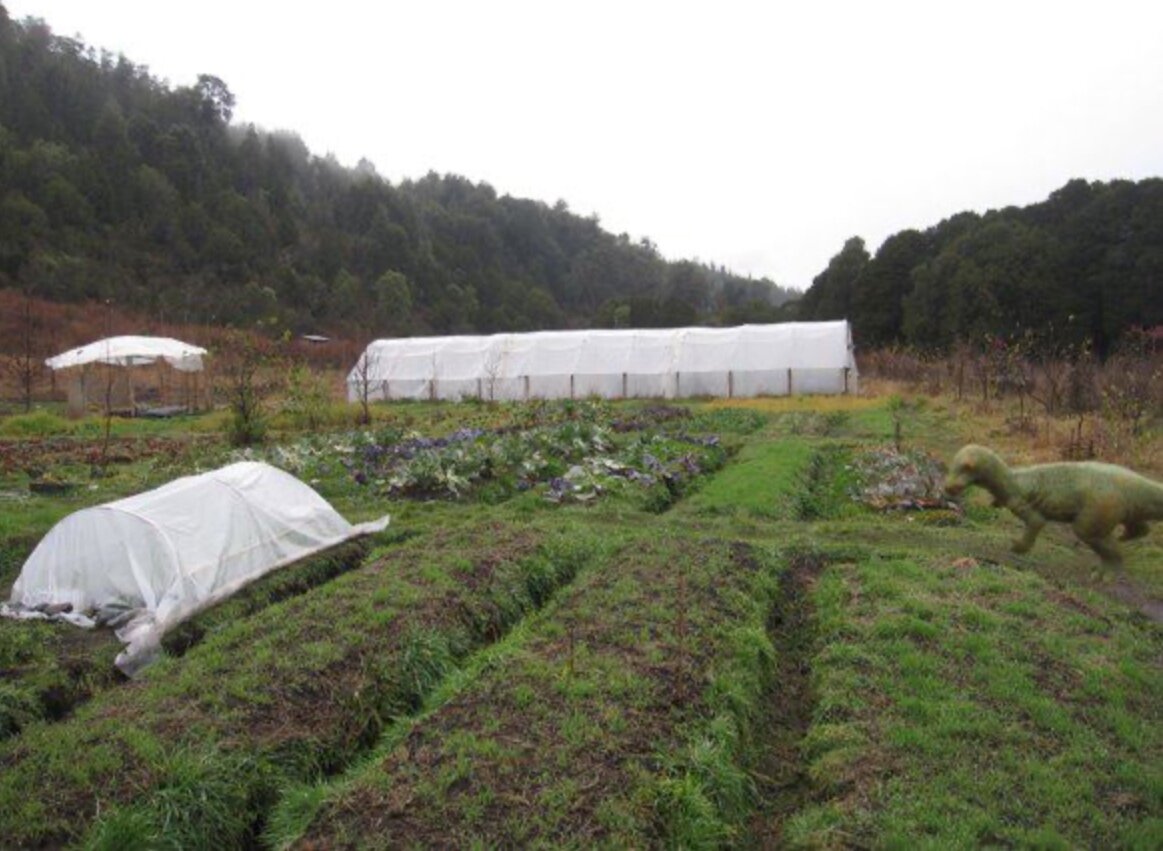
The raised bed garden of La Granja Valle Pintado. We had a dinosaur problem.

The raised bed garden of La Granja Valle Pintado. We had a dinosaur problem.

What I've seen here in the Painted Valley is beautiful art. It sustains many, and is sustained by the beings it sustains. The human culture around the farm hums with life. The farm has an identity, it is a home to so many. People seek refuge here almost daily. Economically and socially the farm works through mutualism. The association of families who support the farm are most concerned with the long term health of the farmland and the farmer — as they should be, it is their sustenance. And so the farm’s produce, its vegetables, are priced with that in mind. In this sense, they are priceless. The farm itself is an ecosystem. Nothing is wasted, waste becomes new life. The air and leaf litter and creatures of the surrounding wild permeate the farm — which is like a slightly more organized emanation of it.

One evening after work, I was putting away some tools, and Alex walked over, pumping his arms in the air and yelling, "I love life in the campo [field]! I love life in the campo!”

"Me too!" I laughed.

Alex got serious all of a sudden and stared inwardly out at the small winter field of rye spreading before us. He was silent for awhile. Finally, he said quietly to me, but also to himself, “It is the art of life and death, you know. Nothing more and nothing less."

* * * * *

See you in the campo,
David & Kayta

Click here for the newsletter archive